



























































































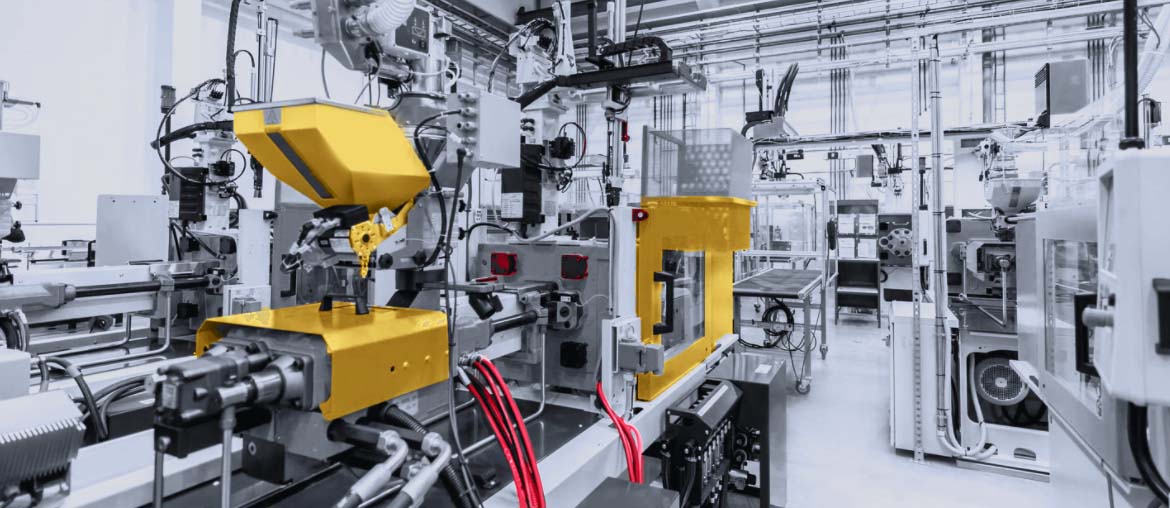





























































Predictive analytics in manufacturing is the use of data, AI, and predictive models to anticipate equipment issues, quality risks, and production trends. It is designed for manufacturers seeking to reduce failures and plan more effectively. Predictive analytics in manufacturing helps identify equipment wear at an early stage, while manufacturing software development services support smart manufacturing solutions that increase uptime and reduce waste.
By 2026, predictive analytics for manufacturing will help track failures, optimize maintenance, and improve quality. When combined with machine learning development services, it reduces downtime and accelerates decision making.
Reduce risks, increase uptime, and improve planning.

The concept of the Internet of Things provided the industrial world with a lot of new opportunities, including organized and continuous data collection from sensors and other devices at facilities. As of today, organizations can collect massive amounts of data on business processes in real time. Additionally, manufacturing software development services play a critical role in leveraging these technologies, enabling businesses to build customized solutions for data management and manufacturing predictive analytics. Thanks to cloud computing, the storage and processing of data no longer pose a tedious challenge. The arrays of historical data go through a sort of a funnel, so to speak, allowing manufacturers to analyze past mistakes and predict future events based on those new insights.
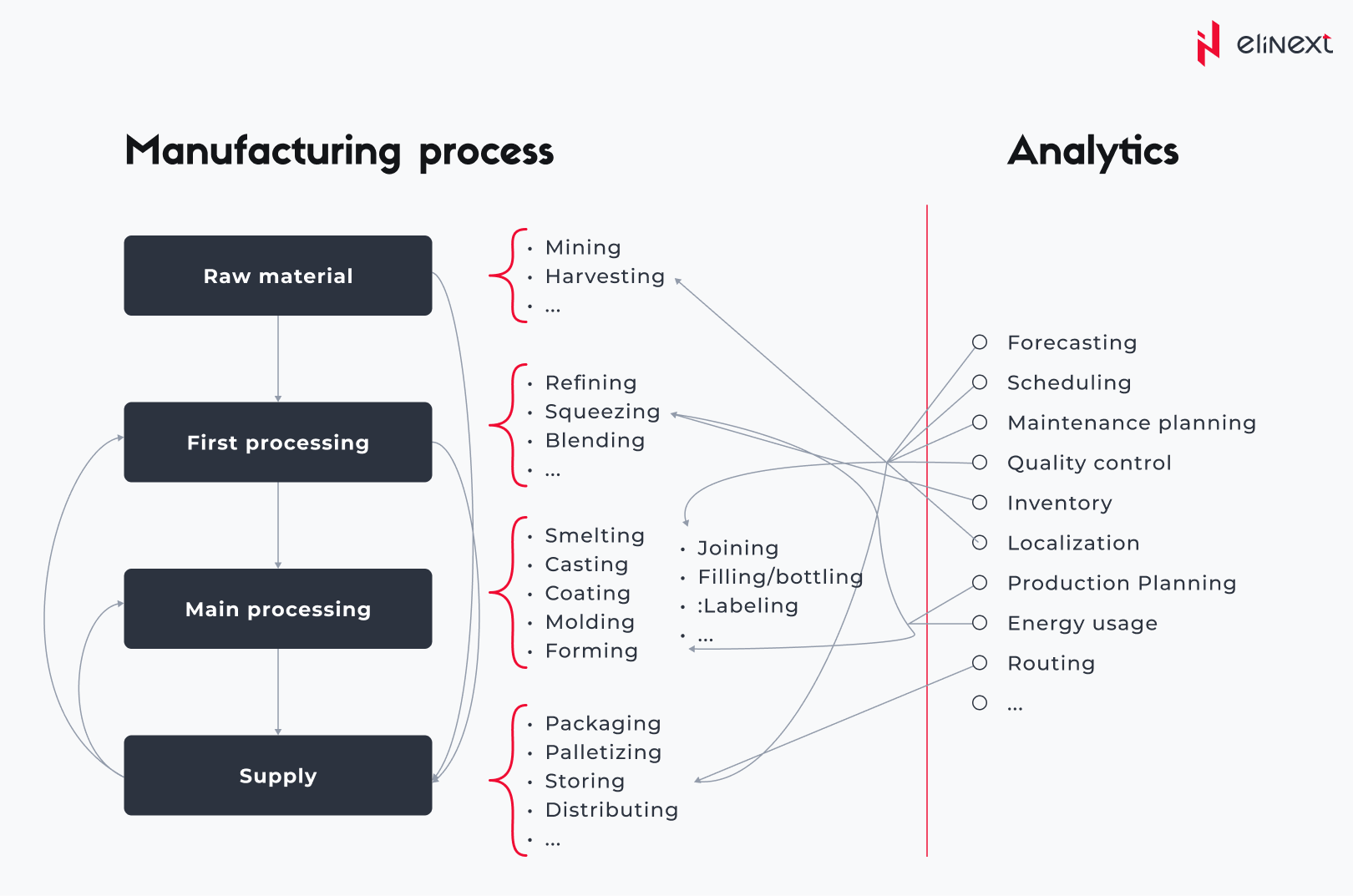

Industry 4.0 is expanding transparency, but many companies still struggle to translate raw data from the production floor into actionable insights. At Elinext, we apply predictive analytics in the manufacturing industry, as well as AI software development services, to connect data with decision making. The result for businesses is reduced downtime, reduced quality loss, and more reliable planning.

What is predictive analytics anyway?
This technique is a set of statistical analysis methods that are developed to extract new information from current and historical data. This information serves as a basis for predicting business processes, trends and behaviors so that a company knows in advance about future events and can adjust its business strategy based on this knowledge. As they say “Knowledge is power”, or, as Eric Siegel specifies in his book “Predictive Analytics: The Power to Predict Who Will Click, Buy, Lie, or Die”: “As data piles up, we have ourselves a genuine gold rush. But data isn’t goldа. I repeat, data in its raw form is boring crud. The gold is what’s discovered therein.”
The basis of predictive analytics is defined by the automatic search for links, anomalies, and patterns between various factors. A large set of statistical modelling methods, data mining, machine learning, neural networks and other mechanisms are used to form a predictive model. Predictive analytics in manufacturing allow organizations to reduce risks, optimize resources and improve company efficiency through the adoption of effective management decisions. Manufacturing predictive analytics are indispensable when a company needs to detect non-obvious patterns, segment goods or customers for marketing purposes, build a sales forecast or change customer base.
Sure enough, predictive analysis has been around for years. However, it required much more information resources and computing power. Back then, only large enterprises and banks could use prognostic analytics tools. They stored the data on the servers, and the processing and analysis of data involved mathematics-statistics or analytics. Nowadays, the servers are being gradually replaced by cloud storage. Artificial intelligence began to perform calculations many times faster than people. The automation of production, emergence of more complex information systems, accumulation of data, and many other factors contributed to the democratization of the predictive analysis domain.
Predictive Analytics for Manufacturing
Predictive analytics represents particular importance for industrial enterprises as their need for processing and understanding of a huge amount of data is unquestionable, and there are high risks of failure when making a decision. As a matter of fact, the data which describes the flow of the process is not always used efficiently while it can be processed to optimize operating processes and improve the technical and economic indicators of a manufacturing facility.
Despite this (sometimes) sad situation, tasks on optimization can be performed at any type of manufacturing facility if there’s a serious level of automation, organized data collection and long-term storage of information. The process follows the following routine: intelligent systems analyze the state of the technological process in real time, predict the further course of the process, determine the level of optimality and, if necessary, change the control parameters or advise the dispatcher. To solve these problems, a predictive mathematical model of the technological process is created using machine learning tools. It analyzes the input parameters, provides a forecast on the process in real time, and suggests its optimization measures. This model is combined with the enterprise control system, MES and ERP systems.
Another task for predictive algorithms is equipment maintenance and repair. Basically, enterprises use basic control mechanisms provided by equipment manufacturers. But the potential of these funds is limited because they do not allow us to analyze additional factors affecting the state of the equipment, so one can’t predict the critical situation in advance. Thus, the maintenance department receives a lot of data, but they don’t know how these flows of data are related to each other.
As a result, a factory’s managers will deal with repair services representatives only following the equipment failure, which leads to downtime, and, consequently, additional costs. By means of machine learning and artificial intelligence, analytics within an enterprise can conduct a continuous research of big data to temporarily address potential equipment failure scenarios. As a result, maintenance time and work are optimized, and the management personnel receive insights on the causes which led to the downtime.
Conclusion
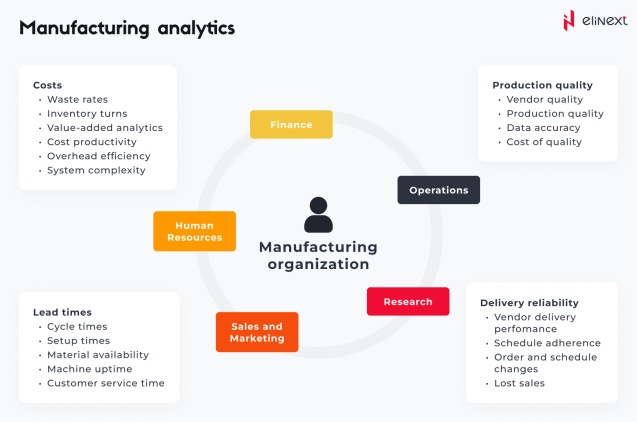
Manufacturing predictive analytics helps companies shift from reactive problem-solving to data-driven prevention. For example, a company can detect vibration anomalies before a motor fails, avoiding costly downtime. Deloitte reported in 2025 that predictive analytics in the manufacturing industry could reduce breakdowns by up to 70% and reduce maintenance costs by up to 25%. Predictive maintenance software development services help turn these advances into repeatable results.
Predictive Analytics in Manufacturing: Terms Explained
-
Predictive Maintenance
Predictive maintenance in predictive analytics in manufacturing means using sensor and performance data to service equipment before failure. It helps avoid sudden stops and costly repairs.
-
Machine Learning Models
Machine learning models are algorithms trained on historical and real-time data to find patterns and predict outcomes. In manufacturing, they help forecast failures, demand, and quality issues.
-
Sensor Data
Sensor data is information collected from machines, tools, or production lines, such as temperature, pressure, speed, or vibration. It powers monitoring, alerts, and predictive analysis.
-
Anomaly Detection
Anomaly detection is the process of identifying unusual equipment or process behavior that may signal faults, defects, or inefficiency. It helps teams respond before problems grow.
-
Failure Prediction
Failure prediction is the use of historical and live operational data to estimate when a machine or component may break down. It supports better maintenance timing and risk reduction.
-
Quality Forecasting
Quality forecasting means predicting defects or deviations before they affect output. It uses production and machine data to help manufacturers improve consistency and reduce scrap.
-
Demand Forecasting
Demand forecasting is the prediction of future product demand using past sales, seasonality, and market signals. In manufacturing, it supports better inventory and production planning.
-
Digital Twin
A digital twin is a virtual model of a machine, line, or factory that mirrors real conditions through data. It helps test scenarios, monitor performance, and predict failures.
FAQ
-
Predictive analytics for manufacturing is the use of data to forecast failures and trends. It helps factories act earlier, for example, by spotting motor wear before a stop.
-
Manufacturing predictive analytics is the use of forecasting models to optimize operations. It improves efficiency by reducing delays, for example, through smarter maintenance timing.
-
Predictive analytics for manufacturing is a data-driven forecasting approach. It helps businesses reduce downtime, improve quality, and plan resources better, for example, via early alerts.
-
Predictive analytics in manufacturing is a method of forecasting equipment issues. It reduces downtime by warning teams early, for example, when vibration signals growing wear.
-
Predictive analytics for manufacturing is a data forecasting system. Its main challenges include poor data quality, integration issues, and weak models, for example, from incomplete sensor data.
-
Manufacturing predictive analytics is a forecasting technology for factory operations. It can be costly at first, but small firms can start with pilot projects and scale gradually.
-
Predictive analytics in manufacturing is a forecasting method based on data models. Inaccurate models can cause false alerts or missed failures, for example, delaying real maintenance.
-
Predictive analytics in the manufacturing industry is a forecasting approach using operational data. It can integrate with SAP or Oracle to align maintenance, inventory, and planning.