



















































































































































A monolithic electronic health record (EHR) system without reliable APIs turns clinical information into isolated tables, screens, and exports. Lab results, medication orders, and patient histories may exist, yet remain unavailable when a decision is made. Clinical decision support systems (CDSS) connect these sources into a controlled context. This article covers their architecture, types, integration requirements, and the mechanisms needed to earn clinician trust without adding another layer of alerts that healthcare professionals learn to ignore.
What are Clinical Decision Support Systems in Healthcare?
What are clinical decision support systems? They are software components that use patient data, rules, models, or clinical knowledge to deliver contextual recommendations, alerts, and prompts within a doctor’s workflow. Clinical decision support systems in healthcare don’t replace professional judgment. They bring verifiable information into the EHR, where the clinical decision remains with the care team. Their value depends on showing the right information at the right moment.
Elinext helps teams design FHIR-compatible integrations, user workflows, and audit mechanisms under our medical device software development services.

Types of Clinical Decision Support Systems
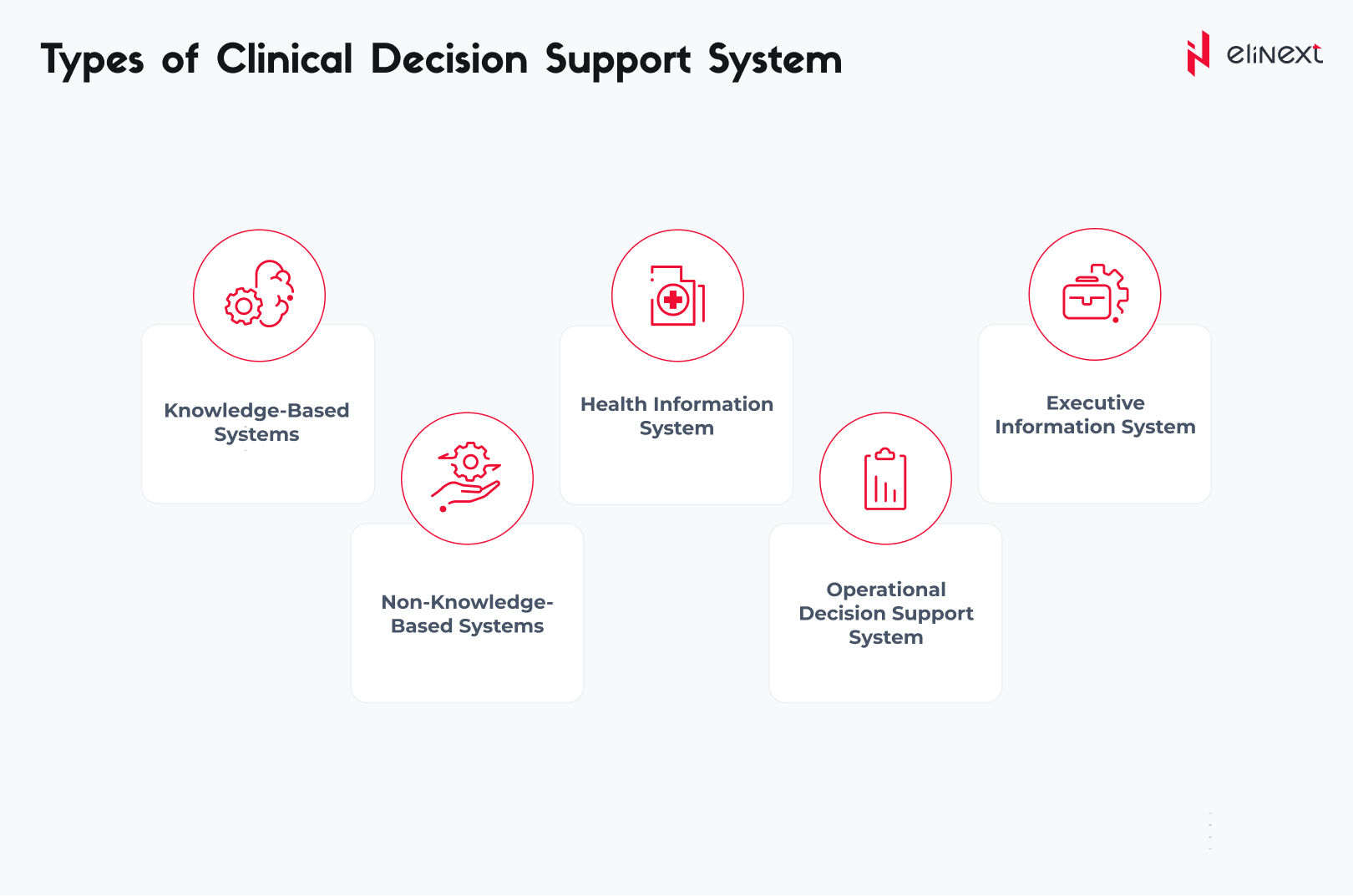
The main types of clinical decision support systems differ not by interface but by how they create a recommendation. Some apply explicitly defined rules and approved clinical knowledge bases; others identify patterns in historical data through statistical or machine-learning models. Organizations use both approaches, but each requires a different validation, versioning, and explainability model.
Knowledge-Based Systems
Knowledge-based clinical decision support systems apply if-then rules, clinical guidelines, drug–drug interaction databases, and threshold values. For example, a service may compare a MedicationRequest, an allergy recorded in AllergyIntolerance, and a result from Observation, then display an alert in the EHR. Their main strength is predictable logic: you can trace which rule fired, which knowledge-base version was used, and which FHIR resources informed the result. Their limitation is maintenance: rules, LOINC codes, SNOMED CT concepts, and local protocols require ongoing change management.
Non-Knowledge-Based (Machine Learning) Systems
Non-knowledge-based clinical decision support systems use ML models trained on historical data to estimate risk or prioritize cases. Rather than relying on one threshold, a model may consider trends in Observation, diagnoses in Condition, procedures, and timing between events. This can help when a clinical pattern does not translate into a fixed rule set. However, value depends on more than model metrics: teams need data-drift controls, representative training data, versioned feature pipelines, and understandable outputs. A model should not become an opaque source of mandatory decisions.
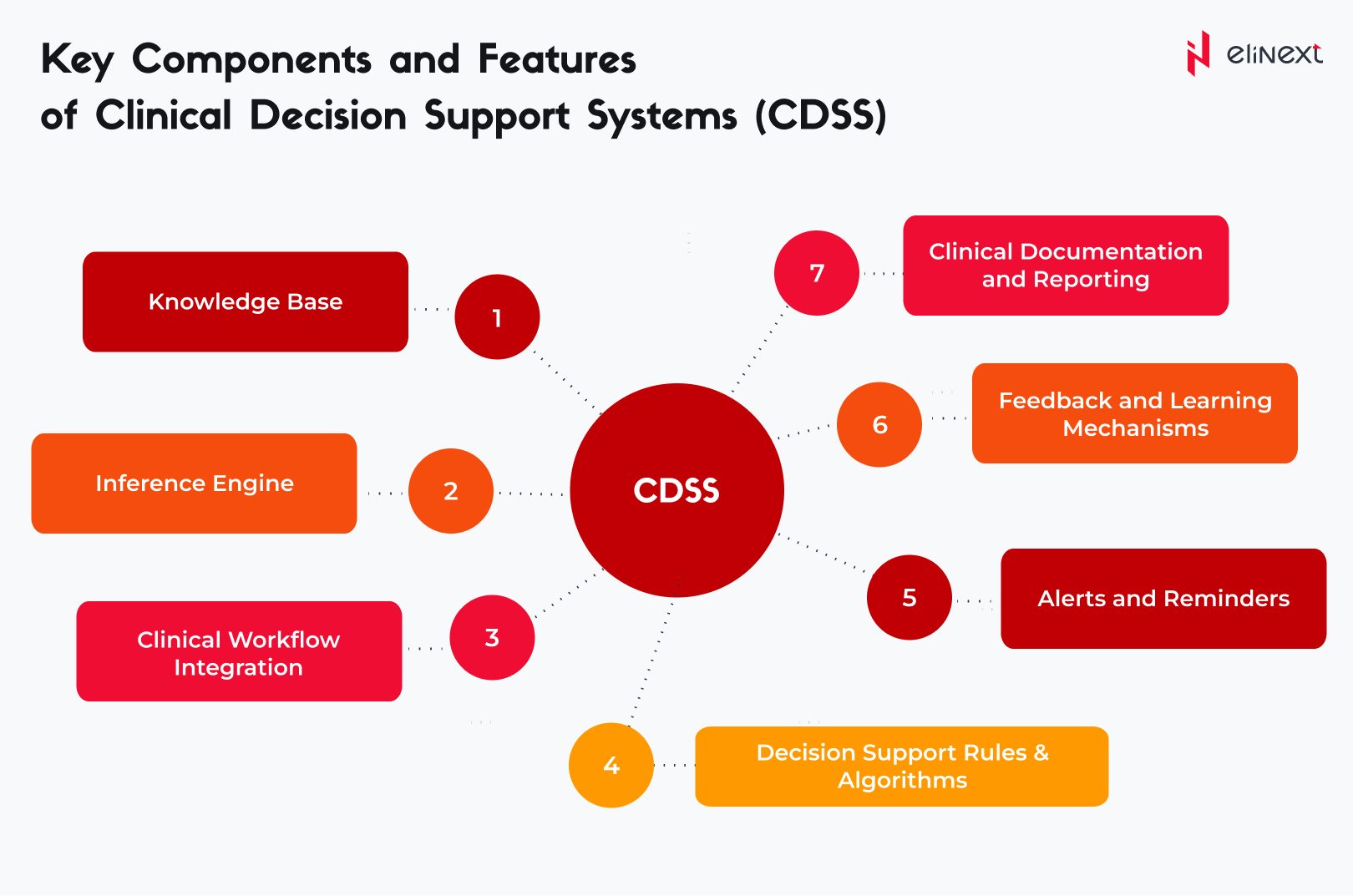
What is a Clinical Decision Support
Clinical decision support is a capability that turns available patient information into timely, explainable assistance when an action must be chosen. It may appear as a contraindication alert, a testing recommendation, a risk calculation, or a queue-prioritization signal. Clinical decision support systems become useful only when they fit the workflow: the signal must appear at the right point in the EHR, show its underlying data, and avoid unnecessary clicks. In our engagements, we have often found that the model represents roughly 20% of the effort, while integration, normalization, and operational controls account for 80%. This is our delivery observation rather than a universal rule.
A CDSS is only as reliable as the real-time data feeding it, and much of that data now comes from connected devices and bedside sensors. Elinext’s IoT healthcare solutions route this device data into the same normalized pipeline used for EHR, lab, and pharmacy records. If your CDSS depends on streaming vitals or remote monitoring, it’s worth checking how that IoT layer connects to your pipeline.
What It Takes to Rebuild: From Data Pipeline to Clinician Trust
Rebuilding a CDSS starts with mapping the EHR, LIS, pharmacy platforms, and local registries. In a typical hospital environment, the same clinical fact may exist in an HL7 v2 message, CSV export, and vendor database. The goal isn’t to add AI, but to create a controlled path from source data to an explainable recommendation in the user interface.
HL7 FHIR Normalization as the Integration Layer
Normalization through HL7 FHIR creates a shared contract across heterogeneous systems. For example, lab results can be represented as Observation resources with LOINC codes, medication orders as MedicationRequest, and diagnoses as Condition. This reduces the number of custom point-to-point interfaces and lets decision logic query a stable data model. FHIR alone doesn’t fix data quality. Teams still need to map local codes, retain provenance, and handle missing, duplicated, or stale values.
Audit Trails for Every Algorithmic Decision
Every recommendation should leave a verifiable record: the patient and encounter identifiers, rule or model version, input FHIR resources, calculation time, result, and user action. Teams can link Provenance, AuditEvent, and an application-level decision log to achieve this. A traceable audit trail supports incident investigation, result reproduction after a model update, and comparison across algorithm versions. Logging must also follow data-minimization and access-control requirements.
Human-in-the-Loop: Why Explainability Beats Full Automation
Human-in-the-loop design means a clinician sees the basis for a recommendation and can accept, reject, or defer it with an understandable reason. This doesn’t eliminate errors, but it reduces the risk of unquestioned reliance on an opaque result. A useful screen shows 0.82 risk, recent Observation values, an active medication order, or a missing test. You need metrics for override rate, alert acceptance, and time to action. Without them, you can’t distinguish a useful signal from alert fatigue.
Hospitals lack a reliable way to reach it when a decision must be made, since lab results, orders, and patient context sit in disconnected systems. At Elinext, we connect these sources through a normalized FHIR layer with versioned rules and full audit trails. That gives clinicians dependable, explainable recommendations instead of fragmented screens.
What the Best Clinical Decision Support Systems Have in Common
The best clinical decision support systems aren’t defined by alert volume or model complexity. They share concrete traits: access to current data through documented interfaces, normalized coding, low latency, and full traceability. They support versioning for rules, terminology mappings, and model artifacts so updates can be reproduced and rolled back. For CTOs, observability matters just as much: dashboards should reveal integration failures, incomplete Observation records, response time, and override patterns. The clinical decision support systems market is growing, but platform selection should begin with EHR compatibility and governance.

A CDSS alert only creates value if the right person on the care team sees it at the right time, which depends on how shifts, roles, and assignments are managed. Our clinical & workforce management solutions connect scheduling and role data to the same systems feeding your CDSS, so recommendations reach the clinician actually responsible for that patient.

Key Takeaways
- Start with the data path rather than the model. A CDSS can’t compensate for gaps between the EHR, and pharmacy system. Define sources, data owners, refresh frequency, and the quality of critical fields before selecting a rules engine or ML approach.
- FHIR is a contract rather than an automatic data-quality fix. Observation, Condition, and MedicationRequest share structure, but local codes, duplicates, and incomplete records still need terminology mapping, validation, and provenance controls.
- Auditability belongs in the architecture. Retain the rule or model version, input data, calculation time, and user response. Without these records, teams cannot reproduce recommendations, investigate incidents, or update decision logic safely.
- Explainability reduces operational risk. Clinicians should see the factors behind a recommendation and be able to reject it. Reviewing override reasons helps teams identify weak thresholds, stale data, and the sources of alert fatigue.
- The industry doesn’t replace architecture review. The clinical decision support systems market offers many products, but EHR compatibility, FHIR support, observability, and governance matter more than a polished model demonstration on a test dataset.
Conclusion
Сlinical decision support systems in healthcare are required not to add another alert screen, but to make fragmented data usable for safe decisions within the workflow. A durable environment begins with normalization, terminology governance, and verifiable EHR integration. Rules, models, and user-facing workflows can then be introduced, measured, and improved. For teams evolving an EHR platform, working with an EHR software development company can be a practical starting point. It will help them define the data contract, ownership boundaries, and one minimum viable workflow before scaling unproven logic across the hospitals and health systems.
FAQ
-
Clinical decision support systems are software solutions that use patient data, rules, guidelines, or models to provide contextual prompts during a clinical workflow. They may flag medication interactions, calculate risk, or present recommendations, but they don’t replace a clinician’s judgment.
-
A CDSS retrieves data through FHIR APIs, SMART on FHIR launch context, HL7 v2 interfaces, or an integration layer. It can read resources such as Patient, Observation, and MedicationRequest, calculate an output, and return it to the EHR as a card, alert, or task at the appropriate workflow stage.
-
The main categories are knowledge-based and non-knowledge-based systems. The first uses deterministic rules, thresholds, and clinical knowledge bases. The second applies machine-learning or statistical models to historical data. Both approaches are combined for different use cases and risk levels.
-
Clinicians may ignore alerts when they appear too frequently, arrive too late, lack patient-specific context, or suggest actions that don’t fit the workflow. A high override rate can also point to outdated rules, incorrect terminology mappings, or poor input-data quality.
-
Even an accurate algorithm produces unreliable results with incomplete, duplicated, or outdated data. Integration determines which Observation records are available and whether terminology is mapped correctly. In real-world CDSS delivery, this layer often drives most complexity.
-
Timing depends on the number of connected systems, API availability, terminology quality, etc. A narrow rule-based pilot involving one EHR workflow may take several months. A multisystem program with FHIR normalization, audit logging, security review, and change management requires phased delivery.
-
HL7 FHIR is usually the primary standard, while HL7 v2 often remains necessary for legacy environments. For semantic interoperability, teams use LOINC for laboratory tests, SNOMED CT for clinical concepts, and RxNorm where applicable. The exact mix depends on the region, EHR, and data sources.
-
The best clinical decision support systems use current, normalized data and fit existing clinical workflows. They explain each recommendation, support rule and model versioning, keep audit trails, and monitor both data quality and user response rather than just alert volume or model accuracy.