


Increasing pressure to improve overall equipment effectiveness (OEE), rising downtime costs (up to $2.3 million per hour in the automotive industry), and persistent labor shortages are driving manufacturers to accelerate automation and the implementation of smart manufacturing systems. Companies are seeking to improve productivity, reduce costs, and remain competitive by leveraging smart factory technologies and manufacturing software development services.
Readers will learn about the core technologies underlying smart factories, the architectural transition from traditional to digital operations, the real-world benefits and challenges, and practical steps for successful smart factory implementation.
By 2026, 46% of manufacturers will have implemented IIoT solutions at the plant level, demonstrating rapid progress toward smart manufacturing.
- A smart factory is a fully interconnected environment where IIoT, AI, and digital twins enable real-time and autonomous decision making. Key technologies: IIoT, digital twins, AI/machine learning, edge/cloud computing, collaborative robots, and 5G.
- Key technologies: IIoT, digital twins, AI/machine learning, edge/cloud computing, collaborative robots, and 5G.
- Documented benefits: 10-30% improvement in overall equipment effectiveness, up to 50% reduction in downtime, and 20-30% faster time to market.
- Key challenges: OT/IT integration (ISA-95), cybersecurity (IEC 62443), legacy system migration, and workforce development.
- Most manufacturers begin with a focused pilot project before scaling smart factory solutions enterprise-wide.
A smart factory leverages Industrial Internet of Things (IIoT), artificial intelligence (AI), and digital twins to create a self-optimizing manufacturing environment. Smart manufacturing lines use real-time sensor data and predictive analytics to reduce downtime and defects. Smart factory technologies, such as collaborative robots and edge computing, enable flexible and efficient operations. Manufacturing software development services are essential for integrating legacy equipment and creating unified data platforms, helping companies overcome architectural and information challenges.
What Is a Smart Factory?
What is a smart factory: a smart factory is a digitally connected manufacturing environment where IIoT, AI, and digital twins enable autonomous, data-driven decision making. While Industry 4.0 is a broader concept of cyber-physical systems and digital transformation, the smart factory is its practical implementation. IoT manufacturing and digital factory refer to the use of connected devices and software, but the key difference is the system that processes and acts on sensor data.
Smart Factory vs Traditional Factory
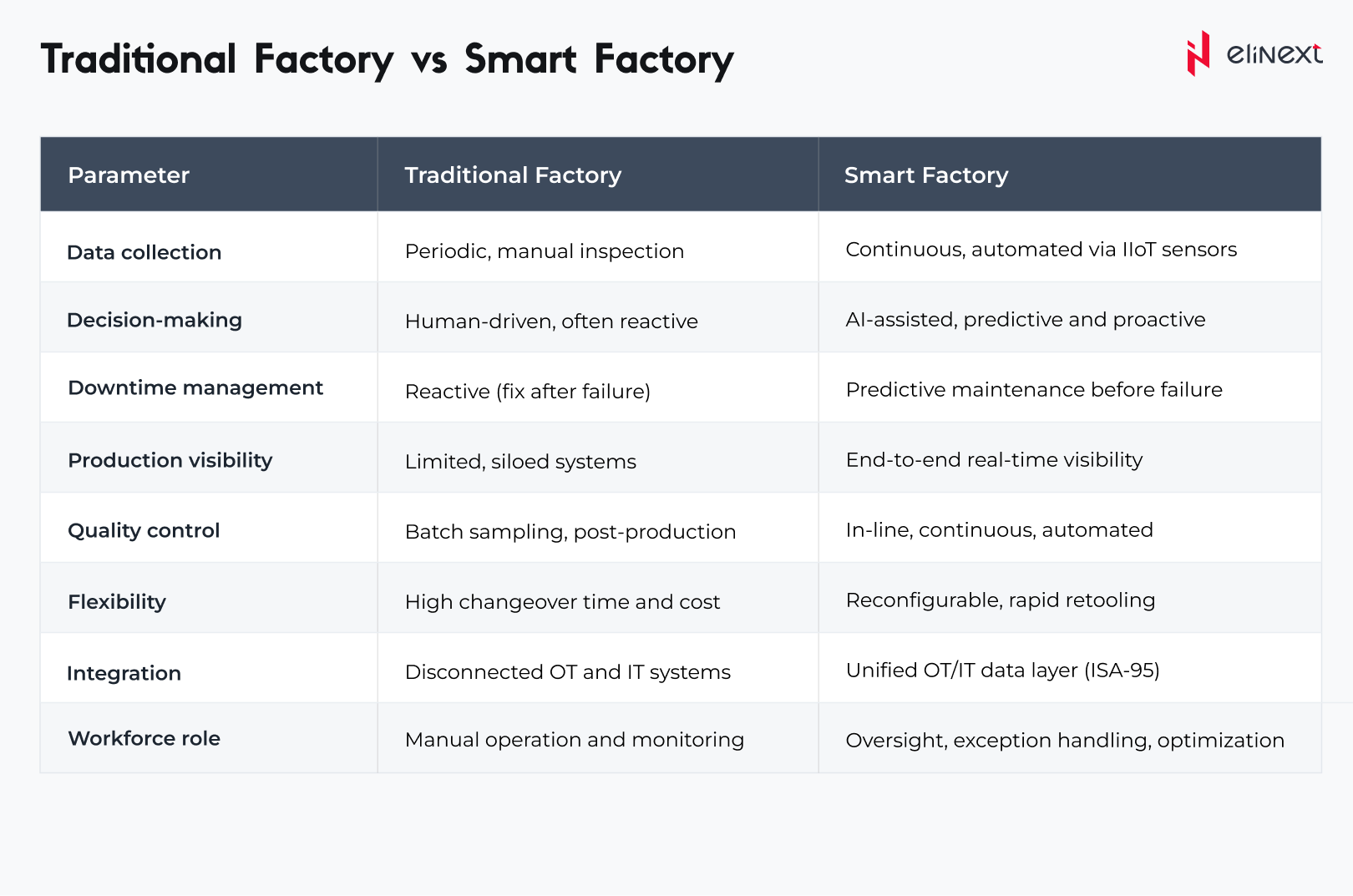
The gap between traditional and smart factories is primarily architectural, not just technological. Smart factory benefits from unified OT/IT integration (ISA-95), enabling continuous data flow and AI-driven decision making. Most factories are in a hybrid state partially automated but lacking full smart factory implementation. Smart factory challenges include connecting legacy systems and providing end-to-end visibility in real time.
Many manufacturers struggle to unify data from legacy machines for digital twin manufacturing and predictive maintenance. Our predictive maintenance software development services address this challenge by integrating multiple data sources, providing real-time monitoring and actionable insights, which is crucial for reducing downtime and optimizing asset performance.
Elinext Expert
Core Technologies Behind a Smart Factory
1. Industrial IoT (IIoT) and Sensor Networks
IIoT manufacturing utilizes networks of intelligent sensors that continuously collect data on equipment operation and processes. This data powers predictive maintenance, allowing smart factory to detect anomalies and plan repairs before failures occur. IIoT and sensor networks form the foundation for real-time monitoring, enabling manufacturers to optimize operations, reduce downtime, and improve safety.
2. Digital Twin Technology
A smart factory uses digital twin technology to create virtual replicas of physical assets and processes. What is a smart factory in Industry 4.0? It’s a system where digital twins simulate, monitor, and optimize production in real time. This enables predictive maintenance, rapid troubleshooting, and scenario testing, making operations more resilient and efficient.
3. Artificial Intelligence and Machine Learning
Smart manufacturing leverages AI and machine learning to analyze vast data streams from smart factory technologies. In a digital factory, AI models detect defects, predict failures, and optimize workflows. Machine learning enables continuous improvement by learning from historical and real-time data, driving higher quality, efficiency, and adaptability in manufacturing processes.
4. Edge and Cloud Computing
A smart factory combines edge and cloud computing to efficiently process data. Edge devices analyze data near machines to provide real-time answers, while cloud platforms provide large-scale analytics and data storage. The implementation of smart manufacturing and smart factory implementation depends on this hybrid approach, which enables rapid decision-making, scalability, and secure data management.
5. Collaborative Robots and Advanced Automation
What is a smart factory advantage? Digital twin manufacturing and collaborative robots (cobots) work together to automate complex tasks. Cobots adapt to changing production needs while working safely alongside humans. Advanced automation increases flexibility, reduces errors associated with manual data entry, and enables rapid reconfiguration, making smart factories more flexible in responding to market demands.
6. 5G and High-Speed Connectivity
Smart factory benefits within Industry 4.0 are enhanced by 5G and high-speed communications. These technologies enable real-time data transfer between machines, sensors, and cloud systems, supporting ultra-low-latency applications such as remote monitoring and autonomous robots. High-speed networks are essential for scaling smart factory operations and achieving new levels of productivity.
Faced with smart factory challenges?
Now is the time to focus on new paradigms, challenges, and profits unlock the full potential of your factory through digital transformation.
Benefits of Smart Factory Implementation
-
Higher Overall Equipment Effectiveness (OEE)
Smart factory implementation results in increased OEE a key performance indicator by minimizing downtime, maximizing productivity, and improving quality. Automated monitoring and AI-powered analytics identify bottlenecks and inefficiencies in real time, enabling rapid corrective action. Companies implementing smart factory solutions report OEE improvements of 10–30%, which directly impacts profitability and competitiveness.
-
Reduction in Unplanned Downtime
A digital factory shifts from reactive to predictive maintenance. Vibration sensors detect anomalies, triggering maintenance requests before breakdowns occur. Unplanned downtime costs an average of $260,000 per hour in the manufacturing industry and $2.3 million per hour in the automotive industry. At Bosch Homburg, predictive maintenance reduced energy consumption by 40% and saved €800,000 per year, proving the value of smart factory solutions.
-
Improved Product Quality and Defect Reduction
Smart manufacturing uses AI-based visual inspection (camera → CNN model → pass/fail/check) for real-time quality control. Unlike batch-by-batch inspection, this enables continuous statistical process control and rapid defect detection. Cognex and Keyence systems have reduced waste by 30% in the food and electronics industries, leading to fewer rework and warranty claims.
-
Energy Efficiency and Sustainability
Smart factory uses energy meters and EMS platforms to automate load balancing and optimize consumption. This contributes to achieving ESG goals by reducing Scope 1/2 emissions. Schneider Electric EcoStruxure and ABB Ability Energy Manager are proven platforms, through which Schneider reports energy savings of $4 billion and avoided 679 million tonnes of CO₂ emissions since 2018. Return on investment depends on tariffs and production type.
Smart Factory Implementation Challenges
-
OT/IT Integration and Legacy System Compatibility
Most factories are brownfield, with legacy equipment lacking network interfaces. Smart factory implementation requires integrating these assets using protocols like OPC-UA. The main challenge is creating a unified environment where diverse sensor data is accessible and actionable. Retrofit solutions bridge the gap, but achieving seamless OT/IT integration remains a major hurdle.
-
Cybersecurity in Connected Manufacturing Environments
Industry 4.0 exposes manufacturing to cyber threats due to high-value disruption targets and legacy OT systems. IEC 62443 is the industry standard for OT security, requiring risk assessment, network segmentation, and secure remote access. Defense-in-depth is essential, and cybersecurity must be treated as an ongoing operational cost, not a one-time project.
-
Workforce Skills Gap and Change Management
Smart factory technologies demand new skills: IIoT, data analysis, and digital workflows. The skills gap spans technical, process, and managerial levels. Industry 5.0 (EU Commission) emphasizes people managing robots, not being replaced by them. Change resistance is read addressed through train-the-trainer programs, digital academies, and systemic change management.
-
Data Quality, Volume, and Architecture
Smart factory benefits depend on robust data architecture. Challenges include data silos, poor data quality (bad ML models), and unclear data governance. The recommended pattern: a Data Lake for raw ingestion plus a semantic layer for analytics. If your team is evaluating data architecture for a connected factory, our manufacturing software development practice covers this as part of its discovery.
Explore smart factory technologies now understand the new paradigms, overcome difficulties, and unlock profits with expert guidance and proven solutions.
How to Start Your Smart Factory Journey
Step 1: Conduct a Manufacturing Readiness Assessment
IIoT manufacturing begins with a readiness assessment: check which machines are connected, evaluate data maturity (historian, MES, ERP), and assess organizational readiness (skills, budget, sponsorship). The result is a prioritized list of use cases, ranked by ROI and feasibility, forming the foundation for a successful smart factory implementation.
Choose one high-impact problem with a measurable baseline for example, “our unplanned downtime on Line X is costing us $Y/month.” The pilot should be limited in scope, measurable, and supported by shop floor operators. Avoid trying to automate everything at once, which often leads to a failure to scale. Focused pilot projects create momentum for broader smart factory adoption.
Step 2: Select One High-Impact Pilot Use Case
Choose one high-impact problem with a measurable baseline and e.g., “Our unplanned downtime on Line X is costing us $Y/month.” The pilot should be scoped, measurable, and gain buy-in from shop floor operators. Avoid trying to automate everything at once, which often leads to a failure to scale. Focused pilots build momentum for broader smart factory adoption.
Step 3: Build the Data and Connectivity Layer First
Connect pilot machines using OPC-UA for secure, vendor-neutral integration. Set up data collection in a data warehouse or data lake, ensuring data quality before deploying machine learning models. A common mistake is launching AI solutions before the data pipeline is stabilized. Reliable connectivity and clean data are critical to the success of a smart factory.
Step 4: Measure, Document, and Scale
After the pilot, document the ROI and operational changes – who is doing what differently. Decide whether to scale the project to adjacent lines or a new use case. Key performance indicators: improved OEE, reduced downtime, change in defect rate. Typical pilot project time: 3-6 months from assessment to first results. Team: plant engineer, data engineer, software developer, and change manager.
Key Takeaways
- A smart factory leverages IIoT, AI, digital twins, and cloud computing at the network edge to create a self-optimizing manufacturing environment – as opposed to simple automation or IoT sensors (McKinsey, WEF).
- Six core technologies define the “smart factory” stack: IIoT sensors, digital twins, AI/machine learning, edge and cloud computing, collaborative robots, and 5G connectivity. Documented benefits include a 10-30% improvement in overall equipment effectiveness, a 30-50% reduction in unplanned downtime, and a 60-90% reduction in defects with automated visual inspection (McKinsey, Cognex).
- The main implementation challenge is OT/IT integration, i.e., connecting legacy machines (PLCs, SCADA) to modern data processing platforms (ISA-95, OPC-UA).
- Most manufacturers start with a single pilot project with a high ROI (predictive maintenance or quality control) and scale the system based on documented results.
Conclusion
Smart manufacturing solutions are transforming industry, and the global smart manufacturing market is projected to reach $380.21 billion by 2026.
Companies implementing Industry 4.0 principles and smart factory technologies report increases in overall equipment effectiveness (OEE) of up to 30% and reductions in downtime by 50%. The Bosch plant in Homburg saved €800,000 per year thanks to predictive maintenance. As digital transformation accelerates, embracing new paradigms and overcoming integration challenges is essential for sustainable growth and competitiveness.
Smart Factory Implementation: Terms Explained
-
Smart Factory
A smart factory is a digital manufacturing environment where the Industrial Internet of Things (IIoT), artificial intelligence (AI), and digital twins enable real-time, autonomous decision-making and optimized production processes.
-
Industry 4.0
Industry 4.0 is the fourth industrial revolution, characterized by the integration of cyber-physical systems, the Internet of Things (IoT), and digital technologies to create intelligent, interconnected, and automated manufacturing environments.
-
Industrial Internet of Things (IIoT)
The Industrial Internet of Things (IIoT) is the use of connected sensors, devices, and software in industrial settings to collect, analyze, and process data in real time to improve efficiency and automation.
-
Automation
Automation is the use of technology to perform tasks with minimal human intervention, improving efficiency, consistency, and safety in manufacturing and other industrial processes.
-
Robotics
Robotics involves the design, construction, and use of programmable machines (robots) to perform tasks in manufacturing, often improving the accuracy, speed, and safety of repetitive or hazardous operations.
-
Artificial Intelligence (AI)
Artificial intelligence (AI) is the imitation of human intelligence by machines, enabling them to learn, reason, and make decisions. In manufacturing, AI is used for predictive analytics, quality control, and automation.
-
Predictive Maintenance
Predictive maintenance uses sensor data and real-time analytics to predict equipment failures before they occur, enabling timely intervention, reducing downtime and maintenance costs in manufacturing.
-
Digital Twin
A digital twin is a virtual copy of a physical asset, process, or system. In manufacturing, digital twins enable real-time monitoring, modeling, and optimization of production operations.
-
Manufacturing Execution System (MES)
A manufacturing execution system (MES) is software that manages, monitors, and controls production in a factory, bridging the gap between enterprise resource planning (ERP) systems and manufacturing operations.
-
Cybersecurity
Cybersecurity is the practice of protecting digital systems, networks, and data from unauthorized access, attacks, or damage. In manufacturing, it ensures the security of connected operations and critical infrastructure.
Smart TV apps for travel agencies are interactive applications designed for smart TVs that allow agencies to showcase destinations, tours, and travel packages on large screens. They are used to engage clients in offices or at events by offering virtual tours, booking options, and real-time updates. A travel agency might use a Smart TV app to display immersive 360° videos of resorts, helping clients make informed decisions.
FAQ
What are smart TV apps for travel agencies?
Smart TV apps for travel agencies are interactive applications designed for smart TVs that allow agencies to showcase destinations, tours, and travel packages on large screens. They are used to engage clients in offices or at events by offering virtual tours, booking options, and real-time updates. A travel agency might use a Smart TV app to display immersive 360° videos of resorts, helping clients make informed decisions.
What is a digital twin in a smart factory?
A smart factory is a digital manufacturing environment where the Industrial Internet of Things (IIoT), artificial intelligence (AI), and digital twins enable autonomous, real-time decision-making and process optimization. They are used to increase efficiency, reduce downtime, and improve product quality. For example, a smart factory can automatically detect equipment anomalies and initiate predictive maintenance, minimizing costly breakdowns and maximizing productivity.
What are the benefits of a smart factory?
Smart factories offer benefits such as higher overall equipment effectiveness (OEE), reduced unplanned downtime, improved product quality, and increased energy efficiency. They are used to optimize production, reduce costs, and increase sustainability. For example, predictive maintenance reduces equipment failures, while AI-based quality control minimizes defects and warranty claims, resulting in more reliable and profitable manufacturing operations.
What is the difference between Industry 4.0 and a smart factory?
Industry 4.0 is a comprehensive concept for integrating cyber-physical systems, the Internet of Things (IoT), and digital technologies into manufacturing. A “smart factory” is a practical implementation of Industry 4.0, where these technologies are implemented to enable autonomous, data-driven production. While Industry 4.0 defines a vision, a “smart factory” is an operational environment that delivers measurable improvements in efficiency and flexibility.
How much does it cost to implement a smart factory?
The cost of implementing a “smart factory” varies greatly depending on the size of the facility, existing infrastructure, and the technologies chosen. Costs can range from $250,000 for a pilot project to several million dollars for a full-scale deployment. These costs include IIoT sensors, software development, integration, and staff training. ROI is typically achieved through reduced downtime, increased overall equipment effectiveness (OEE), and improved quality.
How long does it take to implement a smart factory?
Implementing a smart factory typically takes 3-6 months for a pilot project and 1-3 years for a full-scale deployment. The timeline depends on the complexity of the integration, data readiness, and change management. Connecting a single production line to IIoT sensors and a predictive maintenance system can be accomplished in a few months, while scaling to multiple sites requires phased planning and investment.
What is the difference between a smart factory and a traditional factory?
Industry 4.0 is a comprehensive concept for integrating cyber-physical systems, the Internet of Things, and digital technologies into manufacturing. The smart factory is a practical implementation of Industry 4.0, where these technologies are implemented to enable autonomous, data-driven production. While Industry 4.0 sets the vision, the smart factory is an operational environment that delivers measurable improvements in efficiency and flexibility.
