


























































































































Contact Us
bg img
The Fantastic Four
Elinext Executives

At Elinext, we’ve spent 29 years building more than just software—we’ve built trust. I’m proud of our talented, experienced team and the long-term partnerships we’ve built with clients around the world. Whether you need a full solution or expert support, we’re here to help. Let’s turn your vision into powerful, impactful software solutions.

700+
Employees
350+
Clients
>29
Years in IT
1100+
Projects
img
Working models

Elinext offers flexible working models—dedicated teams, fixed-price, or time & material. Every project begins with a discovery phase to define goals and scope. We provide clear pricing and stay committed to deadlines. Whether you need end-to-end development or expert support, our process ensures efficiency, clarity, and reliable results.

700+
Employees
350+
Clients
>29
Years in IT
1100+
Projects
img
Our values

At Elinext, we value clear communication, responsibility, and practical problem-solving. We focus on building strong, respectful relationships inside the team and with our clients to deliver reliable results. Our team takes ownership of every task and works with pro-activity, consistency, and attention to detail—because that’s what good collaboration is built on.

700+
Employees
350+
Clients
>29
Years in IT
1100+
Projects
img
Corporate social responsibility

At Elinext, we believe in responsible growth. We support our communities, care about the environment, and create a healthy, respectful workplace. From reducing our environmental impact to supporting education and tech initiatives, we take action where it matters. We explicitly avoid involvement in gambling software development or similar activities. Being a tech company also means being a responsible part of the world around us.

700+
Employees
350+
Clients
>29
Years in IT
1100+
Projects
pic

We have been using the Elinext on our projects for two decades already, and in my opinion they compare favorably in terms of project management, individual skills and communication over other eastern European companies. I wouldn't hesitate to recommend this outfit to anyone.

Jordan Ellington
VP Legal Technology, TransPerfect | USA
700+
Employees
350+
Clients
>29
Years in IT
1100+
Projects
img Hottest Topic
img
Industries Affected by AI: Empowered, Not Replaced by 2026

By 2026, AI is expected to transform industries not by replacing human talent, but by amplifying it. From healthcare to manufacturing, finance to education, AI for industries will streamline operations, improve decision-making, and unlock new creative possibilities.

700+
Employees
350+
Clients
>29
Years in IT
1100+
Projects
img
Our Experts

At Elinext, our experts bring together deep technical knowledge and hands-on industry experience to deliver reliable, scalable software solutions. From solution architects and developers to QA engineers and business analysts, our teams collaborate closely to understand client needs and turn complex requirements into efficient, high-quality systems. We continuously invest in professional growth to ensure our specialists stay ahead of evolving technologies and industry standards.

700+
Employees
350+
Clients
>29
Years in IT
1100+
Projects
img
FAQs

At Elinext, our FAQ page answers common questions about our services, technologies, engagement models, security practices, and development process. We provide clear insights into how we work, helping you understand our expertise, approach, and what to expect when partnering with us.

700+
Employees
350+
Clients
>29
Years in IT
1100+
Projects
Services

Whether you need a full software product or just a single service like UI/UX, QA, or DevOps, Elinext is ready to support your goals. We design, build, and scale reliable solutions, offering the flexibility to match your project scope and business needs.

Custom Software Development

Custom software helps your company work more efficiently by fitting your exact needs—no wasted features, no workarounds. We design solutions that improve operations, reduce manual tasks, and grow with you. Get software that matches your goals, not the other way around.

Web Development

Elinext develops fast, scalable web applications tailored to your workflows. We use modern frameworks like React, Angular, and Node.js to build clean, responsive systems. Whether it’s a client portal or a complex app, we align tech with your goals for long-term efficiency.

Mobile App Development

We design and build mobile apps that support your business goals—across iOS, Android, or both. You get smooth performance and intuitive UX. From internal tools to customer-facing apps, our team helps you deliver real value on mobile.

Cloud Engineering

We help you smoothly move to or build in the cloud with architecture that fits your goals. Our clients benefit from lower infrastructure costs, better uptime, and faster scaling. Elinext experts work with AWS, Azure, and GCP to deliver secure, high-performance environments

Software Product Engineering

We handle full-cycle product engineering -- from planning to delivery -- ensuring technical stability and long-term usability. You benefit from reduced rework, faster launches, and a product that aligns with your market and internal processes

DevOps

Elinext’s DevOps engineers streamline your development and deployment processes. We automate builds, testing and delivery pipelines to reduce release time and improve stability. You benefit from smoother deployments, better resource use, and fewer production issues.

DevSecOps

Elinext’s DevSecOps engineers integrate security into every stage of your development lifecycle. We automate security checks, compliance controls, and vulnerability management across your CI/CD pipelines. You get faster releases with built-in protection, reduced risks, and stronger application resilience.

UI & UX Design

Our designers create interfaces based on user research and workflow analysis. Clear, intuitive layouts speed up task completion and improve user satisfaction. Better usability leads to higher conversion, stronger retention, and ultimately, increased revenue for your business.

IT Project Management

Our experienced PMs ensure your project runs on time, on budget, and within scope. You benefit from clear communication, risk control, and predictable delivery. Elinext integrates smoothly with your workflow for better coordination and less stress. We can also lead the process under your project manager—whichever setup works best for you.

Business Analysis

Our skilled Business Analysts help you transform ideas into clear, actionable requirements. You gain a deep understanding of business goals, user needs, and technical feasibility before development even starts. Elinext ensures every feature aligns with your objectives, reducing risks and costly rework. Whether you need full-cycle analysis or support for your in-house BA team, we adapt to your workflow for seamless collaboration and smarter decision-making.

SaaS Development

Our company offers SaaS services, grounded in strong experience and variety of tech tools. We build tailored ERP systems, eLearning platforms, telehealth apps, and more that streamline operations and boost engagement. Our flexible, scalable solutions help middle and big enterprises alike turn bold ideas into high-performing, cloud-based software.

Augmented & Virtual Reality
Elinext creates immersive AR and VR solutions that enhance user engagement and bring ideas to life. Using technologies like Unity, Unreal Engine, and ARKit/ARCore, we build interactive experiences for training, marketing, education, and entertainment, combining innovation with reliable performance.
Embeded Development

Elinext’s embedded software engineers design and develop reliable software for hardware-driven systems. We work close to the hardware layer to ensure performance, stability, and efficient resource usage. You get robust embedded solutions tailored to your devices, industry standards, and real-world constraints.

Manual Software Testing

Manual testing is performed by Elinext’s in-house QA engineers who understand your product and business context. We find issues automation can miss—delivering better quality, real-world usability, and fewer surprises after launch.

Automated Software Testing

We create tailored automated testing systems to handle both routine checks and critical flows. This shortens release cycles, lowers human error, and improves test consistency across versions. You’ll benefit from faster updates, better coverage, and higher product stability as your system evolves.

Penetration Testing
All penetration testing is performed by trusted Elinext specialists. No third parties—just focused, expert simulations to find and fix weaknesses. You get accurate, actionable reports to strengthen security and meet compliance with confidence.
Performance Testing

Our in-house testing team checks how your software performs under stress. No outsourcing—just quick feedback, fast fixes, and better control. We help you avoid crashes, slowdowns, and scaling risks so your system stays reliable under pressure.

Usability Testing

All usability testing is handled by our in-house team, giving you direct feedback, clear reporting, and quick improvements. We identify issues that block users, helping you boost retention and reduce frustration. Get clear insights without third-party delays.

Certificates of our experts
  • img
  • img
  • img
  • img
  • img
  • img
  • img
  • img
  • img
  • img
Technologies

Elinext uses modern tech stacks like React, Node.js, .NET, and AWS to build stable, scalable software. We match tools to project needs, ensuring performance, maintainability, and long-term value. Our focus is on clear architecture, clean code, and reliable delivery.

Back-end

Elinext leverages powerful back-end tools like Node.js, .NET, Java, and Python to create secure, high-performance server solutions. We focus on scalability, efficient data management, and seamless integration to ensure stable, reliable systems that support complex business logic.

Practice
28 years
Projects
350+
Workforce
60+
Enterprise programming language enabling enterprises to build scalable, reliable, and secure applications globally.
Practice
21 years
Projects
230+
Workforce
50+
Popular programming language enabling enterprises to build AI, analytics, web, and backend apps with simplicity and scalability globally.
Practice
21 years
Projects
250+
Workforce
50+
Framework enabling enterprises to build scalable desktop, mobile, and web apps with enterprise-ready security and integrations globally.
Practice
21 years
Projects
210+
Workforce
30+
Popular web programming language enabling enterprises to build dynamic websites, CMS, and apps globally.
Practice
14 years
Projects
200+
Workforce
50+
JavaScript runtime enabling enterprises to build scalable, fast, and real-time applications globally.
Practice
29 years
Projects
170+
Workforce
15+
Programming language enabling enterprises to build high-performance, reliable, and secure systems, games, and enterprise apps globally.
Practice
10 years
Projects
140+
Workforce
10+
Programming language by Google enabling enterprises to build scalable, high-performance apps globally.
Front-end

Elinext uses modern frameworks such as React, Angular, and Vue.js to build fast, responsive, and user-friendly interfaces. Our front-end solutions emphasize performance, accessibility, and clean design, delivering smooth digital experiences across all devices and browsers.

Practice
29 years
Projects
150+
Workforce
25+
Front-end framework by Google enabling enterprises to build scalable, maintainable, and secure web apps globally.
Practice
29 years
Projects
170+
Workforce
40+
JavaScript library by Meta enabling component-based web apps with scalability, reusability, and flexibility globally.
Practice
8 years
Projects
120+
Workforce
15+
Progressive front-end framework enabling developers to build scalable, lightweight, and maintainable apps globally.
Practice
29 years
Projects
500+
Workforce
80+
Most popular web programming language enabling interactive apps, dynamic websites, and enterprise-scale platforms globally.
Mobile

Elinext develops mobile apps using Swift, Kotlin, Flutter, and React Native to ensure native performance and a consistent user experience. We create reliable, high-quality applications that meet business goals while providing intuitive, engaging mobile interactions.

Practice
15 years
Projects
170+
Workforce
30+
Google’s mobile OS enabling enterprises and developers to build apps for billions of smartphones and devices globally.
Practice
16 years
Projects
160+
Workforce
25+
Apple’s mobile operating system enabling enterprises and developers to build apps for iPhone, iPad, and wearable devices globally.
Practice
8 years
Projects
130+
Workforce
15+
Cross-platform framework enabling enterprises to build mobile apps using JavaScript and React with scalability globally.
Practice
7 years
Projects
120+
Workforce
15+
Cross-platform framework enabling enterprises to build apps for iOS, Android, and web with a single codebase globally.
Practice
8 years
Projects
130+
Workforce
20+
Programming language enabling enterprises to build scalable Android and cross-platform apps with reliability globally.
Practice
10 years
Projects
130+
Workforce
15+
Apple’s programming language for iOS, macOS, and watchOS apps enabling enterprises to build scalable, modern apps globally.
Practice
16 years
Projects
130+
Workforce
10+
Apple’s legacy programming language enabling enterprises to build scalable iOS and macOS apps with reliability globally.
Cloud

Elinext implements scalable cloud solutions using AWS, Azure, and Google Cloud. We design secure, cost-efficient architectures for hosting, data storage, and deployment, ensuring flexibility, reliability, and long-term performance for enterprise systems.

Practice
Projects
Workforce
Leading cloud platform offering compute, storage, databases, networking, and managed services enabling enterprises to scale globally with high reliability.
Practice
13 years
Projects
110+
Workforce
10+
Cloud platform uniting AI, data, and IoT with hybrid support, strong security, and 60+ global regions for enterprise scalability.
Practice
13 years
Projects
120+
Workforce
15+
Cloud platform with strong AI, data analytics, and open-source tools enabling business innovation at scale across 200+ countries.
ERP / CRM

Elinext delivers tailored ERP and CRM solutions that streamline business processes, enhance customer engagement, and improve operational efficiency. We design and integrate scalable systems that centralize data, automate workflows, and provide actionable insights to support business growth and informed decision-making.

Open-source ERP and CRM for SMEs with modular apps in HR, sales, and finance, offering flexibility, affordability, and scalability worldwide.
CRM platform delivering sales, marketing, and service automation with AI personalization, integrations, and scalable enterprise-ready tools.
ERP platform for finance, HR, supply chain, and operations with industry depth, compliance, and analytics powering large enterprises worldwide.
Industries

With over 29 years of experience in software development for finance, healthcare, telecom manufacturing, and more, Elinext builds reliable software tailored to the relevant business needs. We align our experience and technology with your goals to deliver tools that improve your processes, reduce costs for you, and support growth.

pic
pic
pic
pic
pic
Case Studies
Custom Healthcare Data Anonymization Platform
A combination of a fully functional website and a remote UNIX-server which covers users needs to manage feeds pipelines.
Country: Canada
Duration: 2017 and running
Staff:
pic
pic
pic
pic
pic
Case Studies
Code Enhancement for Biopharmaceutical Systems
Client While high-tech industries have rapidly adopted AI and ML, the biopharmaceutical industry has also shown interest in modern technological solutions. Our client is a German company that provides software development solutions for the biopharma industry in predictive biomanufacturing. The client leverages Digital Twins to model biochemical processes using predictive models. It helps to analyze … Continued
Country: Germany
Duration: 3 months
Staff:
pic
pic
pic
pic
pic
Case Studies
Online Payment System for a Global Car Manufacturer
Client A major European car manufacturer used Elinext to develop a B2B online payment system. Challenge The company used another developer to build a custom end-to-end payment application that would allow businesses to sell to customers online. For customers, it would be the same as paying via a card terminal in a store — but … Continued
Country: Germany
Duration: 3.5 years
Staff:
pic
pic
pic
pic
pic
Case Studies
Custom Financial Risk Analysis & Mitigation Software
Client A business analytics company based in Silicon Valley commissioned Elinext to develop financial risk assessment software. Challenge This story began in 2011, when an analytics company based in San Jose reached out to Elinext. Operating in multiple markets, this company’s corporate clients had been selling their products in different currencies, which made planning and … Continued
Country: USA
Duration: 10 years in total
Staff:
pic
pic
pic
pic
pic
Case Studies
ERP & Payment Processing Solution for Enterprise Operations
The ERP system for tracking transactions and objects related to them, client and administrative web applications.
Country: Canada
Duration: 2011 - till now
Staff:
pic
pic
pic
pic
pic
Case Studies
Document-Review Platform for Legal Teams
Introduction The client that reached out to Elinext is a global translation and language services company that also specializes in legal document review and production. The company works with large amounts of data that need to be constantly reviewed. This would be extremely time-consuming if done manually, so the client came up with a web … Continued
Country: USA
Duration: 2019 - now
Staff:
pic
pic
pic
pic
pic
Case Studies
Tailored UI Solution for Insurance Fulfilment Platforms
Client The client is an American company that provides automation and technology solutions for the financial and insurance industry. Insurance carriers, brokers, and paramedical companies use their software to streamline the process of collecting information for life insurance applications. Project The client has four core solutions: a singular quoting application and three processing entities that … Continued
Country: USA
Duration: 3 years
Staff:
pic
pic
pic
pic
pic
Case Studies
Avatar-Based Mobile Game for Leading Shoe Manufacturer
Client An Australian company worked with Elinext to enhance their location-based gaming app for sneaker enthusiasts with customizable avatars. Challenge Mobile phones have a reputation for keeping us seated. But they can actually promote an active lifestyle by pushing us to get up, take a walk and keep moving. One Australian company kept that in … Continued
Country: Australia, worldwide
Duration: 18 months
Staff:
pic
pic
pic
pic
pic
Case Studies
Online Used Cars B2B Auction Platform
A web platform featuring regular auto auctions and post-auction order processing for B2B clients.
Country: Switzerland
Duration: Ongoing since 2016
Staff:
pic
pic
pic
pic
pic
Case Studies
Software for Processing Restaurant Orders in Switzerland
Client An entrepreneur from Switzerland commissioned Elinext to develop food ordering software for landline phone calls. Challenge Landline phones are still actively used in Switzerland, and consumers expected restaurants to keep that in mind while adopting delivery during the pandemic. But available technology for quick and effective order processing didn’t comply with the national landline … Continued
Country: Switzerland
Duration: Since 2021
Staff:
pic
pic
pic
pic
pic
Case Studies
Mobile Fitness Application For the Australian Market
Client A provider of exercise programming solutions for users around the globe. Challenge The client had worked with Elinext in the past to build a web portal for instructors and coaches. With the help of the website, a trainer can create various exercise routines, complexes and programs, and share them with users. In 2022, the … Continued
Country: Australia
Duration: 3-4 months
Staff:
pic
pic
pic
pic
pic
Case Studies
Gamification Solution for Retailers Worldwide
Introduction A marketing agency came to Elinext with the goal of updating an existing solution that allows users to play games and attract customers to visit brick-and-mortar facilities (shops, cafes, etc.) as well as online stores (e.g., internet providers) through these games. Any game the customer plays rewards them with prizes or discounts, and to … Continued
Country: Worldwide
Duration: Since 2014 and ongoing
Staff:
pic
pic
pic
pic
pic
Case Studies
360° Property Showcase Mobile Solution for Real-Estate Sales
Tablet application with admin dashboard for real estate agents to show apartments' gallery, features, neighborhood area and amenities to potential buyers and follow them up with the generated brochure.
Country: USA
Duration: 4 months
Staff:
pic
pic
pic
pic
pic
Case Studies
Next-Gen MES Platform for Modern Manufacturing
Challenge This story begins in 2005 when a US MES provider had encountered a problem. Its system was built in the late 1990s, and integrating it with modern software was becoming increasingly difficult. The company looked for a developer with expertise in performance analytics, graph generation, and business process optimization. When they came across Elinext, … Continued
Country: Germany
Duration: Ongoing since 2005
Staff:
pic
pic
pic
pic
pic
Case Studies
Mobile App for Sustainable Vehicle Charging
Challenges A Switzerland-based company that specializes in creating innovative EV-charging solutions came to Elinext with the idea to create iOS and Android mobile apps. Their product represents a new generation of EV-charging solutions and, at the moment is new and unique. The company required the apps that would be used with the company’s EV-charging devices … Continued
Country: Switzerland
Duration: 2 years
Staff:
pic
pic
pic
pic
pic
pic
Case Studies
Real-Time HMI Dashboard for Port Operations
Client Our client is a highly experienced supplier of Radar sensors for distance and position measurement. They are a German-based company well-established in the market, and it was our first common project. Project Description Software implementation of cabin dashboard HMI to display statuses and alarms in real-time to the drivers of straddle carriers and ship-to-shore … Continued
Country: Western Europe
Duration: 2 months
Staff:
pic
pic
pic
pic
pic
Case Studies
Network Monitoring Software for IT Infrastructure
A huge project with a history of more than 10 years and thousands of telecom companies as end-customers from all over the world. It's a complex infrastructure management and network monitoring solution.
Country: Worldwide
Duration: Over 12 years; ongoing project
Staff:
pic
pic
pic
pic
pic
Case Studies
Cloud Video eLearning Platform: uQualio
Back in 2017, a promising eLearning startup from Denmark needed a team of developers to deliver a function reach platform that would enable creating top-notch eLearning video courses. A related proprietary initiative produced Elinext’s elinext LMS learning management system — a purpose-built e-learning system that replaced ad-hoc training sessions with self-paced courses, progress tracking, and … Continued
Country: Denmark
Duration: 18 months
Staff:
pic
pic
pic
pic
pic
Case Studies
Luxury Travel Booking Platform for Premium Flight Services
Poshberry is a company that provides a wide range of services for luxury travel industry. The developed website is a convenient way to book first class tickets for the best price.
Country: Worldwide
Duration: 1 year; ongoing project
Staff:
pic
pic
pic
pic
pic
Case Studies
Subtitle-Management Platform for Media Content Creators
Client A Dutch media company that provides aggregation and tech services for content creators and distributes their production with global platforms. They were looking for an order management system. Project Description The company needed a new system for order management of subtitles to the videos made by translators. The software has to be a web … Continued
Country: Netherlands
Duration: Ongoing Project
Staff:
pic
pic
pic
pic
pic
Case Studies
Renewable Energy Project Management Software Development for Green Energy Investments Company
Client Our customer is an independent developer of infrastructural projects for renewable energy generation. They have offices in three locations around the world with the headquarters in Italy. Their main field of operations is the development of projects for green energy. Project Description As we’ve stated, the company’s business is producing environmental and development projects … Continued
Country: Italy
Duration: 11 months
Staff:
pic
pic
pic
pic
pic
Case Studies
Custom Agriculture CRM Consulting
Elinext provided custom agriculture CRM consulting for a large farming enterprise, helping restructure disconnected processes into a unified, data-driven system. By customizing our existing platform rather than building from scratch, the team delivered a flexible and scalable custom agriculture CRM designed specifically for managing crop production cycles, logistics coordination, and contract workflows across distributed operations.  … Continued
Country: Brazil
Duration: 6 Months
Staff:
pic
pic
pic
pic
pic
Case Studies
Software for Roofing and Solar Paneling Contractors
Challenge The company has been developing software as a service for roofing and solar paneling companies and professionals. The software was designed to help those contractors calculate each project’s cost, request materials from suppliers, quote clients, manage sales and more. For two years, the company had been building the product when it realized it needed … Continued
Country: Canada
Duration: Two years
Staff:
pic
pic
pic
pic
pic
Case Studies
Custom CRM for the Oil and Gas Industry
Custom CRM for the Oil and Gas Industry Elinext adapted its proprietary CRM platform into a scalable custom CRM for the oil and gas industry, enabling energy companies to streamline operations, manage assets, and improve visibility across distributed teams. The solution demonstrates how a custom CRM for oil and gas can be quickly tailored to … Continued
Country: Norway
Duration: 5 Months
Staff:
Expertise
Elinext combines deep experience in building custom software with a suite of in-house products that cover CRM, ERP, BI, and more. We tailor both to your company needs—whether starting from scratch or adapting a proven system. This approach saves time, lowers risk, and ensures the final product fits how you actually work.
Products
Elinext delivers a range of ready-to-use software products designed to streamline operations and boost efficiency. Built with modern technologies and best practices, our products offer reliability, scalability, and flexibility to meet diverse business needs across industries.
bg pic
pic Live Demo
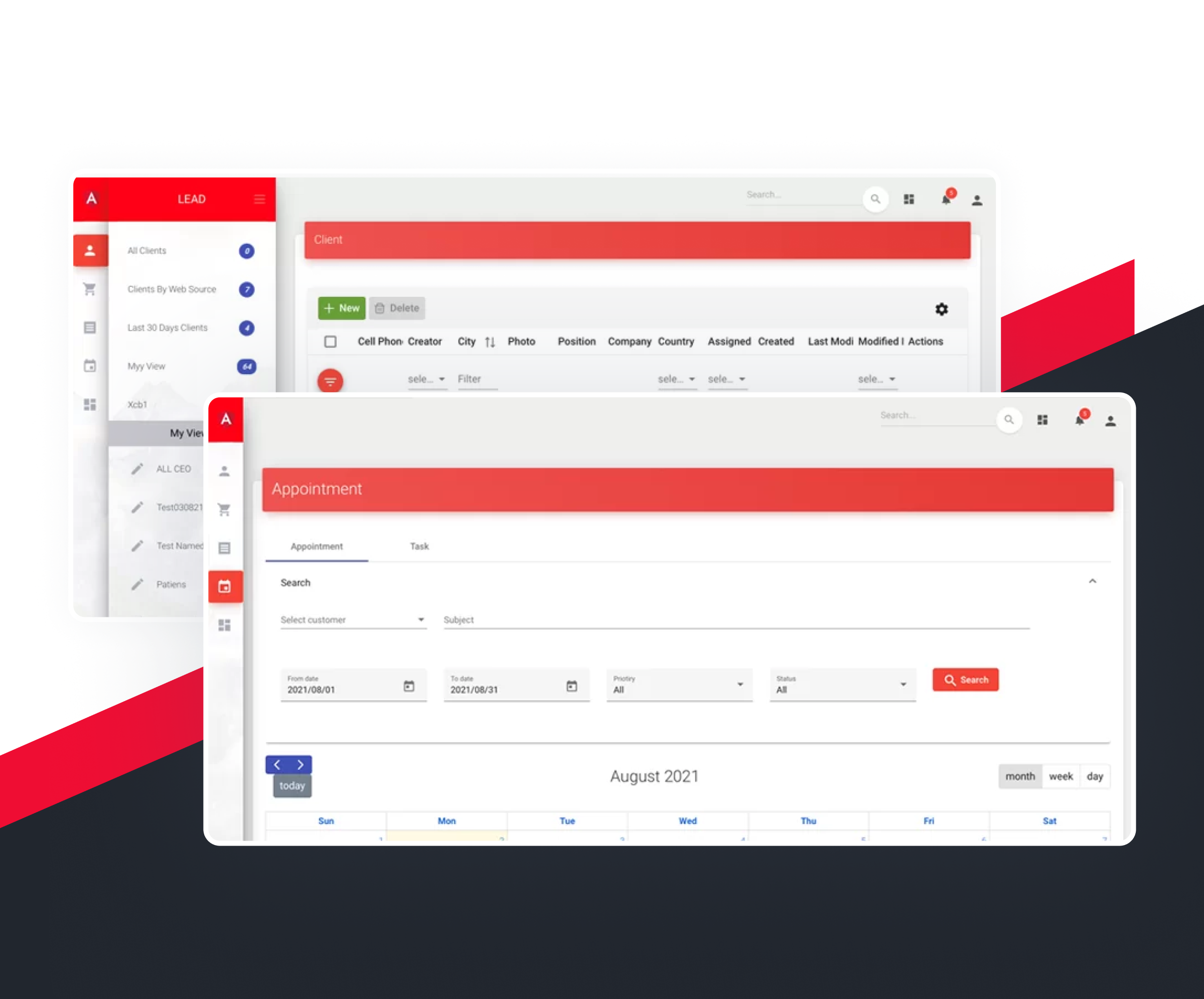
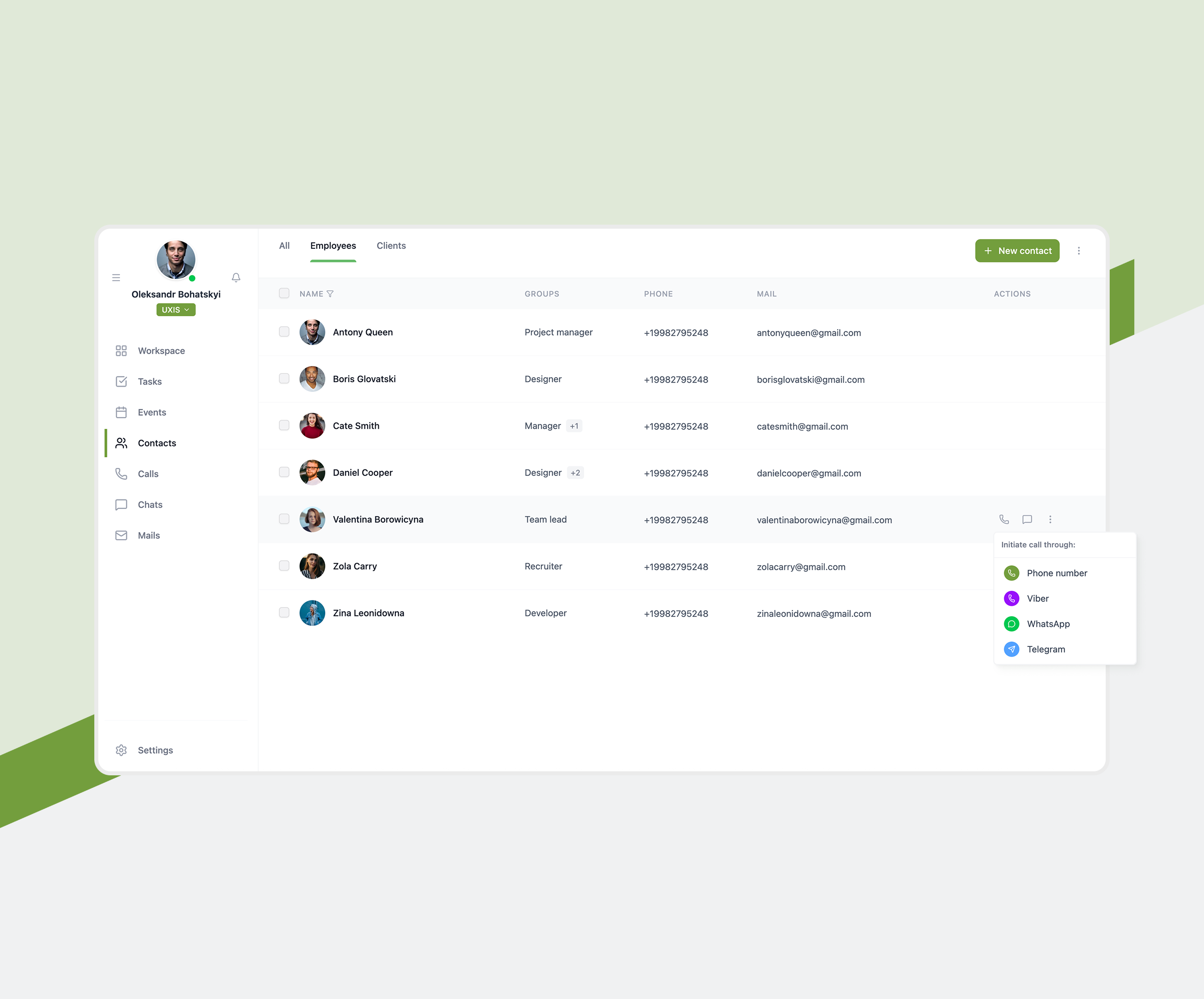
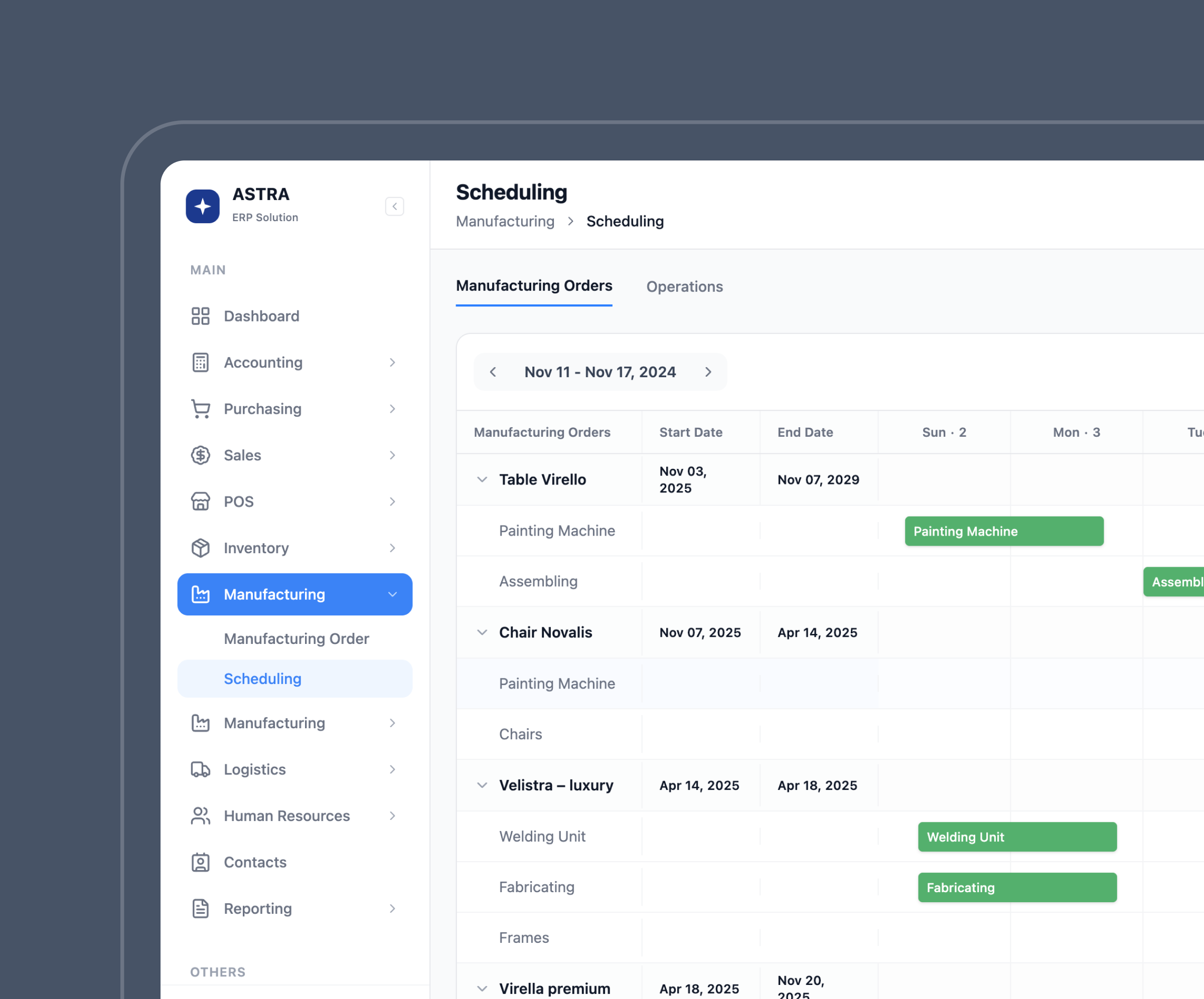
CRM
A web-based CRM that centralizes and automates sales workflows — lead tracking, client management, invoicing, scheduling, and reporting. It supports role-based access, admin configuration, and integrates with external systems to boost efficiency and transparency.
bg pic
pic Live Demo
Payroll Management
A web-based Payroll Management System to automate bonus requests, salary processing, and approvals. It supports roles (managers, directors, accountants, employees) with reports, notifications, chat, and configurable workflows to speed up HR and finance functions.
bg pic
pic Live Demo
Invoice Management
Invoice Management Web App centralizes contracts, payments, invoices, reconciliations, and reporting. It supports role-based access, high security (2FA, encryption), currency control, and automated alerts — offering a unified financial ecosystem for streamlined operations.
bg pic
pic Live Demo
Learning Management
A web-based learning system designed for internal training and candidate assessment. It enables course creation, quizzes, dashboards, analytics, and role-based access. The tool boosts organizational learning, insight, and streamlined education workflows.
bg pic
pic Live Demo
Workflow Management
A Business Process Automation Application that enables users to build templates of repetitive workflows (tasks, approvals, escalations, skips), assign roles (executor, supervisor, viewer), monitor progress on diagrams, receive notifications, and reuse processes—boosting efficiency and clarity.
bg pic
pic Live Demo
Talent Management
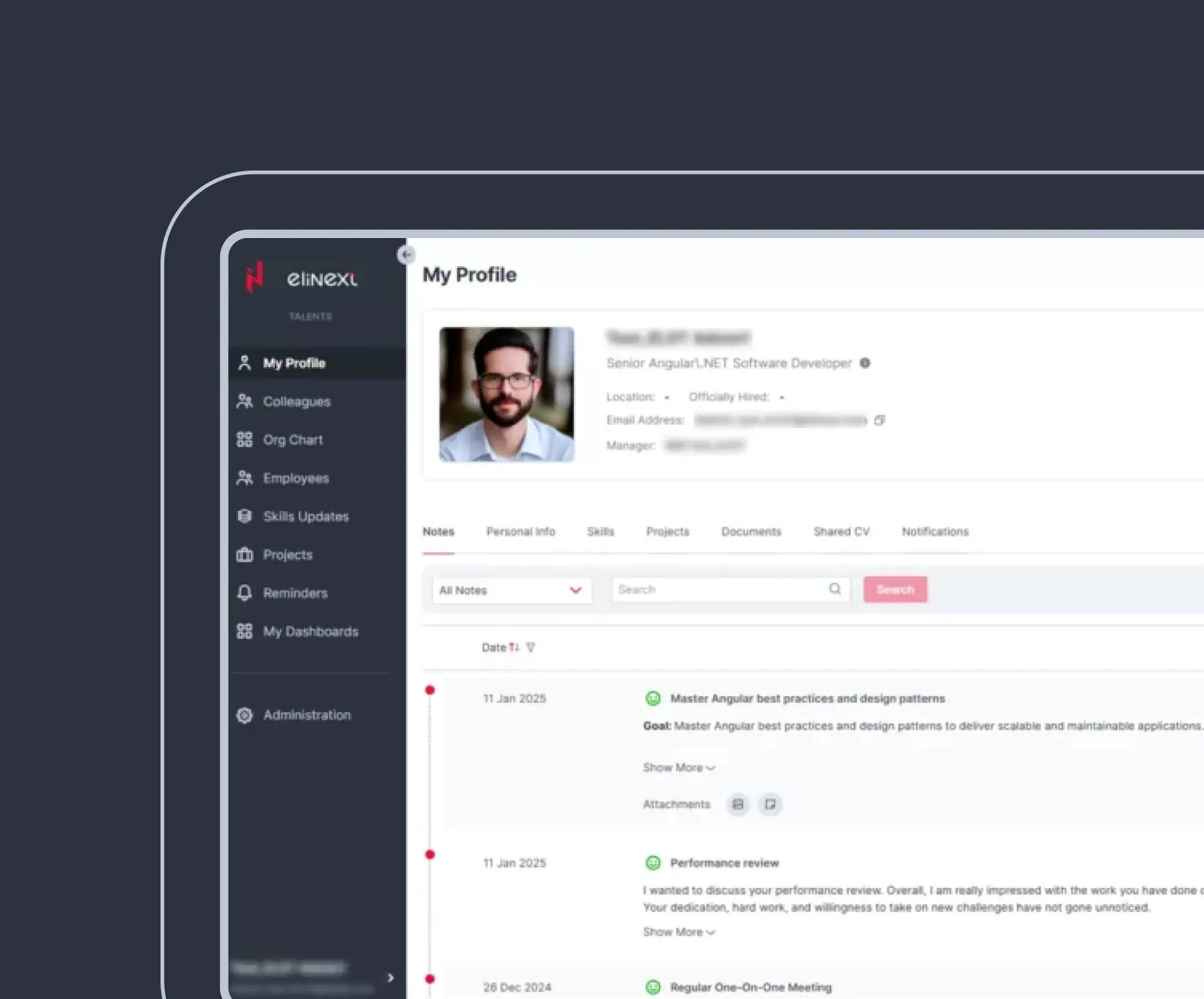
A web-based system for managing workforce planning, performance appraisals, skills, career paths, and resource allocation. It centralizes employee and project data with role-based access, CV tools, notifications, and organizational insights.
bg pic
pic Live Demo
Applicant Tracking
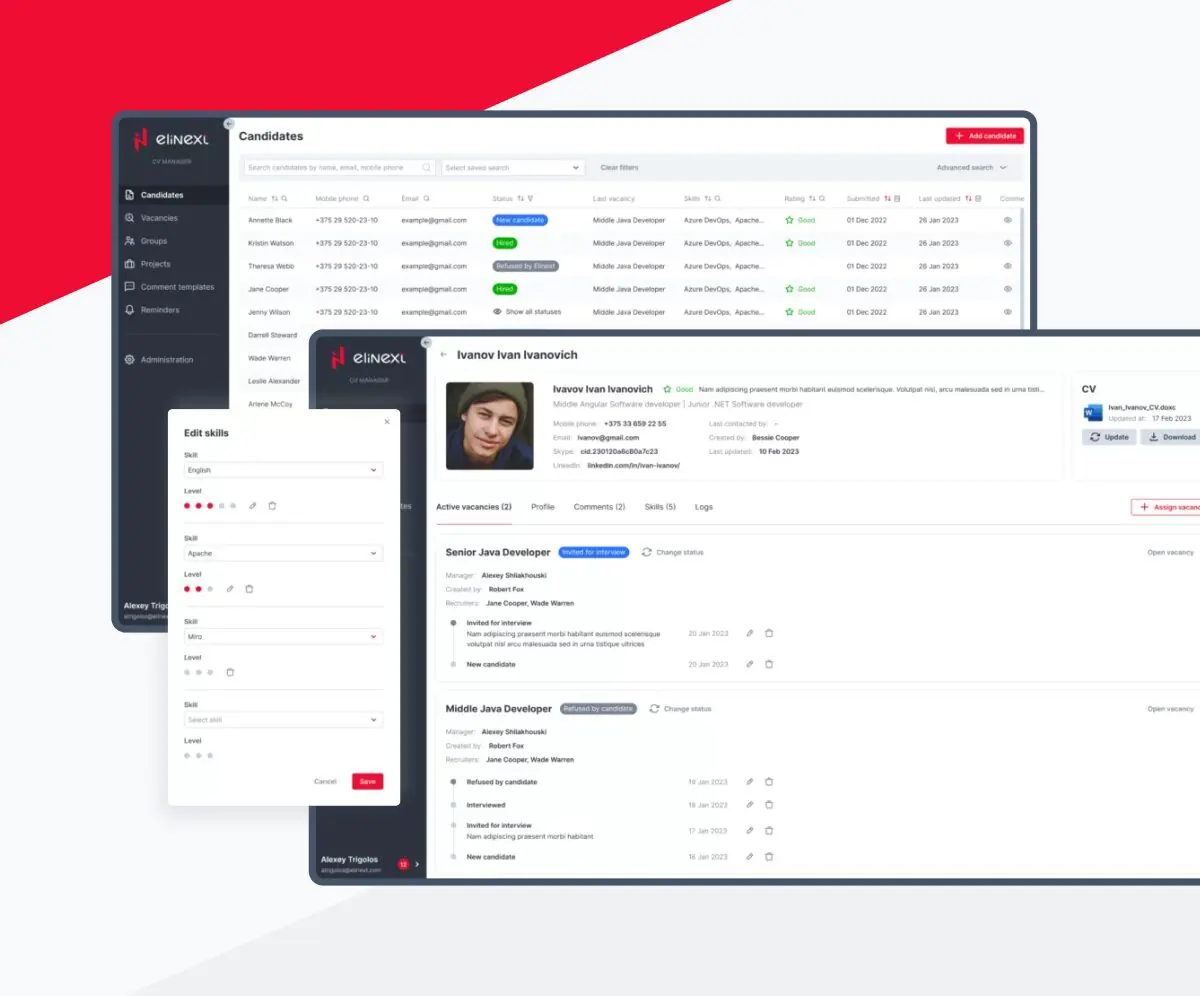
A custom Applicant Tracking System (ATS) to modernize recruitment. It automates vacancy and candidate management, LinkedIn parsing, status pipelines, comments, role-based access, admin configuration, and reminders—accelerating hiring and improving visibility.
bg pic
pic Live Demo
Leave Management
Elinext’s Leave Management app allows employees to request vacation or sick leave, view balances and colleagues’ schedules, while managers approve, report, and manage teams. It includes role-based modules for profile, requests, workflow, notifications, and analytics.
bg pic
pic Live Demo
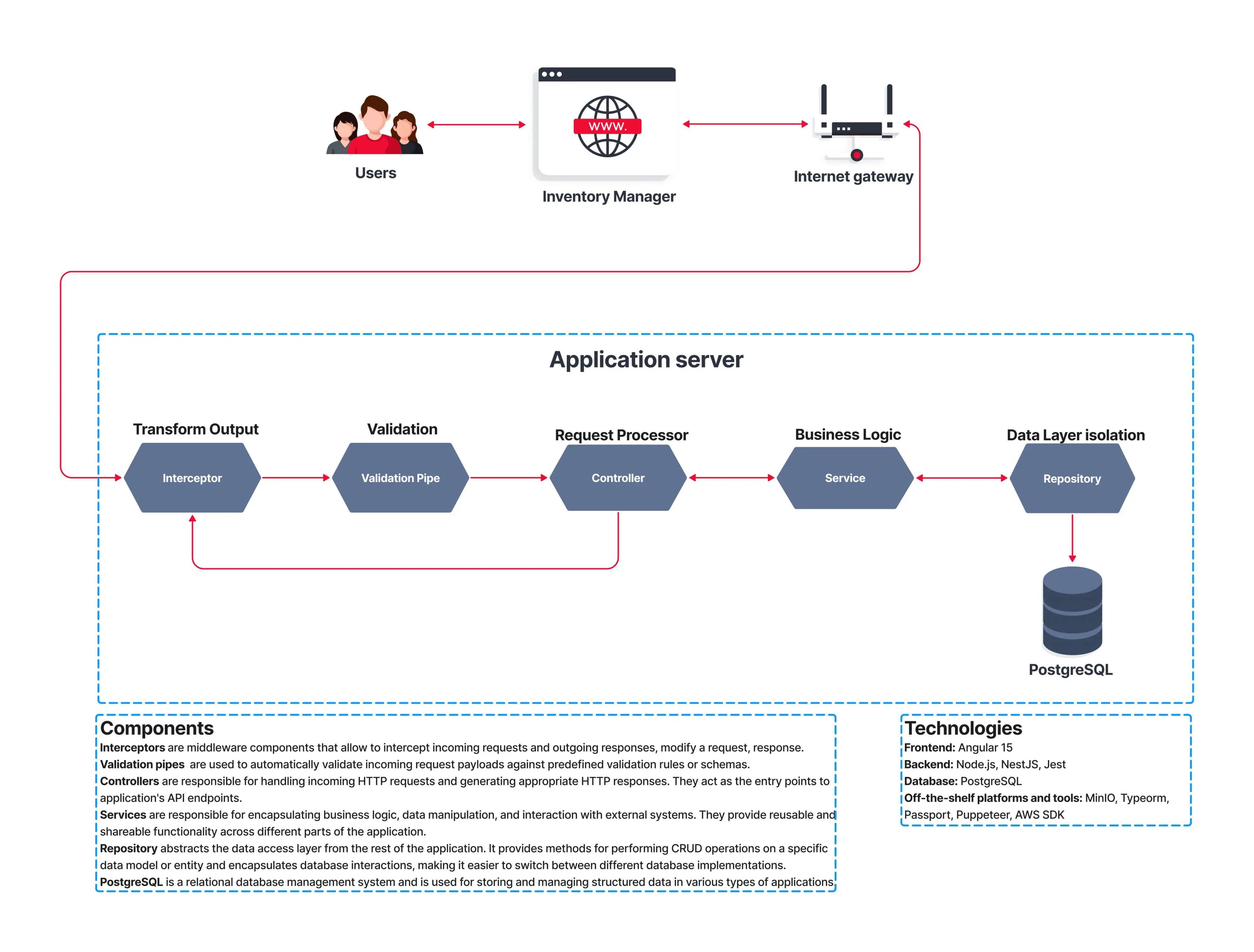
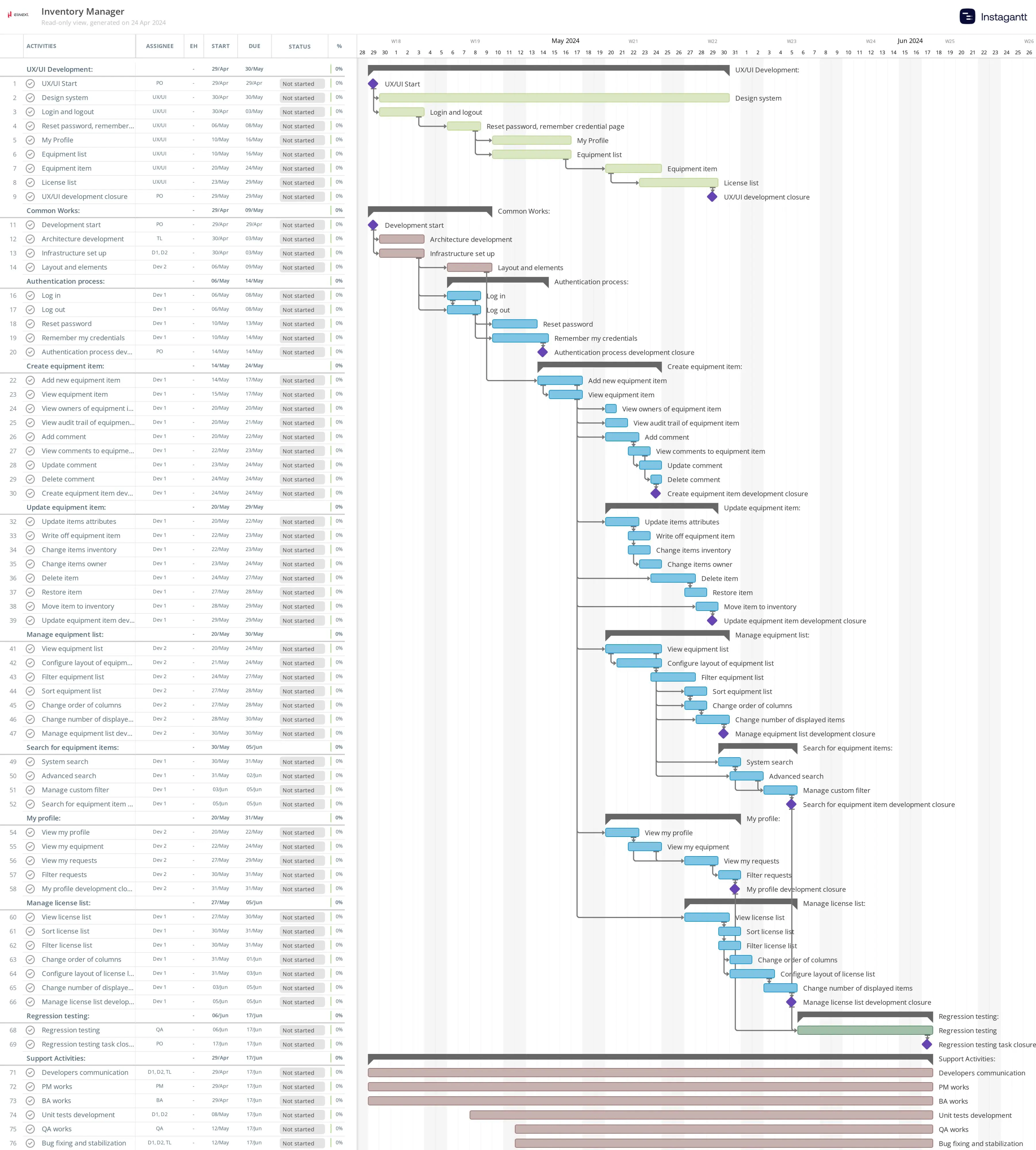
Inventory Management
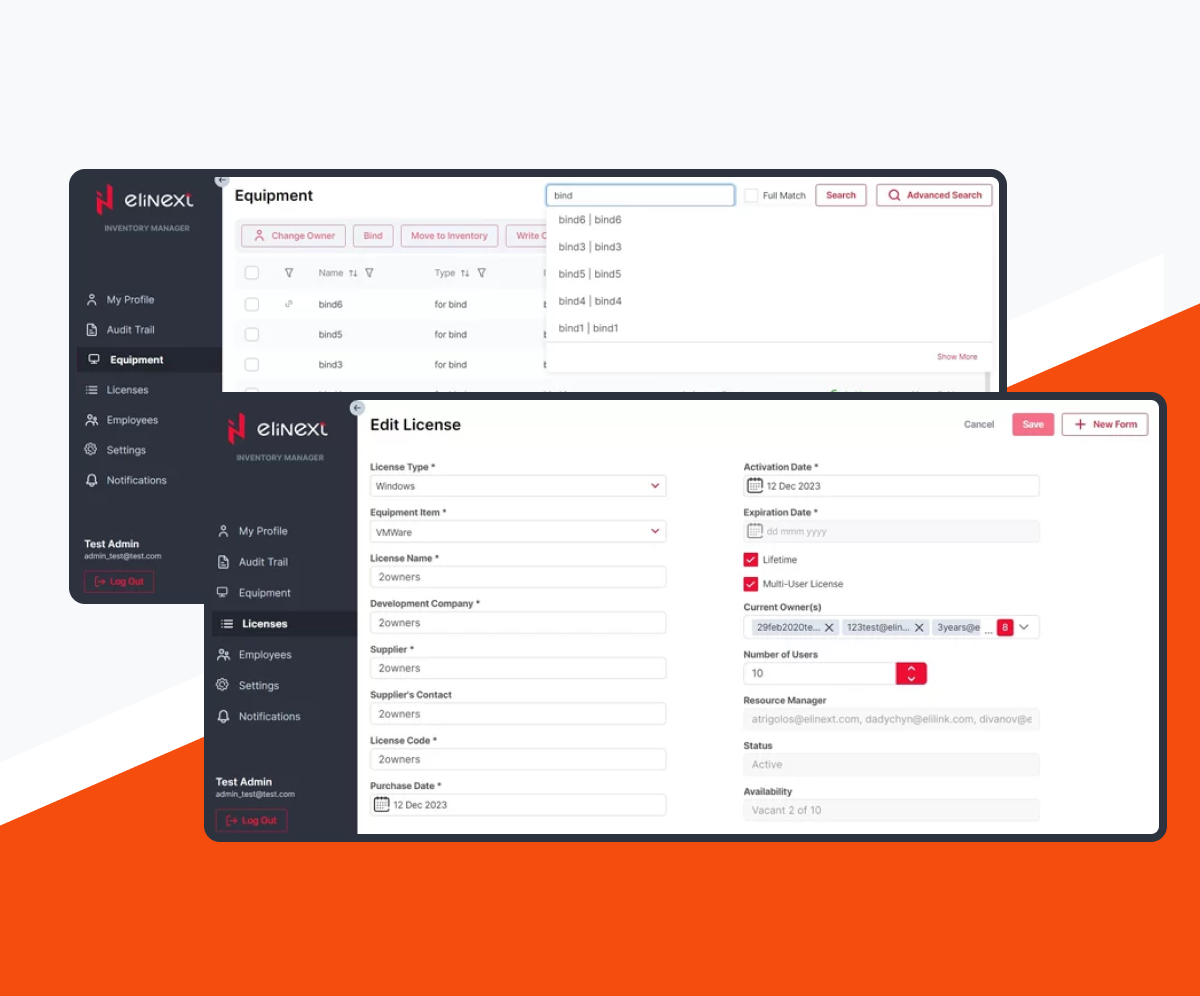
A web app for tracking equipment and software licenses, assigning and exchanging assets, managing inventories, audit trails, and notifications. Role-based access ensures transparency, efficiency, and asset control.
bg pic
pic Live Demo
Network Monitoring
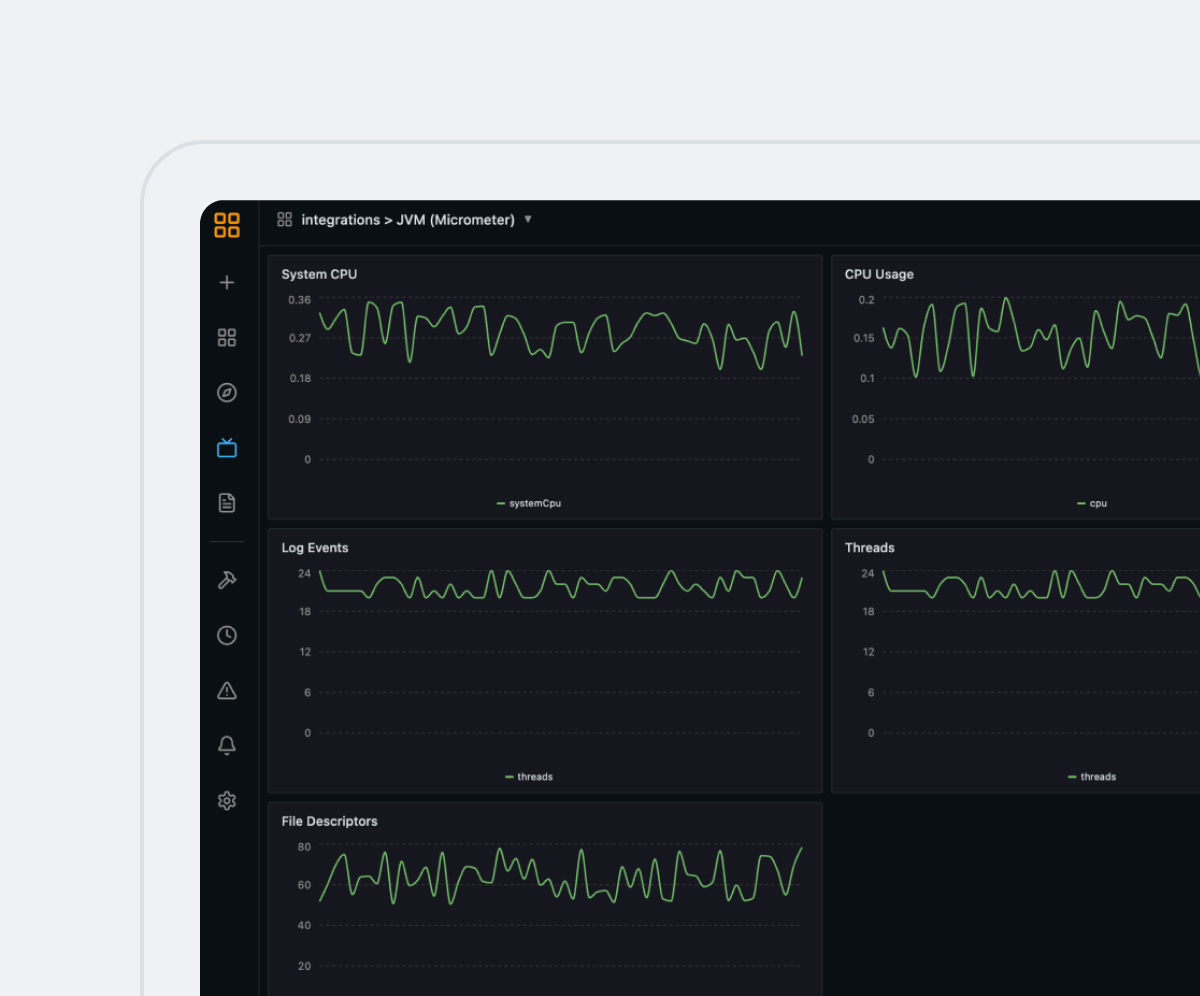
A web app to monitor IT infrastructure health in near-real time, detect failures, and send alerts. Features include role management, dashboards, metrics & stats, notifications (in-app & email) to speed fault response and reduce downtime.
bg pic
pic Live Demo
Access Management
A web app for managing users, roles, and application access. It supports OAuth 2.0, 2FA login, admin controls, audit logs, and external APIs—optimizing secure identity and access across internal systems.
bg pic
pic Live Demo
Notification Management
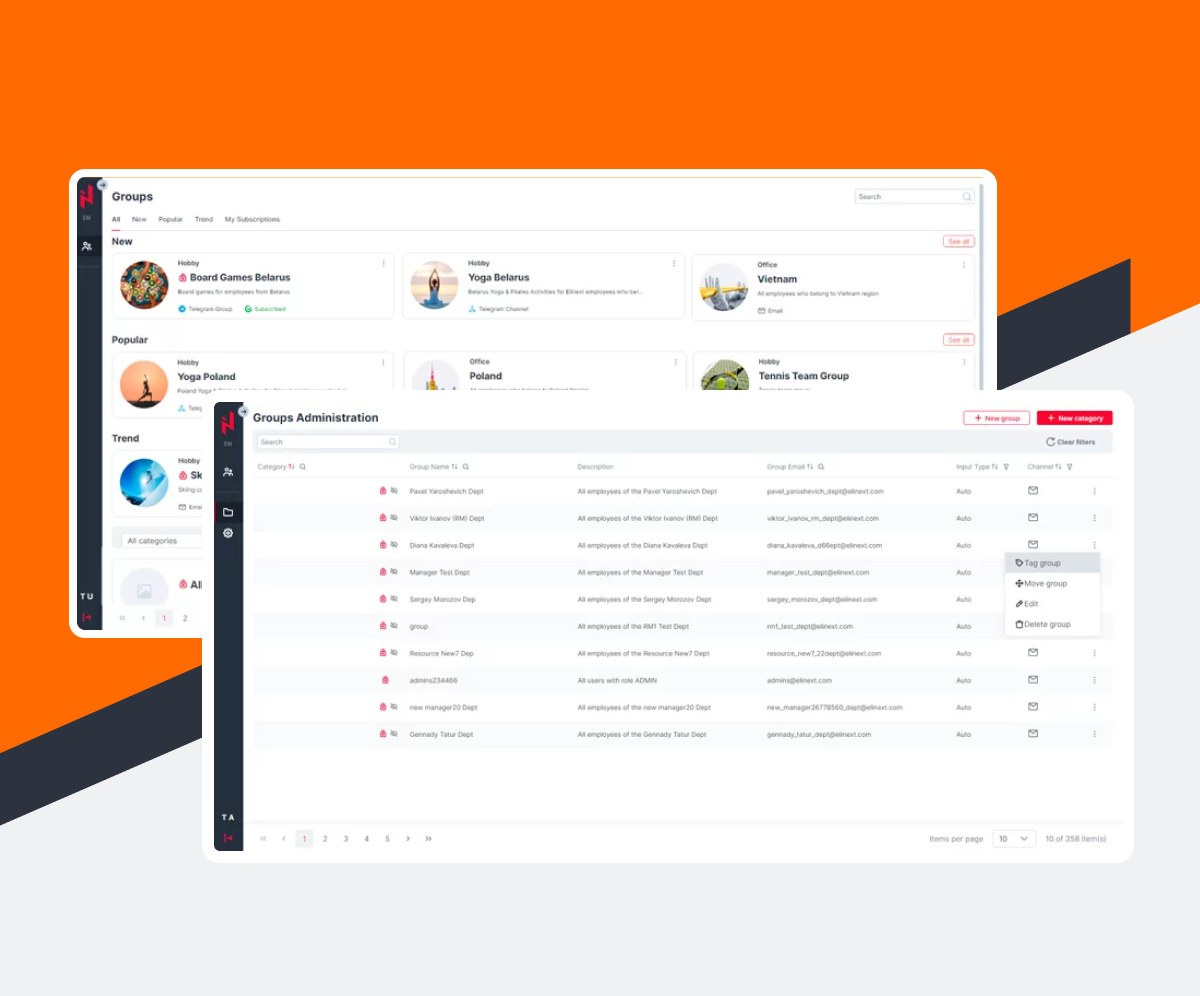
Elinext’s Notification Management app centralizes communication via email and Telegram. It auto-generates mailing lists synced with employee data, enables manual group creation, role-based moderation, and lets users manage subscriptions.
bg pic
pic Live Demo
Test Management
Elinext’s Test Management app centralizes test cases, test plans, and results. Teams track execution, manage defects, and monitor test coverage through configurable dashboards and reports.
Solutions
Elinext provides custom software solutions tailored to specific business goals. We combine deep industry expertise with innovative technologies to create scalable, high-performance systems that drive growth, improve workflows, and deliver measurable value.
bg pic
Data Science
Our data science services include developing predictive models for customer behavior analysis, implementing natural language processing for sentiment analysis in marketing, and utilizing machine learning algorithms for fraud detection in financial services. By leveraging these tailored solutions, we help you make informed decisions, optimize operations, and gain a competitive edge.
bg pic
Machine Learning
Elinext offers machine learning solutions tailored to your business needs. Our services include developing predictive models, automating data analysis, and enhancing decision-making processes. By leveraging machine learning, we help you uncover insights from your data, improve operational efficiency, and drive innovation across your organization.
bg pic
Artificial Intelligence
Elinext provides practical artificial intelligence (AI) solutions that address specific challenges. Our services include developing AI-powered tools for fraud detection in financial services, predictive maintenance in manufacturing, and patient data analysis in healthcare. By integrating AI into your existing systems, we help enhance decision-making processes and operational efficiency.
bg pic
Big Data
Elinext delivers industry-specific big data solutions that address real-world challenges. In retail, we analyze customer purchase histories to optimize inventory and personalize marketing. In healthcare, our systems process patient data to predict disease outbreaks and improve treatment plans. For logistics, we streamline operations by analyzing route efficiencies and delivery times. Our approach ensures that big data translates into actionable insights, enhancing decision-making and operational efficiency.
bg pic
Internet of Things
We create scalable Internet of Things (IoT) solutions to enhance connectivity, automation, and efficiency across industries. Our expertise includes developing custom software for smart homes, wearable devices, connected cars, healthcare monitoring systems, smart energy solutions, and more. We focus on creating secure, data-driven applications that integrate seamlessly with various hardware devices.
bg pic
Data Management
We deliver data management solutions tailored to complex business environments. For enterprises, we design systems that collect, clean, and structure large volumes of data for reliable analytics. In regulated industries, we ensure data governance, security, and compliance across the entire lifecycle. Our data management solutions help you maintain data quality, improve decision-making, and turn raw data into actionable insights.
bg pic
Business Intelligence
Elinext provides tailored Business Intelligence (BI) solutions that transform complex data into actionable insights. Our services include developing interactive dashboards, real-time analytics, and custom reporting tools. By integrating data from various sources, we help youidentify trends and improve operational efficiency across multiple industries.
bg pic
Data Analytics
Elinext provides data analytics solutions tailored to specific industry needs. Our services encompass sales trend analysis, marketing performance evaluation, financial risk assessment, supply chain optimization, and HR analytics. By integrating data from various sources, we help you derive actionable insights, enhance decision-making, and improve operational efficiency across multiple industries.
bg pic
Data Visualization
Elinext delivers custom data visualization solutions that transform complex datasets into intuitive, interactive dashboards. Our tools support various formats—infographics, heat maps, Gantt charts—enabling users to identify trends, monitor KPIs, and make informed decisions efficiently. By integrating data from multiple sources, we help you enhance operational clarity and strategic planning.
bg pic
Data Engineering
We provide you with data engineering services that transform raw data into structured, actionable insights. Our team designs and implements data pipelines that ensure data quality and availability. With Elinext, you can make informed decisions based on accurate and timely data, enhancing your operational efficiency and strategic planning.
bg pic
Data Governance
Elinext implements robust data governance frameworks to ensure data consistency, accuracy, and security. By establishing clear policies and procedures, we help you maintain data integrity, comply with regulations, and make informed decisions based on reliable data.
bg pic
Digital Transformation
Elinext guides companies through digital transformation by integrating modern technologies to replace outdated systems. We focus on automating workflows, enhancing data accessibility, and improving operational efficiency. Our solutions are tailored to align with your strategic goals, ensuring a seamless transition to a more agile and competitive digital environment.
bg pic
Database Administration
Our database administration services ensure your data is secure, accessible, and optimized for performance. We handle routine maintenance, backups, and performance tuning, allowing your team to focus on core activities. With Elinext, you gain a reliable data infrastructure that supports your operations and scales with your growth.
bg pic
CRM Development
Elinext develops custom CRM systems that reflect your unique customer engagement processes. By centralizing customer data and automating interactions, we help you enhance customer relationships and streamline sales activities. Our CRM solutions are designed to improve customer satisfaction and drive your business growth.
bg pic
ERP Development
Elinext offers ERP development services that integrate various business processes into a unified system. Our solutions streamline operations, improve data consistency, and provide real-time insights across departments. By customizing ERP systems to your specific needs, we help you enhance productivity and achieve operational excellence.
bg pic
SAP Development
Elinext provides tailored SAP development services to align SAP systems with your specific business processes. Our approach includes customizing functionalities, integrating third-party applications, and developing bespoke solutions to enhance operational efficiency. By focusing on your unique requirements, we ensure that your SAP environment supports your organizational goals effectively.
bg pic
Robotic Process Automation
We deliver RPA solutions tailored to streamline repetitive business operations. For finance and operations teams, we automate data entry, reporting, and reconciliation tasks to reduce manual effort. In customer support and back-office processes, we deploy software bots that operate across multiple systems with high accuracy. Our RPA solutions help you increase efficiency, minimize errors, and free up teams to focus on higher-value work.
bg pic
Smart Contracts
Elinext develops smart contracts to automate and secure transactions across various industries. Our services include designing, coding, and deploying contracts on platforms like Ethereum, ensuring they align with your specific operational needs. By leveraging smart contracts, you can reduce manual
bg pic
Cryptocurrency
Elinext provides cryptocurrency development services, including the creation of secure crypto wallets, trading platforms, and investment tools. Our solutions are designed to facilitate seamless transactions, enhance security, and support various cryptocurrencies. By leveraging our expertise, your clients can navigate the digital currency landscape with reliable and efficient tools.
bg pic
Blockchain
Elinext develops blockchain solutions that address specific business challenges. Our services include creating decentralized applications (dApps), implementing smart contracts, and integrating blockchain with existing systems. These solutions enhance data transparency, improve security, and streamline processes, providing you with reliable and efficient tools for their operations.
bg pic
Tokenomics
We design tokenomics models aligned with your product and ecosystem goals. For blockchain platforms, we define token utility, supply mechanics, and incentive structures that drive user participation. In decentralized ecosystems, we balance sustainability, governance, and long-term value creation. Our tokenomics frameworks help you build healthy economies that encourage adoption and long-term engagement.
bg pic
Decentralized Finance (DeFi)
We develop DeFi solutions that enable transparent and permissionless financial services. For lending and borrowing platforms, we implement smart contracts that automate transactions and reduce intermediaries. In asset management, we build protocols that ensure security, liquidity, and efficient yield generation. Our DeFi solutions help you create accessible financial systems with trustless execution and global reach.
bg pic
Decentralized App (dApp)
We build decentralized applications tailored to blockchain-native use cases. For Web3 platforms, we create secure and scalable dApps that interact seamlessly with smart contracts. In user-facing products, we focus on intuitive interfaces that simplify blockchain interactions. Our dApp solutions help you deliver transparent, tamper-resistant applications with improved user trust.
bg pic
Decentralized Exchange (DEX)
We develop decentralized exchanges designed for secure and efficient asset trading. For liquidity providers, we implement automated market makers and incentive mechanisms to support healthy trading volumes. In trading platforms, we focus on smart contract security and fast transaction execution. Our DEX solutions help you enable non-custodial trading with transparency and full user control over assets.
bg pic
Infrastructure Management
Elinext provides end-to-end infrastructure management services to ensure system stability, scalability, and efficiency. We optimize networks, servers, and cloud environments using tools like Docker, Kubernetes, and Terraform, enabling smooth operations and continuous performance improvement.
bg pic
Cybersecurity
Elinext delivers comprehensive cybersecurity services to protect digital assets and ensure data integrity. Our experts implement advanced threat detection, encryption, and compliance measures, using trusted frameworks and tools to safeguard systems against evolving cyber risks.

Navigating the Java Virtual Machine Memory Model: Unraveling Memory Management in Java

News
JVM memory architecture Understanding the JVM Memory Model in Java

In the vast landscape of programming languages, Java stands as a cornerstone, celebrated for its cross-platform compatibility and robust performance. At the heart of Java’s efficiency and consistency lies its sophisticated memory management system, an integral component of the Java Virtual Machine (JVM).

Welcome to an in-depth exploration of the JVM memory model—an intricate architecture that governs how Java applications allocate, use, and release memory resources. From the smallest applets to sprawling enterprise software, the memory model plays a pivotal role in ensuring the stability, performance, and responsiveness of Java applications.

This article embarks on a journey into the intricacies of the JVM memory model, offering a comprehensive understanding of the principles that drive memory allocation, object lifecycle, and garbage collection. Whether you’re a seasoned Java developer seeking to optimize your code’s memory usage or a newcomer intrigued by the mechanisms underpinning Java’s versatility, this exploration will shed light on the underlying magic that enables Java’s “write once, run anywhere” promise.

We’ll dissect the various memory regions within the JVM, each with a specific purpose and role in the execution of Java programs. From the method area that stores class structures to the heap where objects live, and the thread stacks that facilitate multi-threading, we’ll uncover how these components interact to create a seamless execution environment for your code.

Understanding the JVM memory model extends beyond efficient programming; it’s a gateway to crafting more robust and scalable applications. In a world where resource optimization and responsive user experiences are paramount, comprehending how Java manages memory is an indispensable skill for developers across industries.

Join us as we peel back the layers of the Java Virtual Machine memory model, revealing the mechanisms that make Java applications efficient, adaptable, and truly platform-independent. Whether you’re embarking on a new Java project or looking to enhance your existing skills, this journey into the heart of memory management will undoubtedly enrich your programming prowess.

JVM

The Java Virtual Machine (JVM) is a key component of the Java platform that enables the execution of Java applications. It provides an environment that abstracts the underlying hardware and operating system, allowing Java programs to be written once and run anywhere (WORA). The JVM interprets and executes Java bytecode, which is a compiled form of Java source code.

Key features and components of the JVM:

1. Class Loader: Loads classes and resources into memory as needed. The class loader subsystem manages class loading, linking, and initialization.

2. Execution Engine: Executes Java bytecode. Depending on the JVM implementation, bytecode is either interpreted or compiled to native machine code for execution.

3. Runtime Data Areas:

  • Method Area: Stores class metadata, constants, and static variables.
  • Heap: Manages object instances and arrays, including the Young and Old Generations.
  • Thread Stacks: Each thread has its own stack, used for method call and local variable storage.
  • PC Registers: Store the address of the currently executing instruction.
  • Native Method Stacks: For native methods (methods implemented in languages other than Java).

4. Garbage Collection (GC): Reclaims memory by identifying and removing objects that are no longer reachable. Different GC algorithms provide various trade-offs between throughput and pause times.

5. Just-In-Time (JIT) Compiler: Compiles bytecode into native machine code at runtime. This improves execution speed compared to pure interpretation.

6. Java Native Interface (JNI): Allows Java code to interact with native code and libraries written in languages like C and C++.

7. Java API: A rich set of standard libraries and classes that provide core functionality for Java applications.

8. Security Manager: Enforces security policies to protect against unauthorized access and malicious behavior.

9. Java Monitoring and Management Tools: Provides tools for monitoring and managing the JVM, including profiling, diagnostics, and performance analysis.

10. Threading and Synchronization: Enables multi-threading and synchronization, allowing developers to write concurrent and multi-threaded programs.

The JVM ensures platform independence by abstracting hardware-specific details. Java applications are compiled into bytecode, which is executed by the JVM on the target platform. This bytecode is portable and can be run on any system with a compatible JVM implementation, making it a key area of expertise for a Java development company.

Different vendors provide their own implementations of the JVM, each with variations in performance, features, and optimizations. Examples of popular JVM implementations include Oracle HotSpot, OpenJ9, and GraalVM.

Overall, the JVM is the foundation that enables Java’s “write once, run anywhere” promise, making it one of the key factors contributing to Java’s popularity and success.

JVM memory model

The Java Virtual Machine (JVM) memory is divided into several distinct regions or memory areas, each serving a specific purpose. These memory areas collectively manage the allocation, usage, and deallocation of memory for running Java applications. Here are the main JVM memory areas:

Class Area (Method Area):

  • Also referred to as the “Method Area” or “Class Metadata Area”.
  • Stores metadata about classes, methods, fields, and other structural information of loaded classes.
  • Shared among all threads and is read-only once classes are loaded.
  • In Java 8 and later, the “PermGen” space from older versions was replaced with “Metaspace,” which is a more flexible and dynamically sized memory area.

Heap:

  • The Heap serves as the area within runtime where objects are allocated.
  • Divided into the “Young Generation” and the “Old Generation” (Tenured Generation).
  • The Young Generation further consists of the “Eden Space” and two “Survivor Spaces”.
  • Most of the objects start in the Young Generation and may be promoted to the Old Generation as they survive garbage collection cycles.
  • Managed by the Garbage Collector to reclaim memory occupied by objects that are no longer referenced.

Eden Space:

  • Part of the Young Generation.
  • Initial allocation area for objects.
  • Objects that survive a minor garbage collection are moved to the Survivor Spaces.

Survivor Spaces:

  • Also part of the Young Generation.
  • Objects that survive a garbage collection in the Eden Space are moved to one of the Survivor Spaces.
  • Objects that continue to survive multiple cycles might eventually be promoted to the Old Generation.

Old Generation (Tenured Generation):

  • Holds long-lived objects that have survived multiple garbage collection cycles.
  • Larger and more persistent than the Young Generation.
  • Major garbage collection events (Full GC) target this area.

Metaspace:

  • Replaced the Permanent Generation (PermGen) starting from Java 8.
  • Stores class metadata, method information, and other runtime structures.
  • Dynamically sized and managed by the JVM, typically using native memory.
  • Helps prevent issues related to memory leaks caused by inadequate PermGen space sizing.

Native Method Stacks:

  • Each thread running in the JVM has its own native method stack.
  • Contains information about native methods used in the application.
  • Memory for these stacks is allocated by the operating system.

Thread Stacks:

  • Each thread has its own private Java stack, containing information about method calls, local variables, and state.
  • Stack frames are pushed and popped as methods are entered and exited.

Program Counter Registers:

  • Each thread has its own program counter (PC) register.
  • Keeps track of the currently executing instruction.

Code Cache:

  • The code cache is used to store compiled native code generated by the Just-In-Time (JIT) compiler.
  • It helps improve execution performance by storing compiled versions of frequently executed bytecode.
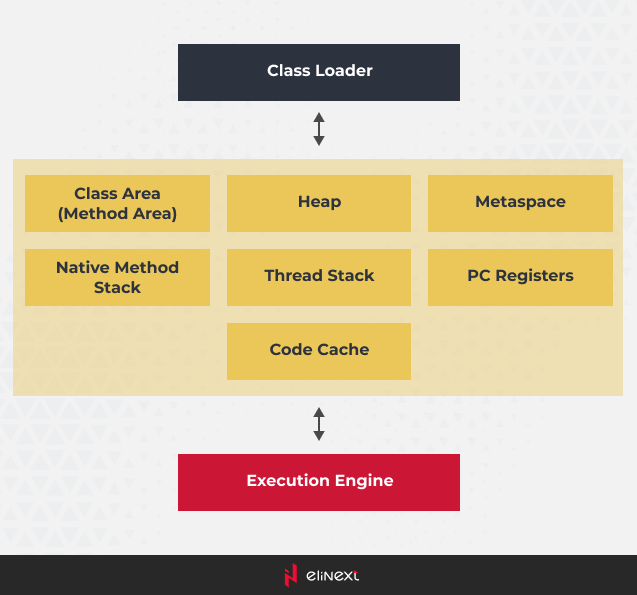
These memory areas work together to manage the memory consumption of a Java application, including the storage of objects, method metadata, and other runtime information. The Java Garbage Collector plays a crucial role in maintaining the memory by identifying and collecting unreferenced objects. Different garbage collection algorithms and strategies are used to optimize memory management and application performance.

Class Area (Method Area)

The “Class Area”, also known as the “Method Area”, is a region of memory within the JVM that stores metadata and information about loaded classes, methods, fields, and other structural elements of Java programs. It’s a critical part of the JVM’s memory structure and is responsible for maintaining the runtime representation of classes and their related data.

Key characteristics of the Class Area:

  • Metadata Storage: The Class Area stores information about classes themselves, not instances of those classes. This includes data like method signatures, field names, access modifiers, and other structural details.
  • Shared Across Threads: The Class Area is shared among all threads running in the JVM. This is because classes and their metadata are common to all instances of a class.
  • Read-Only After Loading: Once classes are loaded and their metadata is stored in the Class Area, it becomes read-only. This means that the structural information of classes is not typically modified at runtime.
  • Permanent Generation and Metaspace: In older versions of Java (up to Java 7), the Class Area was part of the “Permanent Generation” (PermGen) memory space. However, starting from Java 8, the concept of PermGen was replaced by “Metaspace,” which is a more flexible and dynamically sized memory area for class metadata storage.
  • Metaspace: Metaspace is managed by the JVM and can grow or shrink as needed based on the application’s class loading requirements. It helps prevent issues related to memory leaks caused by inadequate PermGen space sizing.
  • Garbage Collection: While class instances are managed by the garbage collector in the “Heap” memory area, the metadata itself in the Class Area or Metaspace is managed separately. As classes become unreachable (e.g., the corresponding class loader is no longer reachable), the JVM can reclaim the memory occupied by their metadata.
  • Native Memory: Metaspace uses native memory (memory from the operating system) to store class metadata, which can help improve memory efficiency compared to the older PermGen area.

It’s important to note that while the Class Area/Metaspace is important for maintaining class information, it’s usually not a primary concern for most Java developers. JVM memory management, including class loading and garbage collection, is typically handled transparently by the JVM itself.

Heap

The Java Virtual Machine (JVM) heap is the runtime data area where Java objects are allocated and managed during the execution of a Java application. The heap is a crucial component of the JVM’s memory management system, responsible for handling memory allocation, object lifecycle, and garbage collection.
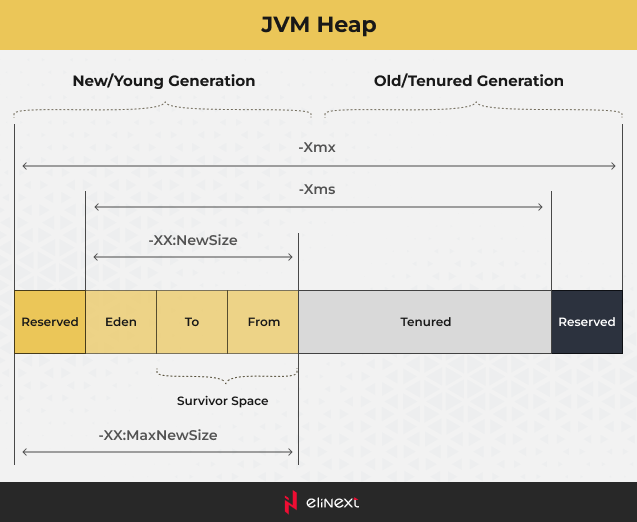
Here are some key points about it:

  • Memory Allocation: When an object is created in Java using the ‘new’ keyword, memory is allocated for that object on the heap. The allocation typically happens in the Eden space, which is specifically designed for short-lived objects.
  • Generational Garbage Collection: The heap is managed using a generational garbage collection approach. This means that objects are categorized into different generations based on their age and how long they have been alive. The main idea is that young objects (recently created ones) are more likely to become garbage, while older objects tend to live longer. Different garbage collection strategies are applied to each generation.
  • Minor and Major Garbage Collections: Minor (young) garbage collections are responsible for cleaning up short-lived objects in the Eden and Survivor spaces. When the Eden space becomes full, a minor collection is triggered to identify and reclaim memory from short-lived objects that are no longer reachable. Objects surviving multiple minor collections in the Survivor spaces are eventually promoted to the Tenured space. Major (old) garbage collections are responsible for cleaning up the Tenured space and are less frequent but more time-consuming.
  • Heap Size Configuration: The JVM heap size can be configured using command-line options such as ‘-Xms’ (initial heap size) and ‘-Xmx’ (maximum heap size). Setting appropriate values for these options is important for efficient memory usage and application performance.
  • Out of Memory Errors: If the heap becomes exhausted and there is not enough memory to allocate new objects or perform garbage collection, the JVM throws an “Out of Memory” error.
  • Tuning: Tuning the JVM heap and garbage collection settings is a critical aspect of optimizing application performance. Different applications have different memory usage patterns, so it’s important to analyze and adjust these settings based on the specific needs of your application.

In summary, the JVM heap is the memory area where Java objects are stored and managed. The heap’s structure and garbage collection mechanisms are designed to optimize memory usage and object lifecycle management, contributing to the overall efficiency and stability of Java applications.

Eden Space

The heap is divided into several regions, with one of them being the Eden space. The Eden space is where newly created objects are initially allocated. Upon initialization, newly created objects are allocated in the Eden space. Over time, if these objects survive a garbage collection cycle, they may be promoted to older generations (like the Survivor and Tenured spaces) in the heap.

The purpose of dividing the heap into different spaces is to optimize memory management and garbage collection. Objects that don’t survive very long are quickly deallocated from the Eden space during a minor garbage collection, freeing up space for new objects. Objects that do survive are moved to the Survivor space and eventually to the Tenured space if they continue to survive.

The Eden space is usually part of a generational garbage collection scheme. This scheme is based on the observation that most objects become unreachable shortly after they are created, so it’s efficient to separate short-lived objects (allocated in Eden) from long-lived objects (promoted to Survivor and Tenured spaces).

Survivor Spaces

One of the other heap’s regions is the Survivor space. Survivor spaces are part of the generational garbage collection strategy used by the JVM to manage memory and improve garbage collection efficiency. Survivor spaces play a crucial role in this strategy, particularly in managing the lifecycle of short-lived objects.

If the Eden space becomes full after a garbage collection cycle, objects that are still alive (surviving objects) are moved to the Survivor spaces. The purpose of the Survivor spaces is to act as a buffer between the Eden space and the Old generation. Survivor spaces hold objects that have survived at least one minor garbage collection cycle.

The JVM uses these spaces to identify and separate objects that continue to survive and objects that become garbage relatively quickly. It also adjusts the aging of objects in the Survivor spaces based on their survival patterns. Objects that are still alive after several minor collections are considered older and are more likely to be promoted to the Old generation. This helps optimize garbage collection by minimizing the overhead of moving short-lived objects while promoting objects that are likely to be long-lived.

The sizes of the Survivor spaces can be configured using JVM command-line options such as ‘-XX:SurvivorRatio’, which determines the ratio of Eden space to each Survivor space.

In summary, Survivor spaces help manage the lifecycle of objects by separating short-lived objects from long-lived ones, allowing for more efficient memory management and garbage collection.

Old Generation (Tenured Generation)

Objects that have survived a certain number of minor garbage collection cycles in the Young Generation (Eden and Survivor spaces) are promoted to the Old Generation. This promotion process is based on the assumption that objects that have survived multiple collections are likely to live for a longer time. These objects are considered long-lived or tenured objects. They are often important data structures, application state, or objects with prolonged lifetimes.

The Old Generation is subject to major garbage collection, also known as a full garbage collection or Old collection. Major collections are less frequent but more time-consuming compared to minor collections. They involve examining and collecting garbage from the Old Generation, compacting memory, and freeing up space. If the Old Generation becomes full and there’s not enough space for new objects or for garbage collection, the JVM may throw an “Out of Memory” error specific to the Old Generation.

In summary, the Old Generation (Tenured space) in the JVM heap is responsible for storing long-lived objects. Proper management and tuning of the Old Generation are crucial for overall JVM performance. This includes setting the appropriate heap size for the Old Generation using the -XX:MaxHeapSize option and monitoring the memory usage patterns of long-lived objects.

Metaspace

Metaspace refers to a memory area in the JVM that’s used to store class metadata and other reflective information, replacing the older “PermGen” (Permanent Generation) memory area in Java 8 and later versions. The PermGen space was used in older Java versions to store class metadata, but it had limitations and could lead to issues like “OutOfMemoryError: PermGen space”.

Metaspace, introduced in Java 8, is a more flexible and dynamic memory region that’s allocated from the native memory of the operating system. Here are some key points about JVM Metaspace:

  • Class Metadata Storage: Metaspace is responsible for storing class metadata, such as class names, method names, field names, annotations, and other reflective information. This metadata is necessary for Java’s dynamic features, including reflection and runtime type information.
  • No Fixed Size: Unlike the PermGen space, which had a fixed size, Metaspace dynamically allocates memory from the operating system as needed. This helps prevent issues like “PermGen space” errors and allows Java applications to utilize available system memory more efficiently.
  • Automatic GC: Metaspace memory is managed by the JVM’s garbage collector. It’s important to note that the GC for Metaspace mainly focuses on reclaiming memory used by discarded class loaders and their associated metadata.
  • Tuning: While Metaspace doesn’t have a fixed maximum size like PermGen, it can still be tuned using JVM command-line options like ‘-XX:MaxMetaspaceSize’ to specify an upper limit for Metaspace memory usage.
  • Native Memory: Metaspace is allocated from the native memory of the operating system, which means it’s not subject to the same memory constraints as the Java heap. However, excessive Metaspace memory usage could potentially affect the overall performance of the application or the system.
  • Metaspace Fragmentation: Metaspace does not suffer from the same fragmentation issues that could occur with PermGen space, since it’s allocated from the native memory pool.

In summary, Metaspace is an improvement over the older PermGen memory area. It dynamically allocates memory from the native memory pool, making it more flexible and efficient compared to PermGen’s fixed-size allocation from the JVM heap. Metaspace also benefits from better memory management and garbage collection, leading to improved application stability and reduced memory-related issues.

Native Method Stacks

Native method stacks are a part of the memory management system that is separate from the Java heap. These stacks are used to manage and execute native methods, which are methods written in languages other than Java, such as C or C++. Native methods are often used to interface with system-level operations or to take advantage of platform-specific functionalities.

Here’s how native method stacks work and how they differ from the Java heap:

Native Method Stacks:

  • Native method stacks are used to manage the execution of native methods. Each thread in a Java application has its own native method stack associated with it.
  • These stacks contain information required to execute native methods, including parameters, local variables, and function call information.
  • The size of each native method stack is typically smaller than the Java thread’s stack (which contains Java method calls), but it depends on the platform and configuration.

Java Heap vs. Native Method Stacks:

  • Java Heap: The heap is used to store Java objects and their associated data. It’s the region of memory where most of the Java application’s runtime data is stored.
  • Native Method Stacks: These stacks are used exclusively for executing native code. They are separate from the heap and the Java thread’s stack.
  • Java Thread Stack: Each Java thread has its own stack for managing Java method calls. This stack is used to store local variables, method call information, and other data related to Java method execution.

Memory Separation:

  • Native method stacks are allocated in native memory, often outside the control of the JVM’s garbage collector.
  • The separation of memory for native method stacks helps prevent conflicts between the execution of native code and the management of Java objects.

It’s important to note that managing native method memory can be more challenging than managing Java heap memory, as the JVM has less control over native code execution and memory management. Incorrect memory management in native code can lead to crashes, memory leaks, and other unpredictable behavior.

As with other memory-related aspects of the JVM, understanding and managing native method stacks effectively can require careful consideration of the application’s architecture, workload, and platform. Always refer to the documentation for your specific JVM version and platform for accurate and up-to-date information on native method stack management.

Thread Stacks

Thread stacks play a crucial role in managing the execution of Java threads in the JVM. Each thread in a Java application has its own dedicated stack space, known as a thread stack. Thread stacks are used to store local variables, method call information, and other data related to the execution of Java methods.

Here’s a breakdown of thread stacks in the JVM:

Thread Stack Basics:

  • Each Java thread has its own thread stack, which is a region of memory dedicated to that thread’s execution.
  • The thread stack is divided into frames, with each frame corresponding to a method invocation. It contains information about the method’s local variables, its state, and the location to return once the method completes.

Role of Thread Stacks:

  • Thread stacks are used to manage the execution of Java methods and to track the flow of program control within each thread.
  • When a new method is called, a new frame is added to the thread stack to hold information about that method’s execution.
  • As methods are called and return, frames are pushed onto and popped off the stack.

Stack Size:

  • The size of each thread’s stack is platform-dependent and can be configured during JVM startup using command-line options like -Xss followed by a value representing the stack size.
  • A larger stack size allows deeper method call hierarchies but consumes more memory.

Stack Overflows:

  • A stack overflow occurs when the thread stack runs out of space due to excessive method invocations, leading to an exception (usually StackOverflowError).
  • Recursive methods that don’t have a proper base case can trigger stack overflows.

Thread stack management is an essential aspect of the JVM’s memory management and plays a role in maintaining the concurrency and parallelism of a Java application. It’s important to consider stack sizes carefully, especially when dealing with applications that require deep call hierarchies or multi-threading.

Program Counter Registers

The Program Counter (PC) is a fundamental concept in computer architecture that exists in various computing systems, including the JVM, and it plays a crucial role in controlling the flow of program execution.

Here’s an explanation of the Program Counter and its role:

Program Counter (PC):

  • The Program Counter, also known as the Instruction Pointer (IP) in some architectures, is a special register that holds the memory address of the next instruction to be executed by the CPU.
  • As the CPU executes instructions, the PC is automatically incremented to point to the next instruction in memory.
  • The PC allows the CPU to sequentially fetch and execute instructions, which is the fundamental operation in a computer’s operation.

Function in Control Flow:

  • The PC is essential for controlling the flow of a program’s execution. It establishes the sequence in which instructions are executed.
  • When a method or function call is encountered, the PC stores the address of the first instruction in that method’s code.

Role in the JVM:

  • In the context of the JVM, the Program Counter keeps track of the current execution point within a method’s bytecode.
  • When a Java method is invoked, the PC points to the first instruction of that method.
  • As the method executes, the PC is updated to point to the next instruction to be executed.

Not Stored in Heap:

  • The Program Counter is not part of the memory management system, and it is not stored in the heap or any other memory region.
  • It’s a special-purpose register within the CPU itself.

Concurrency and Multithreading:

  • In a multithreaded environment like the JVM, each thread has its own Program Counter.
  • Threads execute concurrently, and their respective Program Counters determine the instructions they execute.

Exception Handling:

  • When an exception occurs, the PC helps determine the correct exception-handling code to execute.

The Program Counter is a fundamental concept that is managed by the CPU and is not explicitly managed by software developers. Understanding the Program Counter’s role helps developers grasp how programs are executed and how control flow is managed within a computing system.

Code Cache

Code Cache is a separate memory area within the JVM that is used to store compiled native code generated by the Just-In-Time (JIT) compiler, a dynamic compiler that translates Java bytecode into optimized machine code for execution by the CPU. The primary purpose of the Code Cache is to improve the performance of Java applications by caching these compiled code snippets.

Here’s an explanation of the Code Cache in the context of the JVM:

  • The Code Cache is a memory area used to store compiled machine code generated by the JIT compiler from Java bytecode.
  • The JIT compiler takes frequently executed Java bytecode and compiles it into native machine code to improve execution speed.
  • The compiled code in the Code Cache is optimized for the underlying hardware architecture.
  • By storing the compiled code, the JVM avoids the need to repeatedly interpret the same bytecode, resulting in faster execution times for frequently used methods.

It’s important to note that the Code Cache is a separate memory area from the Java heap. While the Java heap stores objects and their data, the Code Cache stores compiled native code. This separation helps optimize both memory usage and execution speed.

The Code Cache has a limited size, and it’s important for the JVM to manage it effectively to avoid running out of space. The contents of the Code Cache can be cleared and recompiled as needed based on factors such as method profiling and usage patterns.

Conclusion

To sum it up, the JVM memory model is the backbone of how Java manages memory while your programs run. Its well-structured organization ensures that your code runs efficiently and doesn’t waste resources. Just as a well-organized workspace boosts productivity, the memory model’s careful allocation and smart cleanup keep Java applications running smoothly.

From the way it handles objects’ lifecycles in the Heap to optimizing code execution with the Code Cache, the memory model is like a symphony conductor, orchestrating various memory areas to create harmonious software performance. Its dynamic nature adapts to different workloads, and its seamless management frees developers from memory-related worries, allowing them to focus on building innovative applications.

In essence, the JVM memory model isn’t just about memory—it’s about efficiency, portability, and a foundation that empowers Java to thrive in a diverse range of computing environments. As technology evolves, the memory model remains a steadfast pillar of Java’s success, ensuring that the language continues to excel in the ever-evolving world of software development.

Table of content
Start Your Project with 25% Off

Reach out to our team and receive a 25% discount on your first project with Elinext.

Get 25% Off

Contact Us

img
Regional Account Manager
img
Senior Sales and Account Manager
img
IT Consultant
img
Veronika Kruglikova
Software Projects Consultant
img
Anna Gaba
Senior IT Business Manager
img
Key Account Manager

    Full Name *
    Corporate Email *
    Company Name *
    Message *
    Max file size 10MB,
    up to 5 files of 20MB overall
    Supported format:
    doc, docx, xls, xlsx, ppt, pptx, pps, ppsx, odp, jpeg, jpg, png, psd, webp, svg, mp3, mp4, webm, odt, ods, pdf, rtf, ttxt, csv, log
    Join our team
    Upload your CV
    For public relations
    pr@elinext.com
    1100+
    Delivered projects
    350+
    Clients worldwide
    700+
    In-house developers
    29+
    Years in industry
    img
    img
    img