



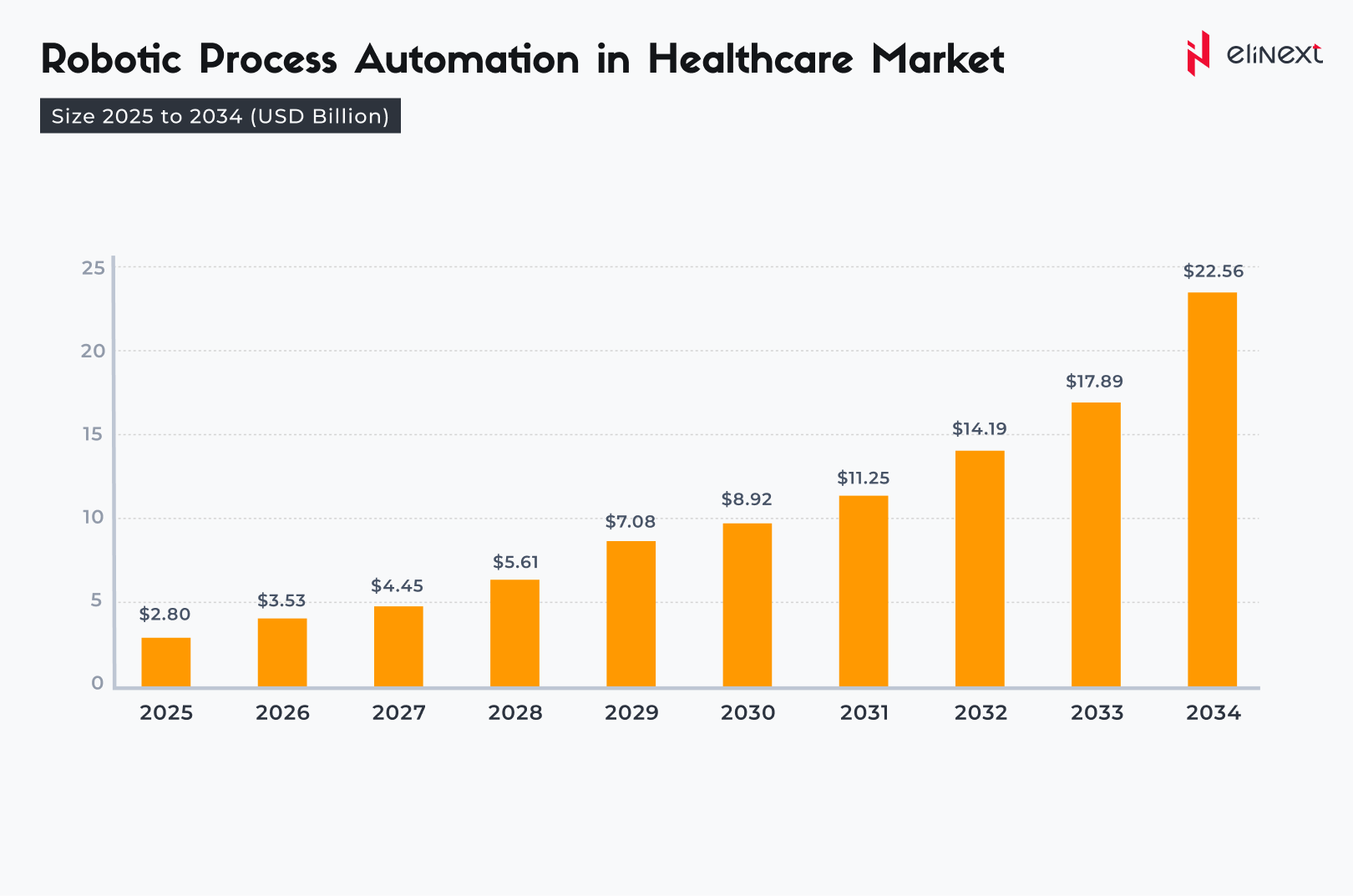
Robotic Process Automation (RPA) has evolved from a luxury into a healthcare standard. The market is set to skyrocket from $2.80 billion in 2025 to $22.56 billion by 2034. Bots now handle most routine work like insurance claims and data verification. This shift slashes operating costs and eliminates documentation errors. Ultimately, RPA in healthcare frees doctors from paperwork burnout, allowing them to focus on what matters most: saving lives.
Key Takeaways
- Implementing robotic process automation in healthcare can lead to a ROI of 30% to 200% within the first year by automating billing and administrative tasks.
- Bots process medical data 15x faster than humans with 0% error rates, significantly improving the quality of healthcare analytics solutions.
- Implementing RPA in healthcare can revolutionize claims management by automating 85% to 95% of manual, labor-intensive tasks.
How Does RPA Function in Healthcare
Robotic process automation in the healthcare industry uses bots to mimic human actions: logging into apps, moving files, and extracting data from EHRs. They act as a digital workforce, connecting siloed programs without changing existing infrastructure. This creates a bridge that ensures instant data flow between pharmacies, labs, and doctors, making fragmented systems work as one efficient unit.
Ready to automate your clinic? Our RPA and EHR software development company is here to build a custom roadmap for your digital transformation.
Key Robotic Process Automation Use Cases in Healthcare
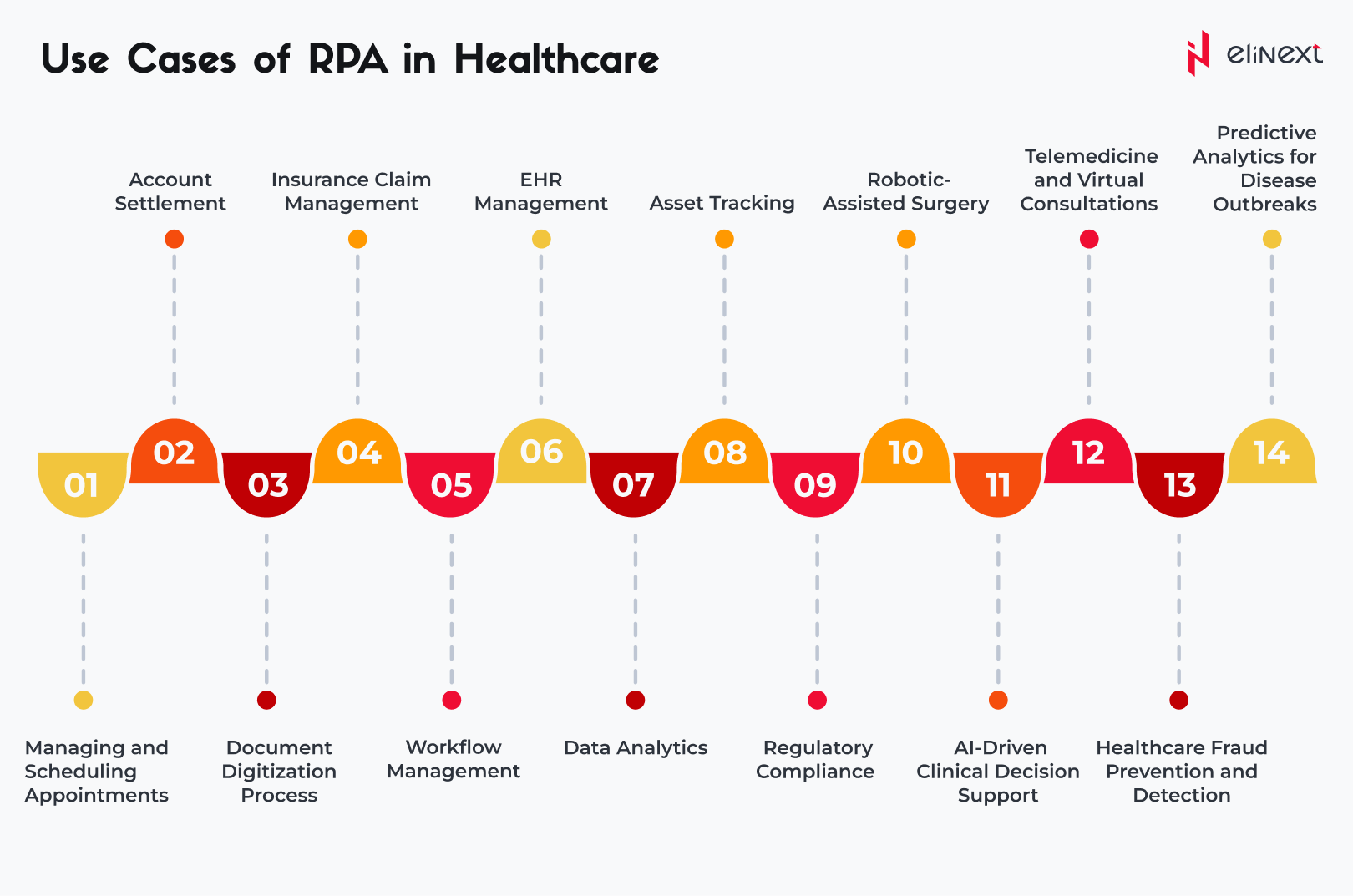
Bots take over repetitive, data-heavy chores. From managing bills to coordinating patient care, they empower providers to prioritize patient outcomes and clinical work. Let’s look at the most common robotic process automation use cases in healthcare.
-
HR Management
RPA solves staff shortages by automating clinical & workforce management solutions. Bots sync systems to handle payroll, performance, and shift tracking. This helps leaders spot talent gaps and balance workloads, ensuring staff stay focused and paid on time without the administrative burnout.
-
Billing & Payment Management
RPA bots speed up medical billing by auto-collecting disease codes, prescriptions, and records from various sources. By merging this data instantly, they handle payments for visits and meds faster and without human error, ensuring a seamless financial cycle for both clinics and patients.
-
Insurance Eligibility Verification
Insurance verification is a major burden as patient numbers rise. RPA bots simplify this by pulling data like IDs and names directly from CRMs and EHRs. They can even auto-email insurers to confirm benefits instantly, saving staff from manual checks and speeding up the intake of new patients.
-
Post-discharge Management
After-care is vital but hard to track. RPA and AI in healthcare automate this by sending personalized discharge reminders via email or text. Bots track prescriptions and follow-ups, ensuring patients stay on track. This proactive support boosts recovery rates and keeps patient satisfaction high.
-
Streamlined Data Integration
Manual data entry is slow and risky. RPA and AI in healthcare automatically sync lab results and histories across all departments with 100% accuracy. This prevents breaches and gives doctors a real-time, complete patient profile, enabling faster diagnoses and truly personalized plans.
-
Asset Tracking
Finding equipment often delays treatment. By linking RPA with sensors, staff can track assets or organs instantly through a portal. Bots check availability and alert managers for delivery, ensuring vital tools and transplant materials are always where they need to be, saving both time and lives.
-
Appointment Scheduling
Scheduling at scale is prone to errors, but RPA acts as a digital assistant to fix it. Bots automatically match patient requests with doctor availability and locations to offer perfect slots. They handle cancellations in real-time and notify everyone, ensuring a smooth, conflict-free calendar.
-
Regulatory Compliance
RPA ensures HIPAA compliance by automating data protection. Bots extract and securely back up ePHI, fulfilling storage requirements. They also scan records for duplicates or missing data, flagging risks for compliance teams to fix. This keeps data audit-ready and minimizes legal risks automatically.
-
Self-service Kiosk Check-in
Robotic process automation use cases in healthcare include self-service kiosks that automate check-ins by syncing patient data instantly. Enhanced with AI, they perform basic triage to rank patients by urgency. This slashes wait times and helps front-desk staff focus on high-priority cases.
-
Patient Onboarding
RPA cuts patient stress by automating onboarding. Bots collect data from digital forms, chats, or emails to generate e-records instantly. This means patients don’t have to wait for staff to manually fill out paperwork during their visit, ensuring a faster and much smoother start to their care.
“Healthcare has long been seen as a sluggish giant. Robotic process automation in healthcare proves that to speed up, you don’t need to tear everything down; you just need to move in digital assistants. The efficiency of robotic process automation in the healthcare industry is proven: implementing these processes can reduce data task time by 30-50%, while achieving 100% accuracy in operations.” – Victoria Yaskevich, Expert in Healthcare Software Development
What are the Benefits of RPA in Healthcare Operations
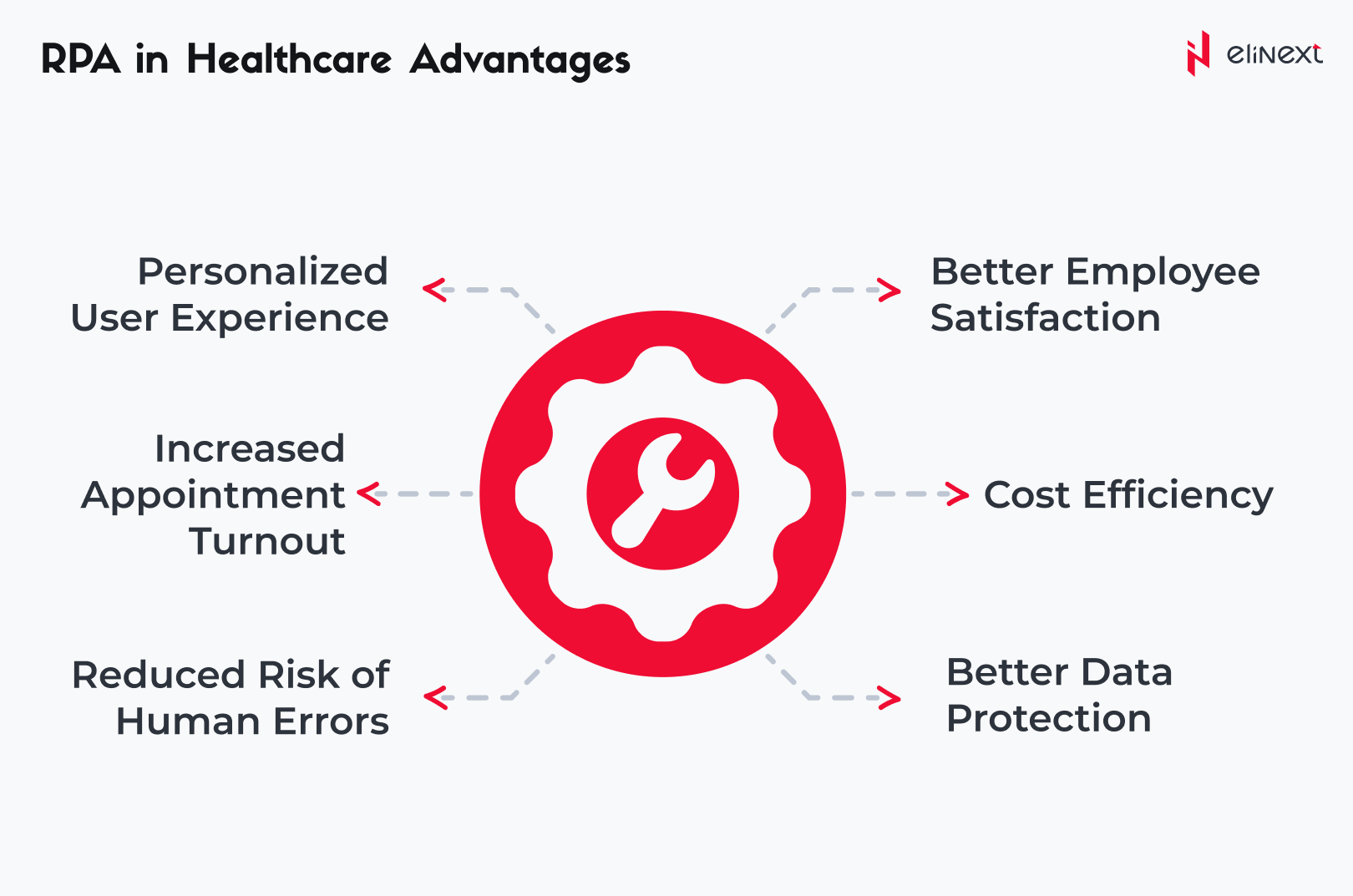
The transition to robotic process automation in the healthcare industry offers transformative advantages for both providers and patients. It bridges legacy systems, ensuring instant and accurate data flow across the entire medical network.
-
Personalized User Experience
RPA bots analyze medical histories to create personalized care plans, boosting patient loyalty and engagement. Thanks to mHealth app development services and RPA in healthcare, customer satisfaction in the industry rose by 18%. This synergy ensures timely, tailored support for every patient.
-
Increased Appointment Turnout
Automated reminders and easy rescheduling systems minimize no-show risks. RPA solutions provided by any telemedicine app development company, such as automated reminders and easy rescheduling systems, minimize no-show risks. Using digital assistants for booking reduces missed appointments by 25%.
-
Reduced Risk of Human Errors
Robotic process automation in healthcare reduces human error in complex tasks like billing codes. By integrating AI, hospitals achieve a 40% accuracy boost in high-volume processing. This precision ensures data integrity and minimizes costly mistakes, as noted in reports by Coherent Market Insights.
-
Better Employee Satisfaction
Automating routine work saves staff from burnout. About 89% of employees report higher satisfaction after RPA adoption, as bots handle the majority of the workload. This allows healthcare providers to focus on patients rather than paperwork, a trend confirmed by a recent Salesforce survey.
-
Cost Efficiency
RPA is the fastest way to slash overhead. Implementing bots saves up to 1,500 manual work hours every month. Across the industry, automating administrative tasks could save healthcare systems more than $20 billion. It gives early adopters a lasting edge by reducing burnout and boosting accuracy.
-
Better Data Protection
In 2024, healthcare organizations lost $4.88 million due to data breaches. Research shows that 61% of incidents were caused by negligent employees. By eliminating manual data entry, RPA in healthcare shifts sensitive tasks into encrypted, automated workflows that sharply reduce exposure.
Elinext PRA Solutions for the Healthcare Industry
We offer a wide range of healthcare software development services, including custom RPA solutions. Our team integrates bots into existing systems, strengthening data security and accelerating ROI. With deep industry expertise, we create scalable digital ecosystems that evolve with your healthcare organization, reduce manual workload, improve customer satisfaction, and lower operational expenses.
Transform your healthcare operations today
Discover how RPA and advanced care delivery management solutions can streamline workflows, eliminate manual errors, and drive measurable ROI.
What are the Best RPA Platforms for Healthcare
The choice of a RPA platform depends on the organization’s scale and task complexity. We have prepared an overview of market leaders that have proven their effectiveness in the healthcare sector and offer the most robust digital solutions today.
-
UiPath
As a global leader, UiPath offers powerful computer vision tools that allow bots to “see” the interface of any medical program. It is perfectly suited for large networks requiring high scalability and seamless AI integration to process complex medical documents. Its reliability makes it a top choice for enterprises aiming for a total digital shift.
-
Appian
Appian focuses on low-code development and process orchestration. It excels at combining RPA, AI, and Business Process Management (BPM) to create complex workflows for real-time patient care coordination. It allows healthcare providers to unify fragmented systems into a single, highly efficient stream, improving the overall quality of care.
-
Automation Anywhere
This cloud-based platform offers specialized healthcare solutions. Its AARI bots act as digital assistants for doctors, helping them quickly retrieve EHR data through an intuitive interface even during patient consultations. This focus on front-office support makes it unique, as it directly reduces the administrative burden during clinical hours.
-
Datamatics
Datamatics focuses on deep automation of data and document processing. Its TruBot solution is particularly effective for billing and claims processing, where high accuracy is required when extracting information from unstructured sources and scanned medical certificates. It is an ideal tool for labs and financial departments handling high volumes.
-
Power Automate
A Microsoft solution that fits perfectly into the Office 365 ecosystem. It is the best choice for clinics already utilizing Microsoft products. The platform is affordable and allows for the rapid automation of simple office tasks and internal document flows. Its familiarity and low entry barrier make it a favorite for small to mid-sized clinics.
-
Tungsten Automation
Formerly known as Kofax, this platform specializes in intelligent data capture. It is indispensable for digitizing archives and processing massive amounts of paper records, transforming them into structured information for modern medical systems. It bridges the gap between old-fashioned paper-based filing and modern digital healthcare databases.
-
SS&C Blue Prism
This platform emphasizes corporate security and regulatory compliance. Blue Prism offers an autonomous digital workforce that operates under strict rules, which is critical for protecting sensitive patient data in both public and private hospitals. It provides the high-level governance needed to satisfy even the most demanding legal audits.
RPA and AI in Healthcare: How Does it Work?
The synergy between RPA and AI in healthcare creates intelligent automation. Instead of just copying data, AI-enabled bots understand context, detect pathologies in lab scans, flag critical anomalies, and alert physicians instantly. This combination is the backbone of the most advanced medical device software development services in 2026.
Unlock innovation in digital health
Empower your teams with tools that streamline workflows and elevate patient outcomes.
The Future Trends in RPA for Healthcare
The future of RPA lies in hyperautomation — the integration of bots, AI, and machine learning. This shift enables systems to make informed decisions rather than just copying data. Key trends include the transition to cloud-based RPA for flexible scaling and the use of predictive analytics for early diagnostics. Finally, a heightened focus on data privacy ensures that automated workflows meet the world’s tightening cybersecurity standards.
“RPA fails when treated as a simple plug-in. Healthcare’s legacy sprawl and strict compliance require deep architectural expertise. At Elinext, we align automation with clinical logic, offering various solutions (even specialized ones like mental health app development services or pharmaceutical software development services). This reduces manual workload, cuts costs, and improves care consistency.” – Victoria Yaskevich, Expert in Healthcare Software Development
Conclusion
RPA solutions for healthcare empower providers to transform fragmented data into a unified, high-performance network. By bridging the gap between legacy systems and modern digital tools, organizations eliminate costly manual errors and fortify data protection. This strategic automation goes beyond cost-cutting; it totally reclaims time for clinicians, shifting the focus from administrative bottlenecks to high-quality, personalized patient care.
FAQ
What is RPA in healthcare?
RPA in healthcare refers to using software robots to automate repetitive, administrative tasks. These bots handle data entry, billing, and scheduling, allowing medical staff to focus on clinical work.
Can RPA impact clinical outcomes directly?
RPA influences clinical outcomes indirectly by reducing delays and errors that affect patient care. When clinicians receive cleaner data faster, they diagnose and act more accurately and efficiently.
Is RPA just for large hospitals?
Thanks to cloud solutions and flexible platforms, RPA is accessible even for small private practices, helping them handle workloads without hiring extra administrative staff.
