








Digital transformation in healthcare is accelerating in 2026, with the market forecast to reach $427.24 billion. Custom healthcare software development is driving the advancement of AI-based diagnostics, telemedicine, and wearable IoT devices. Over 80% of healthcare organizations now use cloud platforms to store patient data, and remote monitoring devices are expected to serve 115.5 million patients by 2027. These trends are improving outcomes, efficiency, and patient engagement.
Key Takeaways
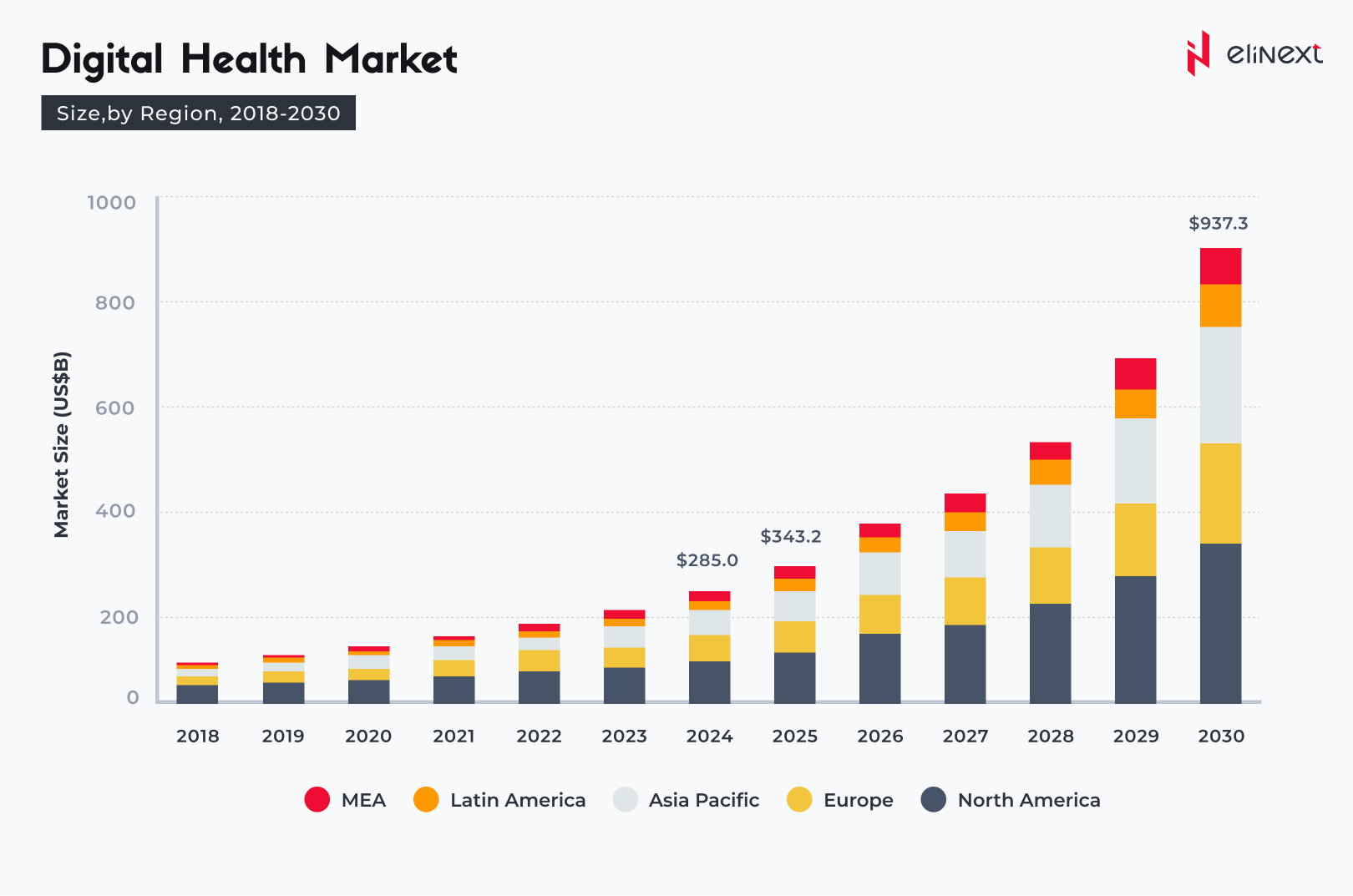
- Healthcare digital transformation services are fueling rapid growth, with the market expected to reach $1,183.2 billion by 2030 at a 32.4% CAGR
- AI adoption is surging, with the AI-driven digital healthcare market projected to exceed $187.9 billion by 2030
- Telehealth and remote monitoring now account for 45% of digital health revenue, with 115.5 million patients using RPM devices by 2027
The Key Digital Transformation Trends for Healthcare Industry
Digital transformation in the healthcare industry is driven by the development of artificial intelligence, the Internet of Things, and patient management solutions. Hospitals are using AI-powered patient management systems to optimize treatment, while wearable devices with the Internet of Things provide real-time monitoring. Telemedicine and cloud platforms are expanding access, increasing efficiency, and personalizing treatment.
-
Big Data Analytics
The benefits of digital transformation in healthcare are enhanced by healthcare analytics solutions. Big data analytics enables predictive modeling, population health management, and personalized care. Analytics platforms process data from electronic health records and wearable devices to identify at-risk patients, optimize resource allocation, and improve treatment outcomes. Hospitals using big data have achieved efficiency gains of up to 20% and reduced readmissions, demonstrating the transformative impact of analytics.
-
IWearables & Internet of Medical Things
Wearable devices are perhaps a major trend and digital innovation in healthcare today. Insights from Allied Market Research reveal that the Internet of Things (IoT) in the healthcare market is expected to reach $332 Billion by 2027.
Connected devices give healthcare professionals more options to collect vital medical data in real-time and provide an accurate assessment of health. Wearable and medical IoT devices are risk analyzers and fall detectors that enable the patients to collect and transmit data.
Digital transformation for healthcare leverages wearable IoT devices for continuous patient monitoring. Smartwatches track heart rate and transmit data to doctors, enabling early intervention and personalized care for chronic diseases.
-
Artificial Intelligence & Data Analysis
Artificial Intelligence (AI) and Data Analysis have already become sustainable technology trends in the medical industry. Multiple healthcare organizations are taking advantage of AI and data analysis in their day-to-day operations, logistics, and admin functions. The valuable thing about AI is that technology is being used to improve the diagnostic accuracy of medical practice.
The most promising AI applications as future trends in healthcare technology:
- Robot-assisted surgery
- Virtual nursing assistants
- Administrative workflow assistance
- Fraud detection
- Dosage error reduction
- Connected machines
- The clinical trial participant identifier
- Preliminary diagnosis
- Automated image diagnosis
- Cybersecurity.
AI solutions and digital transformation in healthcare are revolutionizing diagnostics and data analysis. AI algorithms analyze medical images, predict disease risks, and automate clinical documentation, improving accuracy and efficiency.
-
Augmented Reality
AR helps patients show more vision of their disease while physicians are enabled to make more precise diagnoses and demonstrate how the treatment will affect the human body in an interactive way.
3D reconstructions of organs and tumors allow surgeons to reduce risks and improve surgery results. Augmedics, an Israeli start-up, has developed an AR guidance system for spine surgery.
Such digital innovation in healthcare provides surgeons with an “X-ray” vision of the spine. It helps with the accurate guidance of instruments and implants during an intervention.
Healthcare digital transformation services and mHealth app development utilize augmented reality for medical and patient education. Augmented reality apps provide 3D visualization of anatomy, improving training and surgical planning.
-
Virtual Reality
The implementation of Virtual Reality (VR) has gone beyond computer games and entertainment, and become a trend in the healthcare industry. Medical students and trainees could leverage cutting-edge VR innovations in healthcare like ImmersiveTouch as if they had a scalpel in their hands themselves.
VR healthcare technology is also used for relaxing patients, including women in labor, to distract them from painful stimuli and manage pain.
Digital transformation in healthcare leverages virtual reality for rehabilitation and therapy. VR platforms offer immersive exercises for stroke recovery, increasing patient engagement and improving treatment outcomes.
-
Telemedicine
Digital transformation in the healthcare industry is driving the development of telemedicine. Virtual consultations and remote monitoring ensure continuity of care, reduce the number of hospital visits, and improve access to medical services for rural patients.
Telemedicine implies the use of telecommunication technologies to diagnose and treat patients. With the expansion of the Internet, telemedicine is becoming a more affordable digital innovation in healthcare across a number of telemedicine connection types like:
- networked connections – when remote healthcare facilities are linked to larger hospitals. For example, in the USA, there are 200 networked telemedicine programs delivering medical assistance to over 3,000 sites.
- point-to-point connections – they imply connectivity of smaller clinics with central medical facilities.
- monitoring center links for remote patient monitoring.
Telemedicine makes consistent healthcare affordable even in most rural areas.
Telemedicine also makes it possible for physicians to consult each other on a patient’s case regardless of their location or even outsource some medical services like teleradiology.
The latter along with telepsychiatry, teledermatology, teleoncology, telerehabilitation are the most popular telemedicine technology trends in the medical industry. However, telemedicine healthcare technology delivers a variety of services for ambulatory and hospital treatment.
-
Robotics
Healthcare digital transformation services integrate robotics for surgery and patient care. Robotic-assisted surgery systems enhance precision, while service robots automate medication delivery and disinfection.
Robotic medical assistants help medical personnel in their routine tasks. Robots perform medical procedures safer and less costly for patients, transport sensitive substances, clean patient rooms, take samples in labs and enter patient data into electronic medical records.
Another emerging robotic technology in the healthcare industry is exoskeletons.
The devices like Hybrid Assistive Limb use skin sensors to detect signals in the patient’s body and respond with a movement rehabilitating patients after limb disorders, including strokes and spinal cord injuries.
Care robots are more of an upcoming trend in healthcare technology.
-
Blockchain
Blockchain as a healthcare technology can bring more interoperability for healthcare stakeholders. It has the potential to connect separate systems to generate insights and provide better access to healthcare.
Digital transformation for healthcare leverages blockchain for secure and transparent data exchange. Blockchain platforms protect patient medical records from unauthorized access and automate insurance claims processing, increasing trust and efficiency.
The blockchain project participants could verify the product’s status in a few seconds. It improves pharmaceutical safety and transparency in tracking and tracing medicines. In the follow-up, pilot participants also consider blockchain to enable a centralized solution for all manufacturers, distributors, and dispensers and pave the way for common standards and procedures.
-
5G Mobile Technology
5G can become a valuable healthcare technology to change the way medical care is delivered. 5G mobile technology will expand the capacities of the healthcare providers enabling more complex use cases of all the current technology trends in healthcare.
Since 5G coverage is available in remote areas, it will permit the delivery of high-quality video and images 10 to 100 times faster than 4G. 5G potential takes the lead in robotic tools for healthcare providers.
5G wearables instantly transmit patient vital signs for faster and more accurate treatment. The benefits of digital transformation in healthcare are further enhanced by 5G, which enables remote monitoring and real-time telemedicine.
“Digital transformation in healthcare is revolutionizing patient care and operational efficiency. Healthcare digital transformation services now leverage artificial intelligence, the Internet of Things, and 5G to deliver real-time analytics, personalized treatment, and seamless patient engagement, setting new standards for innovation and accessibility in 2026.”
Elinext Software Development Expert
What is the Future of Digital Transformation in Healthcare?
The future of digital transformation in the healthcare industry is driven by solutions based on artificial intelligence, the Internet of Things, and Machine Learning solutions. Digital transformation in healthcare will lead to predictive analytics, remote real-time monitoring, and personalized medicine becoming the standard. Machine learning-based applications analyze patient data for early disease detection, and 5G technology enables instant telemedicine consultations. Hospitals implementing these innovations report improved treatment outcomes, reduced costs, and increased patient satisfaction.
Embracing digital transformation for healthcare is critical to improving patient outcomes, streamlining operations, and expanding access. Invest now to ensure a more intelligent, connected, and patient-centered healthcare experience in the future.
Conclusion
Healthcare digital transformation services are transforming the industry in 2026. AI, the Internet of Things, and 5G technologies enable more intelligent diagnostics, remote monitoring, and seamless patient engagement. Digital platforms now integrate electronic medical records, telemedicine, and analytics for comprehensive care. As digital transformation accelerates, healthcare providers are increasing efficiency, improving outcomes, and delivering more personalized and accessible care, ensuring a healthier future for all.
FAQ
What is digital transformation in healthcare?
Digital transformation in healthcare involves integrating advanced technologies such as artificial intelligence, the Internet of Things, and cloud platforms into medical processes. Hospitals are using digital tools for remote monitoring, telemedicine, and data-driven decision-making to improve the quality of care.
What are the key trends shaping digital transformation in healthcare?
Key trends include AI-powered diagnostics, IoT-enabled wearables, telemedicine, and 5G connectivity. Smart devices monitor patients’ vital signs in real time, while AI analyzes the data for early disease detection, making treatment more proactive and personalized.
How is AI being used in healthcare digital transformation?
AI algorithms analyze medical images, predict patient risks, and automate administrative tasks, improving accuracy and efficiency. Digital transformation for healthcare leverages AI for diagnostics, predictive analytics, and workflow automation.
Why is digital transformation important in healthcare?
Digital transformation is vital for improving treatment outcomes, reducing costs, and expanding access. Telemedicine and remote monitoring ensure timely delivery of care, while data analytics help physicians make more informed and rapid clinical decisions.
What challenges come with digital transformation in healthcare?
Challenges include data security, integration with legacy systems, and staff training. Ensuring patient privacy while implementing new digital tools requires robust cybersecurity and compliance with healthcare regulations.
Who benefits from digital transformation in healthcare?
Everyone wins: patients, providers, and payers. Patients receive faster, more personalized care; providers improve efficiency and analytics; and payers see reduced costs and improved outcomes thanks to a more intelligent, data-driven approach to care.
