








Insurers should strive to adjust to customer needs in a more comprehensive way to retain loyal customers and reach tangible results. That will involve significant improvements in service and sales, based on end-to-end assessment of clients, their values and priorities.
According to the statistics many insurers are now laying their hopes on reaching an all-time high by supplying their customers with CRM software development services and introducing mobile CRM for insurers. While many insurance customers still prefer face-to-face communication, mobile insurance applications have become an essential tool satisfying customer requests.
It’s time to integrate mobile CRM in insurance. The mobile CRM software market size has grown rapidly in recent years. It will grow from $28.43 billion in 2024 to $31.61 billion in 2025. And it will grow to $57.17 billion in 2029 at a compound annual growth rate (CAGR) of 16.0%.
Beneficial Changes Mobile CRM for Insurance Industry
The adoption of mobile CRM in insurance is bringing about significant beneficial changes to CRM in insurance industry. By giving agents access to customer data on the go, mobile CRM increases responsiveness and customer engagement. Features like automatic policy renewals and real-time analytics enable agents to provide personalized services, increasing customer satisfaction and retention. This shift not only streamlines operations, but also helps strengthen the relationship between insurers and customers, ultimately transforming the way the insurance business operates.
Below are several beneficial changes that best CRM for insurance can introduce to any insurance business:
New products and services notification
In 2025, an AI software development company will enable insurers to launch innovative products like personalized health plans and usage-based auto insurance. More and more companies prioritize AI, enhancing customer notifications and engagement in the insurance sector.
Providing quotes by means of mobile CRM in insurance
Using mobile CRM in insurance, agents can provide instant quotes to customers while on the go. People are usually quick to check their mobile devices. For example, an agent can access a customer’s data and generate a personalized auto insurance quote within minutes, increasing customer satisfaction and speeding up the sales process.
STP (including legal e-signature)
STP (Spanning Tree Protocol) makes it possible to accomplish all the sales quickly and efficiently. The electronic signature software market is projected to reach US$ 35.7 billion by 2030; it is expected to record a CAGR of 34.2% from 2022 to 2030.
Renewal lists
This service is aimed at contacting existing and potentially profitable customers before they get their policy renewed. It allows simultaneously dealing with current customers and gaining new clients.
Comparison shopping
This mobile service also has a favorable impact on insurance companies’ clients. It gives them an opportunity to compare the offered service layer to the service of other competitors.
Claims service
If a client encounters an unfavorable complaint towards a company, he/she is likely to immediately change the current service and turn to a different insurance company. The service also helps customers to observe and follow claims.
The ability to make policy changes
With mobile CRM for insurance industry, agents can easily facilitate policy changes for clients. For example, if a client wants to update their coverage, the agent can access their policy details on their mobile device and make the necessary adjustments in real-time. Among other benefits it allows to decrease service costs (using call centers and branches).
Cross-selling recommendations
The above mentioned service implies using mobile CRM to gain customers by making offers that are able to promote cross-selling (for example, personalized offers or preapproved online discounts). You can lure potential clients and raise your profit from current customers.
Lifetime value-based offers
Gaining customers is important, but their retention takes much more time and effort. Lifetime value-based offers focus on maximizing the long-term profitability of customers. For instance, an insurance company might provide discounts on renewals or additional coverage options to clients with high lifetime value, encouraging loyalty and increasing overall revenue.
Integrated product offers
Integrated product offers assume insuring auto with property, or term life with disability, for instance. Hereby, these offers are able to push up sales and increase profits. And mobile CRM can play a significant role throughout the insurance value chain.
Key Insurance CRM Features
Lead Management
CRM for insurers enhances lead management by centralizing all lead information, making it easy to access and track data. Agents can quickly view and update lead statuses, ensuring no opportunities are missed. This streamlined approach fosters better collaboration among teams and improves conversion rates, ultimately driving business growth.
Contact & Account Management
Effective contact and account management is critical in insurance. A robust system allows agents to store customer data, track interactions, and manage policies efficiently. This results in personalized service and stronger relationships, ensuring customers are valued and understood, which ultimately increases retention and satisfaction.
Sales Management
Insurance CRM software development enhances sales management by automating processes and tracking performance. Agents can monitor sales pipelines, manage leads, and analyze customer interactions, leading to improved efficiency and higher conversion rates. This streamlined approach allows insurers to focus on building relationships and closing deals effectively.
Policy Administration
Policy administration in insurance involves the efficient management of policy creation, renewal and extension. An optimized system ensures accurate data processing and quick responses to customer queries. This improves operational efficiency and customer satisfaction, as customers receive timely service and clear communication regarding their policies.
Claims Management
Claims management is essential in insurance, ensuring efficient claims processing from submission to resolution. A robust system allows for rapid assessment, reducing processing time. This increases customer confidence and satisfaction, as policyholders value timely updates and seamless communication throughout the claims process.
Analytics & Reporting
Analytics and reporting in insurance enable data-driven decision making. By analyzing trends and performance indicators, insurers can identify opportunities for growth and service improvement. This insight helps refine strategies, improve customer service, and optimize operations to increase profitability.
Challenges and Strategies of Insurance CRM Mitigation
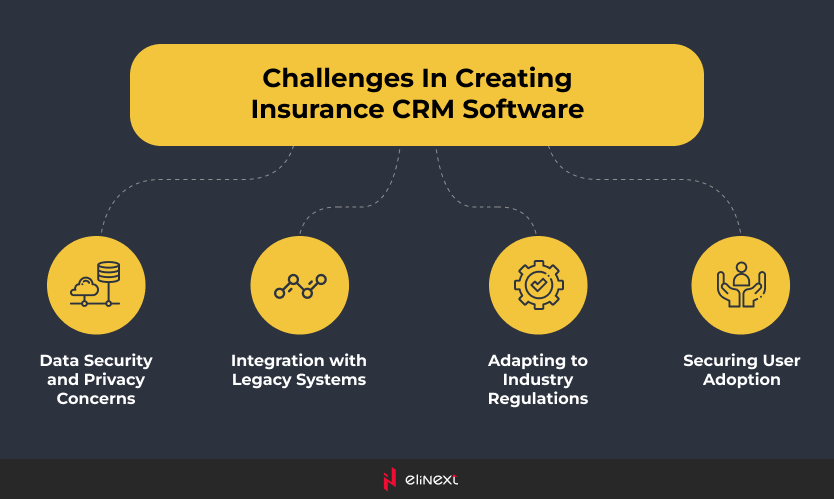
CRM for insurance industry faces challenges such as data integration and user acceptance. Mitigation strategies include comprehensive training, regular updates, and user-friendly interfaces. These approaches increase engagement and maximize the potential of CRM, ensuring better customer relationships and operational efficiency.
Legacy System Integration
Insurtech software development services offer solutions to integrate legacy systems with modern platforms. This process improves data flow and operational efficiency, allowing insurers to leverage existing assets while implementing innovative technologies, ultimately improving customer service and flexibility.
Data Privacy and Compliance
Data privacy and compliance are critical in insurance, ensuring that sensitive customer information is protected. Compliance with regulations like GDPR and HIPAA helps build trust and prevent legal issues. Insurers must implement robust security measures and provide training to protect data while maintaining transparency with customers.
Change Management and Employee Training
Change management and employee training are vital to successful insurance transformation. Effective strategies help staff adapt to new systems and processes, reducing resistance. Ongoing training ensures that employees have the necessary skills, fostering a positive culture that embraces innovation and improves overall productivity.
High Initial Investment
The high initial investment in insurance technology can be daunting, but often results in long-term benefits. Investing in advanced systems improves efficiency and customer satisfaction. Over time, these benefits can outweigh the costs, spurring growth and improving competitive advantage. Strategic planning can help manage costs effectively.
Low User Adoption Among Customers
Low user adoption among customers can hinder the success of insurance platforms. For example, if a new mobile app is complex, customers may prefer traditional communication methods. To combat this, insurers should simplify interfaces and provide training to improve user engagement and satisfaction.
Future Trends of CRM in Insurance Industry
A machine learning software company can define future CRM trends in the insurance industry by integrating artificial intelligence for personalized customer engagement, predictive analytics for risk assessment, and automation for efficient claims processing, ultimately improving service delivery and operational efficiency.
AI-Powered Personalization
CRM for insurers can use AI-powered personalization to improve customer engagement. By analyzing data, insurers can tailor communications and offers to individual preferences, increasing customer satisfaction and retention while driving sales through targeted marketing strategies.
Predictive Analytics for Customer Retention
Predictive analytics plays a key role in customer retention by analyzing behavioral data to identify at-risk clients. Insurers can proactively address issues and tailor offerings, increasing satisfaction and loyalty, ultimately reducing churn and increasing long-term profitability.
Integration with IoT and Wearables
Integration with IoT and wearables transforms the insurance landscape by providing real-time data on customer behavior and health. This allows insurers to tailor policies, improve risk assessment, and offer personalized services, fostering stronger relationships and enhancing customer satisfaction.
Voice and Chatbot Integration
Voice and chatbot integration are revolutionizing customer service in insurance by providing instant support and information. These tools improve the user experience through 24/7 availability, fast query resolution, and personalized interactions, ultimately increasing customer satisfaction and operational efficiency.
Omnichannel Experience and Real-Time Syncing
An omnichannel experience with real-time synchronization ensures that customers receive a seamless experience across all platforms. Insurers can ensure constant communication and access to information, increasing satisfaction and engagement while fostering stronger loyalty among customers.
Blockchain for Secure Data Sharing
Blockchain technology enables secure data exchange in the insurance industry, creating immutable records and increasing transparency. This reduces fraud, streamlines claims processing, and builds trust between stakeholders, ultimately increasing efficiency and protecting sensitive information.
API-Driven Ecosystem Expansion
The expansion of the API-based ecosystem allows insurers to seamlessly integrate a variety of services and partners. This promotes innovation, improves customer service, and enables rapid adaptation to market changes, ultimately driving growth and improving service offerings in a competitive environment.
Conclusion
In today’s fast-paced world, having the best insurance CRM is critical for companies to thrive. Mobile CRM solutions empower insurance agents by providing access to important customer data anytime, anywhere. This increases responsiveness by allowing agents to interact with customers on the go, which is vital for building relationships.
Mobile CRM also streamlines communication, simplifies data entry, and provides real-time updates, improving overall efficiency. By implementing mobile CRM, insurance companies can improve productivity, increase customer satisfaction, and remain competitive in a changing market environment.
FAQ
What is mobile CRM in insurance?
Mobile CRM in insurance refers to mobile applications that allow agents to access customer data, manage relationships, and optimize processes on the go, increasing efficiency.
Why is mobile CRM important for insurers?
Mobile CRM is critical for insurers because it allows agents to access important customer information anytime, improving response times and communication. This leads to improved customer relationships, increased productivity, and higher satisfaction rates.
How can mobile CRM reduce operational costs?
A mobile CRM solution reduces operational costs by streamlining processes, minimizing manual tasks, and increasing agent efficiency, resulting in faster service and reduced overhead.
Does mobile CRM work for all types of insurance?
Yes, Mobile CRM works for all types of insurance, including health, auto and life insurance. It provides customized solutions for effective management of customer relationships, claims and policies, regardless of the insurance sector.
