
Digital wallets are secure software for storing payment data and assets, enabling seamless mobile transactions. They help fintechs, banks, and retailers transfer to mobile-first operations, resulting in faster processing, higher user retention, and lower cart abandonment.
With the global market projected to exceed $16 trillion by 2028, wallets are now the primary gateway for finance. They’ve already accounted for over 50% of e-commerce. For modern businesses, launching a digital wallet is a strategic necessity to thrive in a cashless society.
Key Takeaways
-
Large-scale migration to mobile finance
By the end of 2026, the number of digital wallet users worldwide is expected to exceed 5.2 billion. This means that more than half of the global population will move away from traditional payment methods in favor of mobile solutions, turning the smartphone into the primary tool for capital management.
-
Dominance in the e-commerce sector
Digital wallets are transitioning from an alternative payment method to the industry standard: they now account for 53% of all global online trade transactions. For businesses, this means that a lack of integration with e-wallets could result in the loss of more than half of potential revenue.
-
Direct impact on business financial performance
Implementing a digital wallet allows companies to radically improve their sales funnel. According to statistics, using such applications reduces shopping cart abandonment rates by 40% due to the simplified checkout process. Furthermore, built-in loyalty programs can increase customer retention rates by 30% or more.
What is a Digital Wallet App and How It Works?
A digital wallet is a secure app that stores payment credentials, digital assets, and loyalty points, eliminating the need for physical cash. It works by encrypting data and using tokenization to facilitate safe, instant transactions. Users pay by tapping via NFC or scanning QR codes, making financial management smooth and accessible from anywhere.
Explore our money transfer app development services to build a scalable and compliant e-wallet that captures new revenue streams and builds user trust.
What are the Cost Factors in Digital Wallet App Development
Estimating the cost of digital wallet development involves balancing feature complexity, security requirements, and regional labor rates. While a basic MVP might start at $25k, high-end solutions with AI-driven insights can exceed $200k. Success requires a strategic budget roadmap that prioritizes scalability and regulatory compliance.
-
Development Stages and Time Estimates
Developing a custom digital wallet usually takes 6 to 12 months, depending on complexity and compliance needs. The process involves discovery, UI/UX design, backend and frontend development, API integration, rigorous security testing, and final deployment with ongoing maintenance.
-
MVP vs. Full-featured App
An MVP focuses on core functionality to test the market quickly, while a full-featured app offers a polished, comprehensive suite of tools. Starting with an MVP minimizes risk and costs, allowing for iterative scaling based on real user feedback before investing in a complex, final product.
-
Maintenance and Scalability Costs
Maintenance and scalability costs usually consume 15-20% of the initial development budget annually. These expenses cover security patches, server infrastructure, and API updates to ensure the app handles growing user loads without performance drops or downtime as the business expands.
Key Types of Digital Wallets
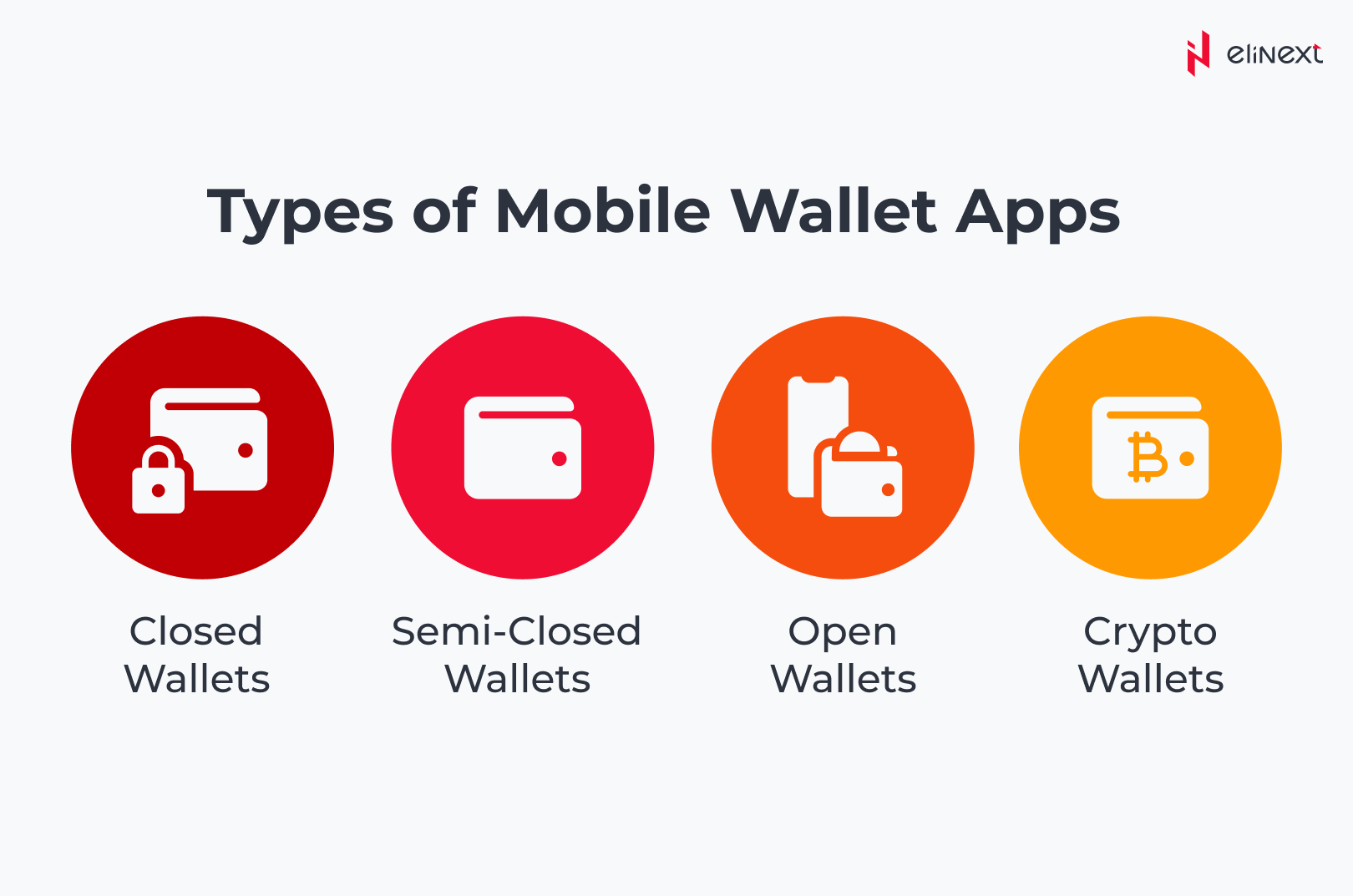
Digital wallets aren’t one-size-fits-all; they are categorized by their transaction limits and merchant networks. Understanding these types is crucial for choosing a model that aligns with your specific business goals. In 2026, selecting the right architecture (from niche loyalty tools to global banking hubs) determines your market reach.
-
Closed Wallets
These are brand-specific tools (like Amazon Pay) where funds are spent only with the issuer. They eliminate third-party fees and keep capital within your network. It is a perfect way to boost customer loyalty and retention through exclusive rewards and internal programs.
-
Semi-Closed Wallets
Accepted by a specific group of partner merchants, semi-closed wallets allow online payments but usually no cash withdrawals. They offer a flexible, secure environment to expand your retail network across multiple brands, creating a convenient, cashless payment ecosystem.
-
Open Wallets
There are apps issued by banks (like Google Pay) that work everywhere for purchases, P2P transfers, and ATM withdrawals. They are highly versatile, serving as a user’s primary daily financial tool. They offer global scalability by integrating directly into existing banking infrastructures.
-
Crypto Wallets
There are digital solutions for managing assets like Bitcoin or Ethereum via blockchain. They cater to the decentralized economy with transparent, borderless transactions. Security is managed through private keys, providing direct access to the world of DeFi and NFT investments.
Join the DeFi market right now! Partner with Elinext to build a secure, compliant platform using our industry-leading cryptocurrency wallet development services.
Core Features of a Digital Wallet Apps
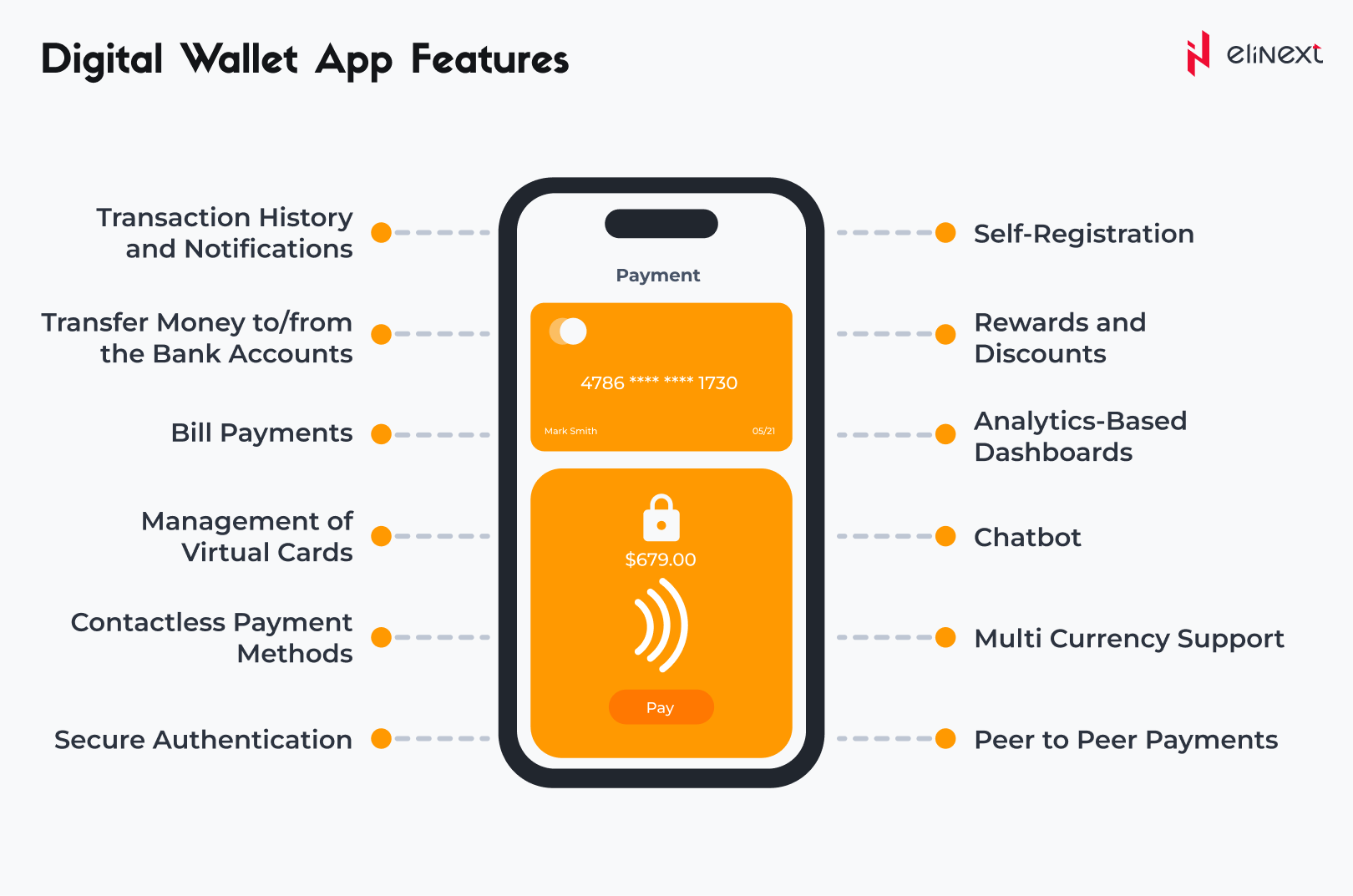
To build a successful digital wallet in 2026, you must prioritize standard-setting features that go beyond simple transactions. A competitive app acts as an all-in-one financial hub, combining security, speed, and intelligence. These core functionalities ensure user trust and scalability in the global fintech market.
-
Chatbot Integration
More than 60% of banks use chatbots that provide 24/7 automated support, handling routine inquiries instantly without the need for human staff. Virtual assistants help businesses save on operational costs while ensuring users get help right when they need it, boosting overall satisfaction.
-
Multi-Currency Support
The capability to hold, convert, and spend various fiat and digital currencies expands your market reach to international travelers and global investors. By enabling diverse asset management, businesses see increased transaction volumes from cross-border payments that amounted to $371.59 bn in 2025.
-
Peer-to-Peer (P2P) Payments
About 55% of users worldwide prefer instant mobile transfers that drive organic growth by turning financial tasks into social features, such as splitting bills. This fosters a powerful network effect, resulting in higher app engagement and a wider user ecosystem.
-
Bill Payments
When users can pay for goods or services directly in the app, it becomes an essential daily tool. People log in every day to handle their responsibilities, which builds a strong habit and keeps them using the app long-term. On average, people spend $12.55 every time they use their digital wallet.
-
Management of Virtual Cards
Digital cards for online shopping keep a user’s main account safe from hackers. This significantly reduces fraud cases and complaints, making people trust your brand more than traditional physical cards. The global virtual cards market is expected to reach $60,064.6 mln by 2030.
-
Contactless Payments Method
Paying with a phone via NFC or QR codes is the 2026 standard. This makes shopping in physical stores incredibly fast, bridging the gap between digital wallets and the real world to make life easier for the customer. By the way, the global contactless payment market was valued at $56.11 bln in 2025.
-
Secure Authentication
Since 82% of banking fraud is tied to account takeovers, implementing robust authentication like Face ID or a fingerprint is a necessity today. Security is the top priority in fintech; when users feel their money is safe, they are much more comfortable storing larger amounts in your app.
-
Transaction History and Notifications
Real-time alerts and detailed spending logs provide total transparency, which drastically reduces errors, fraud exposure, and customer support disputes. Empowered with instant financial awareness, users can manage their budgets effectively and feel in control of their money.
-
Transfer Money to/from the Bank Accounts
76% of adults worldwide have a bank account, which shows that bank connectivity is essential for broad accessibility. Linking an e-wallet to bank accounts taps into the world’s dominant financial infrastructure, ensuring users can move money freely and reliably. This will make your app versatile.
-
Self-Registration
89% of consumers switch to a competitor due to poor onboarding experiences. That’s why it’s important to provide a simple sign-up process with automatic ID verification. The fewer steps there are, the more people will actually finish the registration and start using your digital wallet.
-
Rewards and Discounts
Cashback and partner deals motivate people to pay with your wallet instead of another bank’s card. 61% say it is “extremely or very important” for banks to offer more creative loyalty rewards. This is a proven way to drive sales and ensure customers stay with you for years to come.
-
Analytics-Based Dashboards
90% of users experience better financial health when using AI‑enhanced budgeting and goal‑tracking tools. Provide your digital wallet with beautiful spending charts to help users see exactly where their money goes and how to save more. This will turn your app into a smart financial advisor.
“The core challenge in 2026 is balancing strict security (PCI DSS, GDPR) with a seamless UX. Many projects fail during complex banking integrations or data protection. Rendering our mobile banking app development services, we solve this by applying Zero Trust architecture and tokenization from day one. This allows us to build secure and reliable digital payment solutions.” – Anastasia Timoshenko, Expert in Financial Software Solutions
Explore Digital Wallet App Development Services by Elinext
We offer full-cycle payment app development services, from discovery to post-launch maintenance. Elinext builds secure, high-performing e-wallets with AI fraud detection, P2P transfers, and multi-currency support. Our PCI DSS and GDPR‑compliant solutions deliver a cohesive, intuitive UI/UX for global users. We also provide loan lending mobile app development services for scalable credit products.
Ready to launch a cutting-edge digital wallet that sets new standards for security and user experience? Look at our web3 wallet development services to bring your fintech ideas into a scalable, high-growth reality.
What are the Future Trends of Digital Wallet App Development?
The future of digital wallets lies in their transformation into AI-powered super apps that serve as a central gateway for financial and lifestyle services. By 2028, over 60% of platforms will natively support cryptocurrencies and NFTs. Advanced biometrics like voice-activated payments will ensure frictionless security. Integration with the metaverse and IoT will turn e-wallets into essential tools for digital identity.
Conclusion
In 2026, digital wallet development is a strategic necessity to stay competitive in a global cashless economy. With users projected to reach 6 billion by 2029, integrating advanced biometrics and AI analytics is critical. Building a multifunctional app boosts trust and loyalty. This shift positions forward‑thinking companies at the forefront of digital finance, enabling them to capture market share before the next wave of innovation arrives.
Cryptocurrency Wallet Development: Terms Explained
-
Private Key
A highly secure cryptographic code used to authorize transactions and maintain control over digital assets. Losing this key results in the permanent loss of access to all stored funds.
-
Public Key
A digital address derived from the private key used to receive transfers. In ewallet app development, it functions similarly to a visible account number within the blockchain network.
-
Seed Phrase / Recovery Phrase
A set of 12-24 words used to restore access to a wallet. In digital wallet app development services, it serves as a master key that must be stored offline to prevent unauthorized recovery.
-
Hot Wallet
A software-based wallet that remains connected to the Internet. While convenient for frequent trading, it’s more susceptible to online security threats.
-
Cold Wallet
An offline storage solution, such as a hardware device, used for digital assets. It’s popular in ewallet app development because it provides maximum security by staying disconnected from the web.
-
Multi-Signature (Multisig) Wallet
A multisig wallet requires multiple approvals before funds can be moved. This structure enhances security in digital wallet development by ensuring no single party can compromise the entire account.
-
Blockchain Node
A server that validates and records all network transactions. In digital wallet app development services, it maintains the integrity and synchronization of the decentralized ledger for the wallet.
FAQ
What are the key features of a successful digital wallet app?
Key features include secure biometric login, NFC/QR payments, and AI-driven personalization. During the ewallet app development process, provide multi-currency support, real-time notifications, and seamless bank linking to ensure user convenience.
Which tech stack is best for building a digital wallet app?
The ideal tech stack combines Flutter or React Native for the frontend with Node.js or Python for the backend. Databases like PostgreSQL and cloud services like AWS or Google Cloud are essential for handling high transaction volumes.
How much does digital wallet app development cost?
Ewallet app development costs range from $25,000 for a basic MVP to over $150,000 for complex enterprise solutions. Final pricing is influenced by the specific feature set, AI integration, and the development team’s geographical location.
What are the main challenges in digital wallet development?
Main challenges in ewallet app development include ensuring strict compliance with PCI DSS and GDPR while integrating complex banking APIs. Developers must overcome hurdles in gaining user trust and balancing high-speed performance with security.
How can I ensure my digital wallet app is secure?
Security is ensured through tokenization, end-to-end encryption, and biometric authentication. Implementing a Zero Trust model and performing regular penetration testing during digital wallet app development services are also vital for user safety.
What are the latest trends in digital wallet app development?
Latest trends in digital wallet development include the transformation of wallets into super apps and the adoption of AI-powered financial assistants. Additionally, support for cryptocurrency, NFTs, and wearable IoT payments is becoming a standard.
How long does digital wallet app development take?
Digital wallet app development services usually take between 4 to 9 months to complete. This timeline accounts for the discovery phase, UI/UX design, backend and frontend development, rigorous security testing, and final deployment to app stores.
About the Author
Anastasia is a financial and banking IT consultant at Elinext with over 10 years of experience in fintech project delivery. She specializes in client management, RFP bidding, and cross-functional coordination for complex financial sector solutions — helping businesses bridge the gap between regulatory requirements and scalable software implementation.