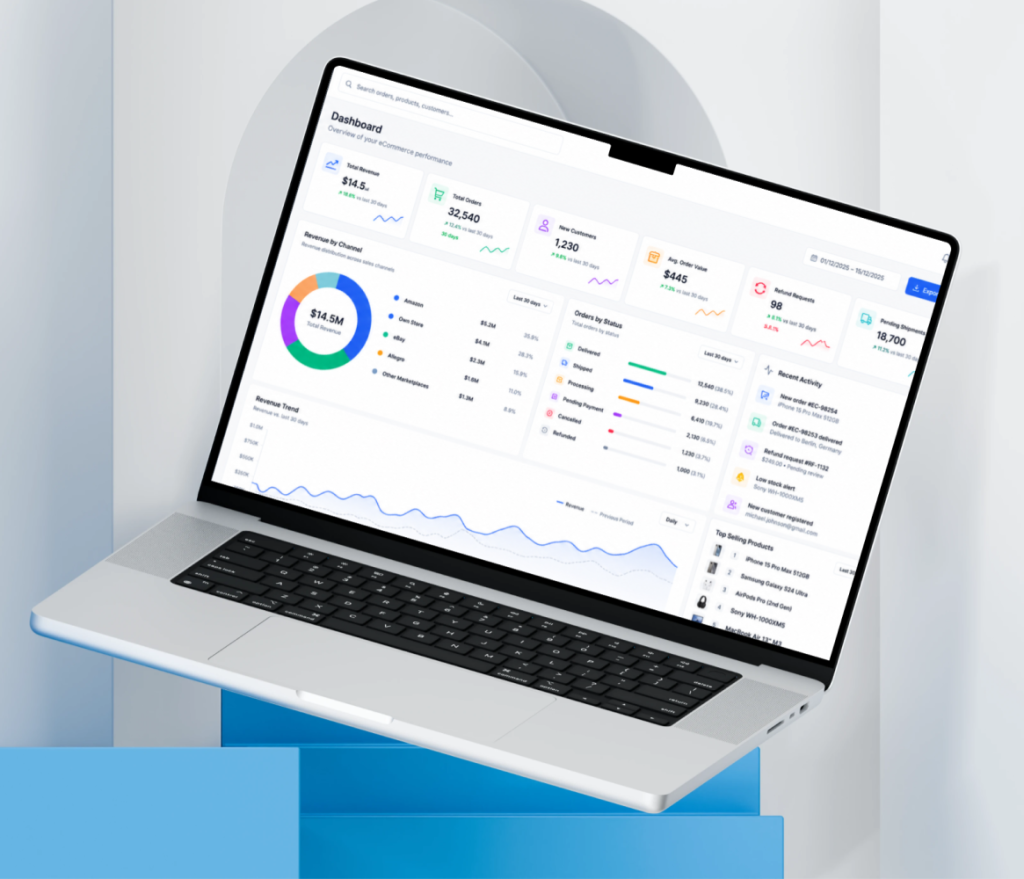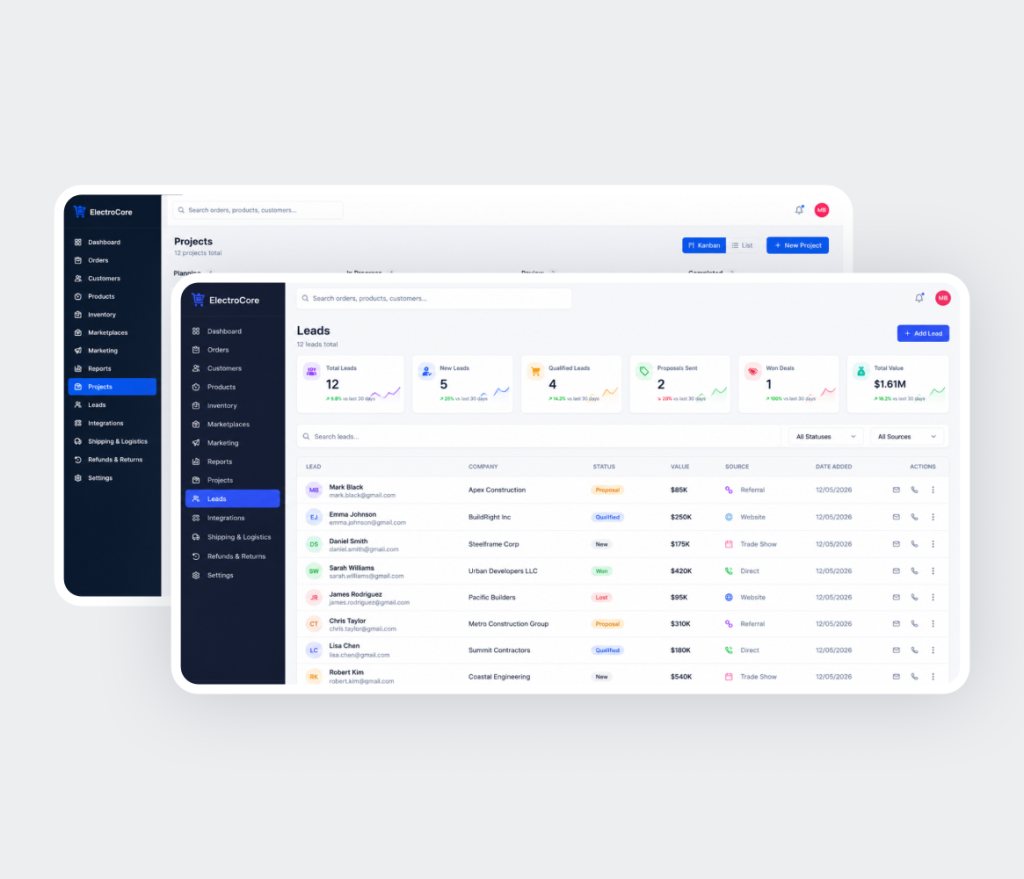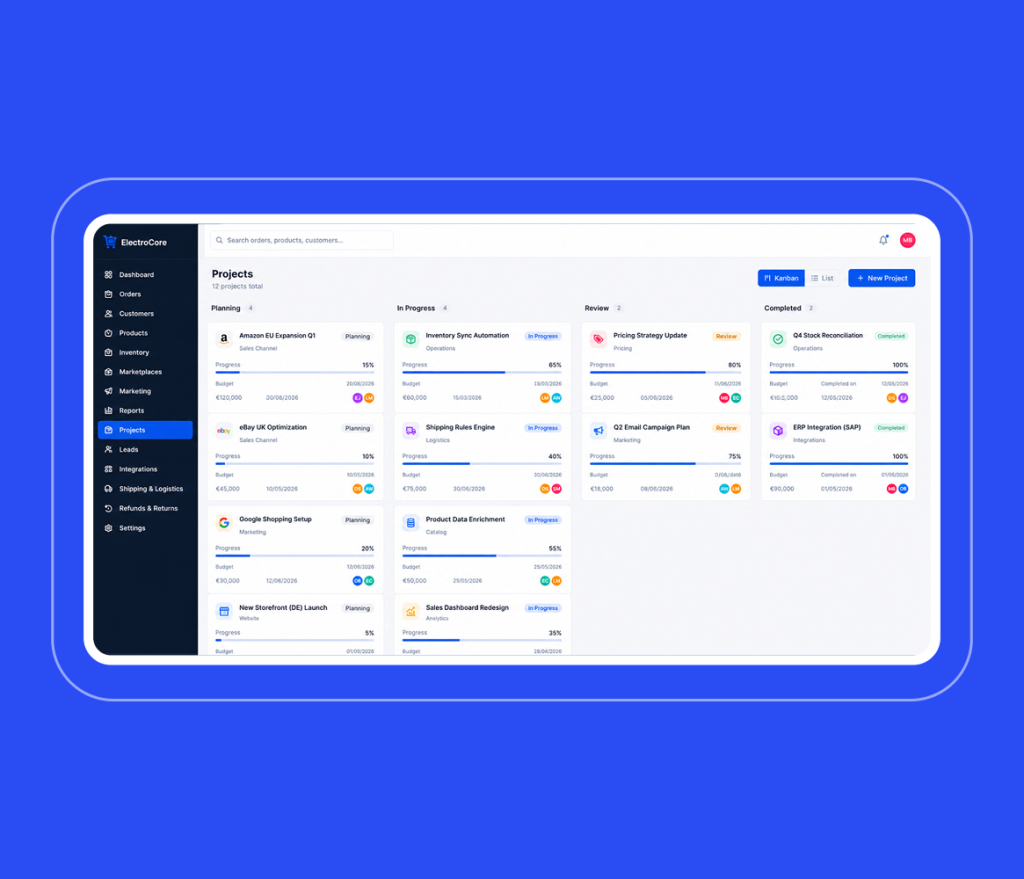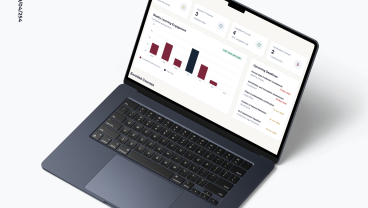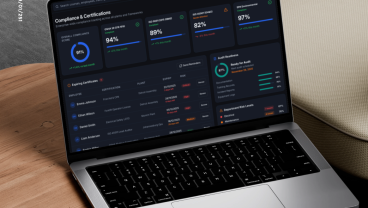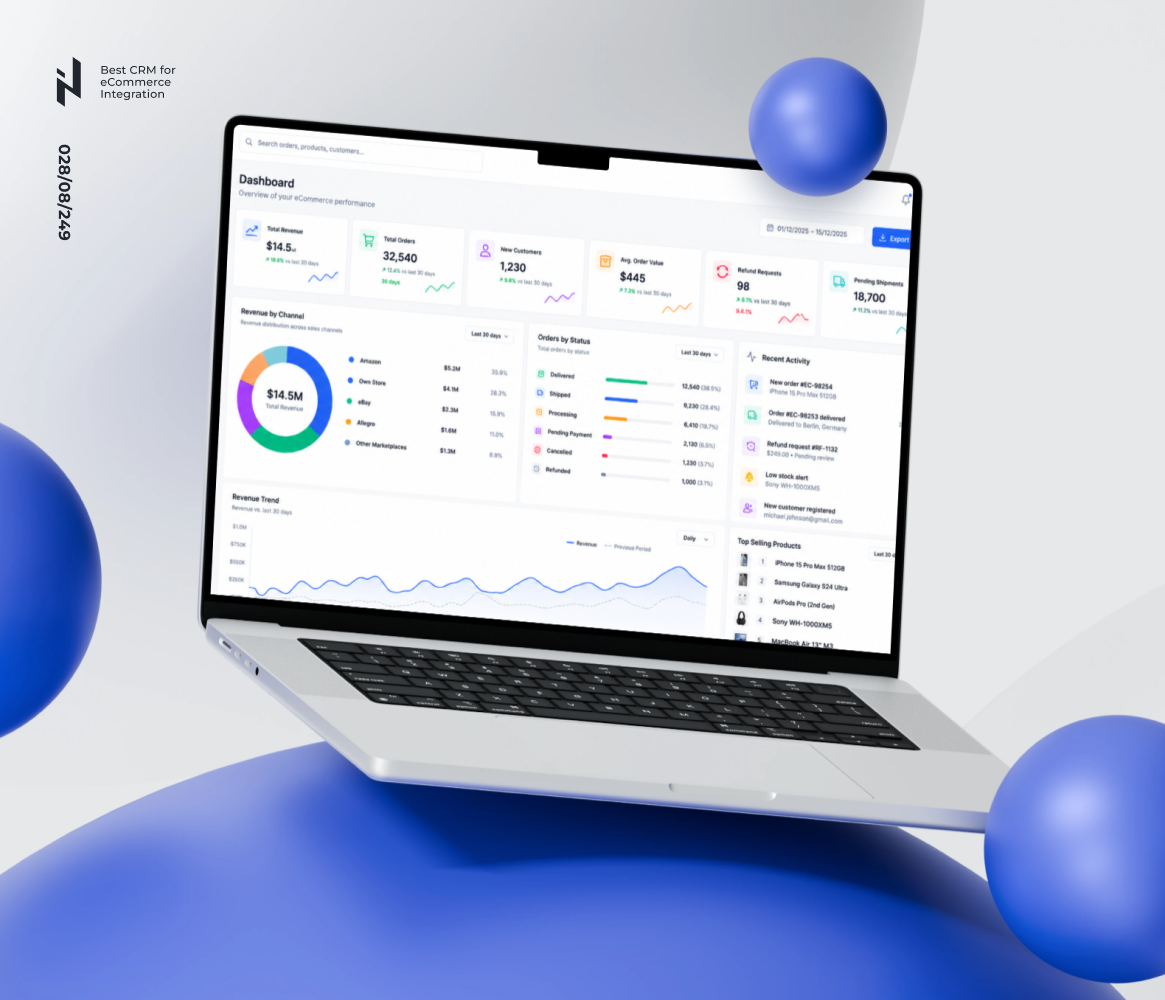
Our team, which uses our own-made product, custom EliCRM for everyday operations, has been adjusting this product to a retail company’s needs. With the help of custom CRM ecommerce integration, they analyzed customer data and managed multi-channel operations in one system. We made sure the system our team adapted possesses all the qualities for the best CRM for an ecommerce business. The result was a flexible custom CRM software for ecommerce that supports growth, automation, and real-time visibility.
Client
The client is a fast-scaling eCommerce company operating across Europe, specializing in consumer electronics and accessories for this hardware. The business runs multiple online storefronts, including its own websites and marketplaces such as Amazon, eBay, and regional platforms. With a catalog of over 25,000 items and thousands of daily transactions, the company relies heavily on efficient data flow between sales channels, logistics, and customer service.
As the company expanded, its internal systems became increasingly fragmented. Customer data was stored across multiple platforms, order processing was partially manual, and marketing teams lacked a unified view of customer behavior. Support teams struggled to track interactions across channels, while management lacked real-time insights into sales performance.
The client was searching for the best CRM for ecommerce business that could consolidate operations and scale with their growth. However, building a solution from scratch was not feasible due to time constraints and high development costs. Instead, they opted for custom CRM ecommerce integration, aiming to adapt an existing platform into a fully functional custom CRM software for ecommerce tailored to multi-channel retail operations.
Project
The project focused on implementing custom crm ecommerce integration by adapting Elinext’s ready-made CRM platform to the specific needs of multi-channel retail. The goal was to create a centralized system capable of managing orders, customers, inventory signals, and communication flows.
Instead of developing new custom CRM software for ecommerce, the team reconfigured existing modules and extended them with eCommerce-specific capabilities such as marketplace synchronization, customer segmentation, and automated workflows.
The platform was integrated with online stores, payment systems, and logistics providers, enabling real-time data exchange and operational visibility. This approach allowed the client to implement a solution that meets the expectations of the best CRM for ecommerce business without lengthy development cycles.
For related expertise, see other products in our eCommerce software development services section.
Challenges
The main challenge was adapting a general-purpose CRM into a solution capable of supporting complex ecommerce operations through custom CRM ecommerce integration.
The system needed to handle high transaction volumes, synchronize data across multiple sales channels, and provide a unified customer view. At the same time, it had to function as scalable custom CRM software for ecommerce, supporting growth and peak demand periods.
Another challenge involved integrating various third-party systems, including marketplaces, payment gateways, and logistics providers, while maintaining data consistency and performance.
Main Challenges
- Eliminating data mismatches between Shopify, Amazon, and internal systems where order statuses, payments, and cancellations were not syncing correctly
- Processing 10,000+ daily transactions without delays in order confirmation, inventory updates, or customer notifications
- Building stable, bidirectional integrations with marketplaces, payment gateways, and 3PL logistics providers without data loss or duplication
- Creating a single customer profile by merging data from website purchases, marketplace orders, and support interactions
- Maintaining system performance during peak events (Black Friday, seasonal sales) with traffic spikes of up to 5–7× normal load
Process
The project began with a detailed analysis of the client’s eCommerce ecosystem as part of custom CRM ecommerce integration. Elinext mapped data flows between platforms, identified inefficiencies, and defined how the existing CRM could be adapted.
The team customized data models, workflows, and interfaces to transform the platform into a custom CRM software for ecommerce. Special attention was given to automation, customer segmentation, and multi-channel synchronization.
Through iterative development and testing, the system evolved into a centralized solution aligned with real business operations. This approach ensured that the final platform meets the expectations of a best CRM for ecommerce business while remaining flexible and scalable.
Solution
Elinext delivered a tailored system based on custom EliCRM, enhanced through custom CRM ecommerce integration to support modern retail workflows.
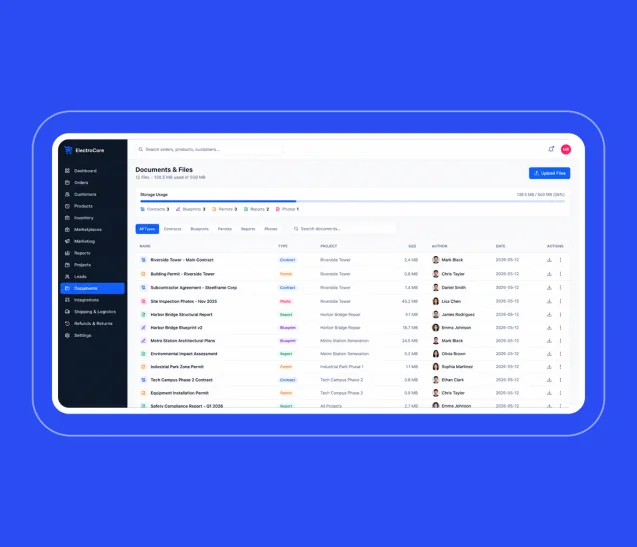
The solution centralizes all customer, order, and communication data, enabling businesses to manage operations from a single interface. By leveraging a modular architecture, the platform functions as scalable custom CRM software for ecommerce, capable of adapting to new channels and business requirements.
The implementation was supported by expertise in CRM software development services and aligned with industry practices from retail software development services
This approach allowed the client to deploy what can be considered the best CRM for ecommerce business use case, without building a system from scratch.
Results
The implemented custom CRM ecommerce integration significantly improved operational efficiency and customer experience.
- 46% faster order processing through automation
- 3.2x improvement in customer response time
- 92% data consistency across all channels
- 34% increase in repeat purchases due to better customer insights
- 5 months implementation time using custom crm software for ecommerce approach