



About Client
The client specializes in developing a production-ready aerial anomaly detection platform for solar panel inspections. The solution is designed to learn and adapt to the specific characteristics of each inspection site, enabling reliable, high-precision diagnostics across diverse solar installations. From us, they wanted an AI anomaly detection platform development. To clarify, our role was focused on the web infrastructure and integration. While the client provided their own proprietary AI, we developed the platform that interfaces with it, managing data exchange and front-end visualization.
Business Challenge
The solar energy industry’s fundamental bottleneck is often inspection. While solar capacity has been expanding steadily for years, inspection workflows have remained largely manual, fragmented, and difficult to scale. This mismatch between rapid infrastructure growth and slow operational processes created inefficiencies across the entire value chain.
For our client, this challenge became a critical pain point as global solar deployment surged. The sheer volume of newly installed solar assets dramatically increased the demand for frequent, accurate, and fast inspections. Manual processes that were once merely inefficient now posed a direct threat to scalability, operational reliability, and commercial growth.
While the client provided their own proprietary AI algorithms, our team developed the web-based platform required to process and visualize the solar inspection data. These capabilities were embedded in a specialized AI anomaly detection platform development tool that did not yet function as a full, end-to-end digital product. There was a significant gap between:
- Field operations, where drone pilots and technicians collected raw inspection data under demanding real-world conditions
- Office-based analysis, where engineers and analysts needed structured, synchronized, and actionable insights derived from that data
Without a unified digital ecosystem, data transfer between the field and the office was slow, error-prone, and heavily dependent on manual steps. This limited ability to scale its operations and constrained its transition from a service-oriented model to a true SaaS platform that enables AI-powered anomaly detection.
Compounding this challenge was a lack of internal capacity. Our client did not have the resources to simultaneously design, build, and maintain without outside help in energy software development services:
- A sophisticated, data-rich web dashboard for office users to enable AI-powered anomaly detection
- Native-quality mobile applications for both Android and iOS, capable of supporting field workflows
- A consistent user experience across all devices while integrating seamlessly with their AI-powered anomaly detection backend.
Attempting to build these components in parallel internally would have significantly delayed their go-to-market timeline and introduced high technical and operational risk. Yet speed was criticalto not lose opportunities and increased competitive pressure.
Our client, therefore, faced a multifaceted business challenge:
- Utilizing AI integration services, including transforming a specialized AI solution into a scalable, market-ready digital ecosystem
- Eliminate the inspection bottleneck by tightly connecting field data collection with centralized analysis
- Deliver professional, reliable, and consistent web and mobile experiences across platforms
- Accelerate time-to-market without compromising quality, performance, or future scalability
To overcome these challenges, they needed a development partner capable of moving fast, handling complex web and mobile engineering, and delivering a polished product that could support their global commercial expansion in the solar energy sector.
Process
The collaboration with our clientwas designed as a long-term product journey rather than a one-off delivery. As the platform matured and market dynamics evolved, our process transitioned from a structured, roadmap-driven approach to a flexible, user-driven development model. Below is an overview of the process, broken down into clear stages.
Stage 1: Discovery, Planning, and Roadmap Definition
Timeline: May 2023 – Initial Phase
The project started in May 2023 with an initial 12-month timeline. However, during the final third of the development cycle, the client began actively participating in trade shows. The feedback gathered from potential customers at these events led us to pivot our strategy and adapt our approach to better meet market needs. Here is what we’ve managed during this stage:
- Understand the business objectives and long-term SaaS vision
- Analyze existing workflows and identify bottlenecks between field operations and office analysis
- Define system architecture capable of supporting AI-driven processing, real-time synchronization, and future scalability
- Establish functional requirements for the web dashboard and native-quality mobile applications for iOS and Android
Stage 2: UX/UI Design Services and Core AI Anomaly Detection Platform Development
Timeline: Year 1
Once the roadmap was established, the focus shifted to design and core implementation. Key activities included:
- Designing a consistent and professional user experience across web and mobile platforms
- Building the foundational web dashboard for office-based users
- Developing mobile applications optimized for field technicians and drone pilots
- Integrating the client’s proprietary AI algorithms into the user-facing workflows of our generative AI development services
- Establishing secure data pipelines between field data collection and centralized analysis
The initial core platform was delivered successfully within the planned framework, providing our client with a market-ready foundation for its SaaS offering.
Stage 3: Transition to Iterative, User-Driven Development
Timeline: Year 2
Following the successful core release, real-world usage and customer feedback began to shape the product’s, AI platform for anomaly detection, evolution. As market requirements shifted and new opportunities emerged, the original scope expanded beyond the initial one-year estimate.
To support this evolution, we transitioned away from rigid long-term schedules and adopted a more dynamic, iterative development approach. Development priorities were now driven by:
- Direct feedback from end users in the field and in the office
- Insights gathered from production usage data
- Specific marketing initiatives and commercial expansion plans
This shift allowed the platform to evolve in near real time, ensuring continuous alignment with user needs and market demands.
Stage 4: Dedicated Team Model and Continuous Delivery
Timeline: Ongoing
To sustain long-term growth, we operate under a Dedicated Team model, providing our client with a full-cycle development squad that functions as an extension of their internal organization. The team includes:
- Product and delivery management
- AI platform for anomaly detection architecture
- Web and mobile development
- Quality assurance
This structure enables end-to-end ownership of the product lifecycle, from feature ideation and implementation to scaling, optimization, and maintenance. It also ensures deep domain knowledge, fast decision-making, and consistent strategic alignment with the client’s vision.
Stage 5: Long-Term Partnership, Scaling, and Optimization, including Mobile App Development Services
Timeline: Year 3 – Present (Continues in 2026)
As of 2026, the collaboration has been ongoing for over 32 months, evolving into a long-term strategic partnership. The focus has shifted toward:
- Scaling the AI platform for anomaly detection to support global commercial expansion
- Maintaining and improving performance, reliability, and security
- Continuously delivering new, user-driven features for seamless AI-powered anomaly detection
- Supporting marketing-led initiatives with rapid product enhancements
While the original requirements were estimated for a one-year delivery, the expanded scope is managed through a predictable and transparent budget enabled by the dedicated team model. This approach provides our client with the flexibility to prioritize the highest-value features without being constrained by an outdated roadmap.
Through this staged and adaptive process, the AI platform for anomaly detection continues to evolve as a living product, closely aligned with user needs, market conditions, and client’s long-term business strategy.
Final Product Overview
The final solution of our AI software development services delivered is a fully integrated, end-to-end SaaS ecosystem for solar inspection, designed to seamlessly connect field operations with centralized office analysis. The AI anomaly detection platform development allowed transforming proprietary AI and 3D visualization technology into a scalable, production-ready product used across global operations.
At its core, the ecosystem consists of:
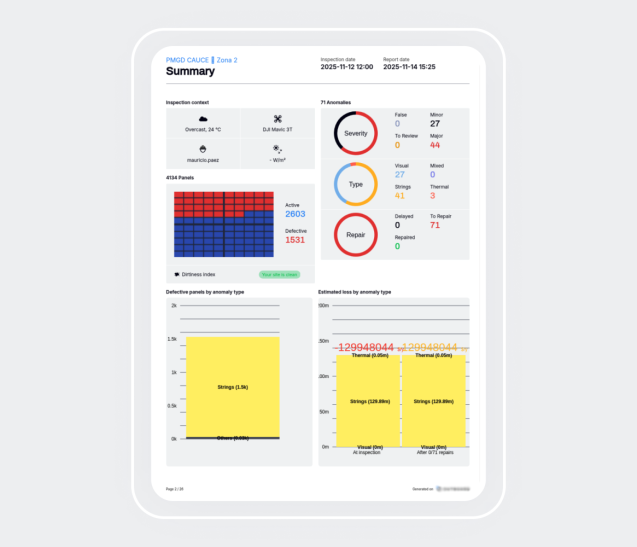
Web-based analytics and management platform
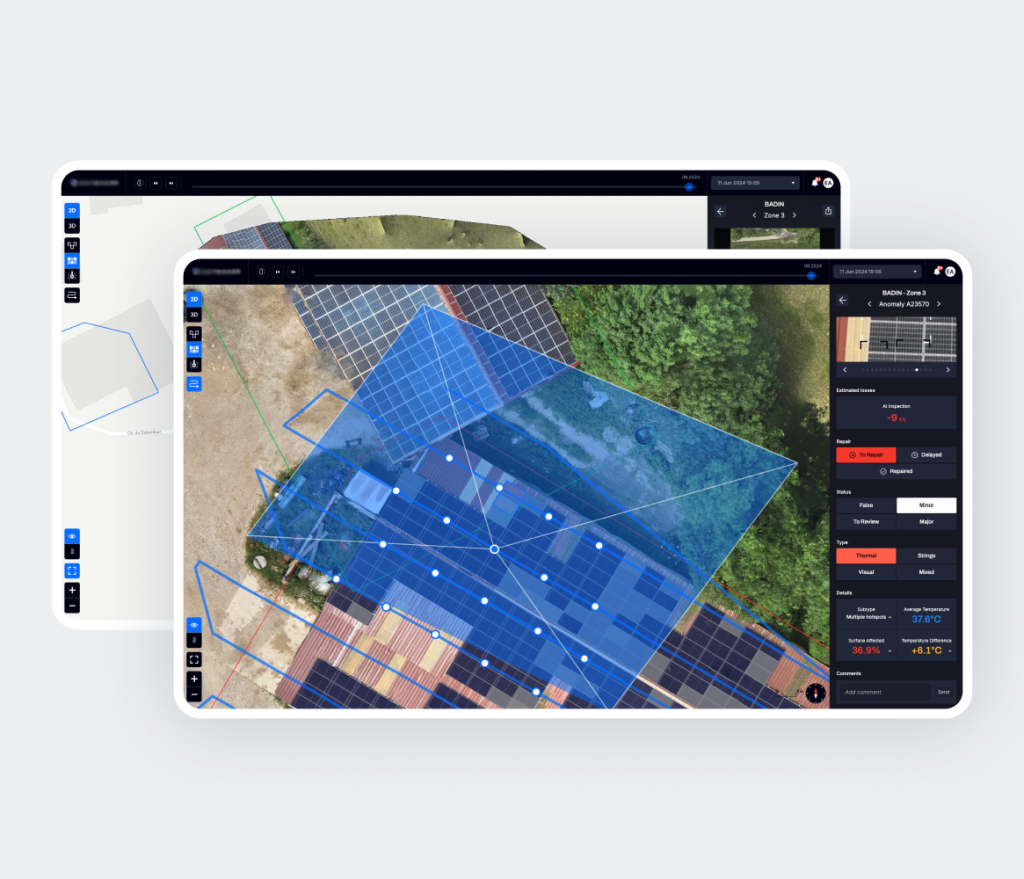
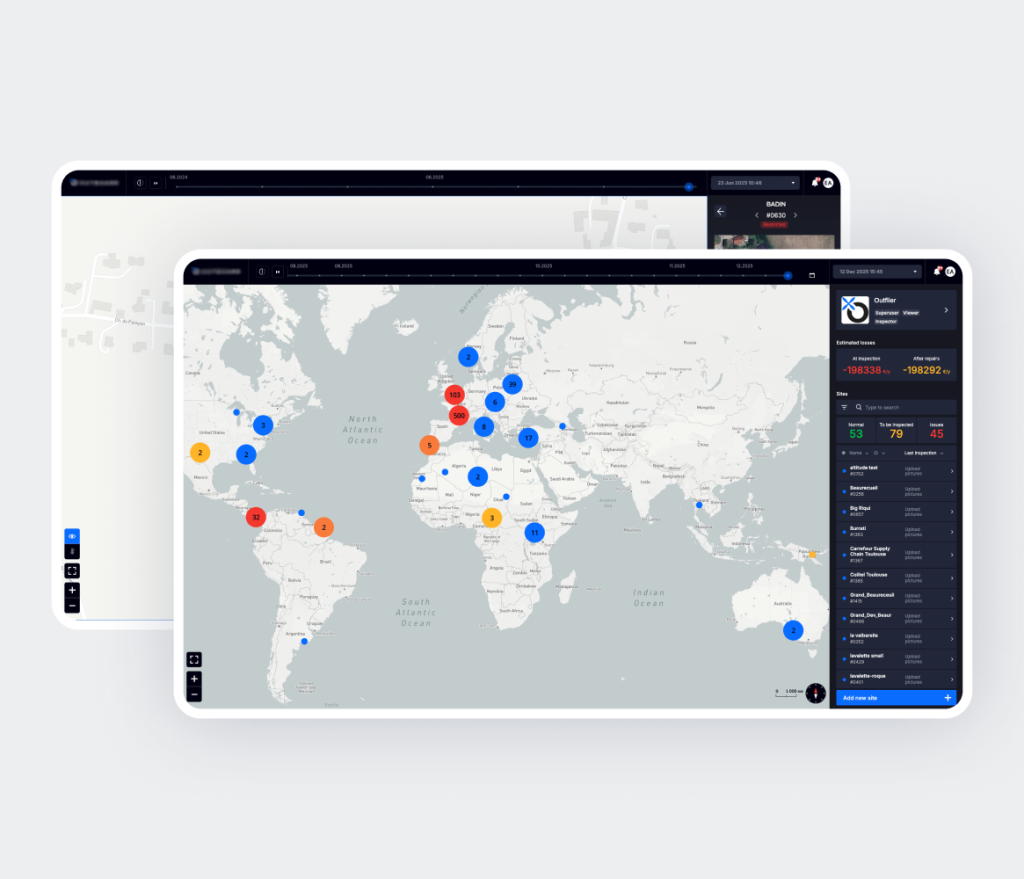
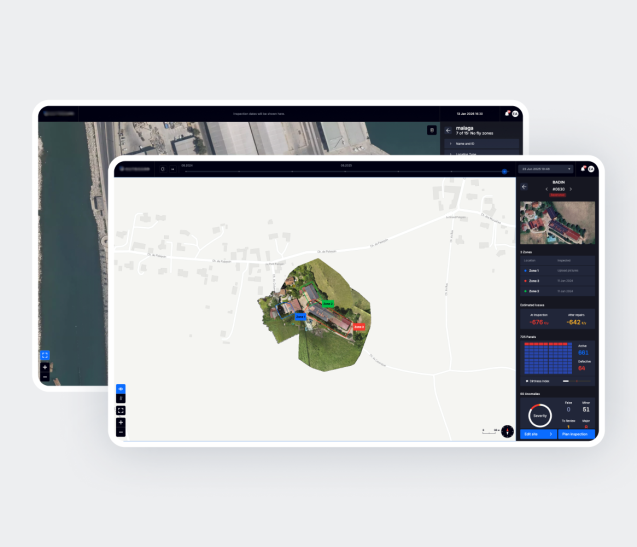
A high-performance dashboard that enables office teams to analyze inspection results, localize defects with photorealistic 3D visualization, manage users, and oversee large portfolios of solar assets from a single interface of AI platform for anomaly detection.
Native-quality mobile applications (iOS and Android)
Optimized for drone pilots and field technicians, the mobile apps support efficient data capture, anomaly review, and seamless synchronization with the web platform, ensuring that field data is instantly available for office-based analysis.
Advanced AI-driven inspection workflows
Automated defect detection and localization significantly reduce the need for manual review, replacing slow, error-prone workflows with fast, repeatable, and accurate analysis.
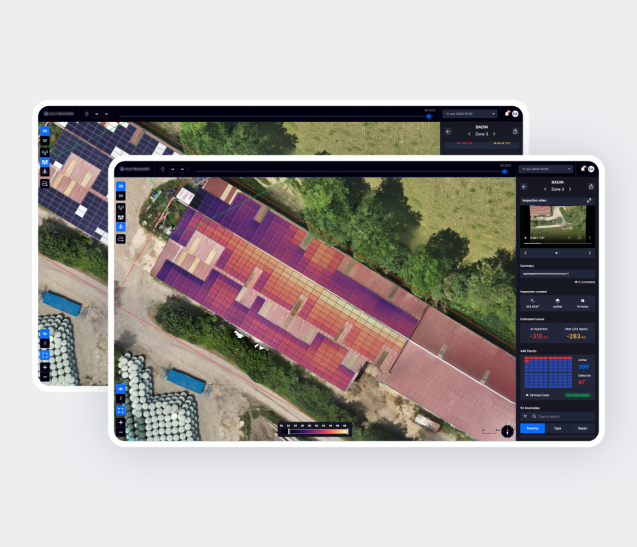
High-precision 3D visualization tools
Photorealistic 3D models allow users to explore solar assets in detail, add or adjust anomalies manually, and clearly communicate findings to stakeholders. These tools also serve as a powerful differentiator during sales and client presentations.
Operational and commercial features
The platform includes analytics, billing and invoicing, onboarding flows, and robust user management, enabling our clientto operate the product as a complete, self-contained SaaS business.
Delivered initially within the planned core scope, the product has since evolved through continuous development into a mature, flexible platform. It remains in active use and ongoing enhancement, with new capabilities added based on real-world user feedback and market-driven priorities.
Business Effects for Client
- 32+ months of continuous development, evolving from core delivery into a long-term strategic partnership
- A successful transition from a manual, service-based inspection model to a fully automated SaaS platform that works for AI-powered anomaly detection immediately after initial launch
- Significant reduction in operational costs by replacing manual defect localization with AI-driven analysis and automated 3D visualization
- Substantial productivity gains for both field and office teams through seamless mobile-to-web data synchronization
- Scalability unlocked: the platform now supports a growing volume of solar assets without a proportional increase in operational headcount
- Expanded market reach, enabling participation in large-scale and utility-level contracts previously unattainable under a manual model
- Improved sales performance, using photorealistic 3D visualization as a high-impact tool to demonstrate technical superiority
- Higher long-term customer value, driven by historical data accumulation and the foundation for predictive analytics and improved ROI for solar park owners
- Predictable and controlled budget, maintained through a Dedicated Team model despite significant scope expansion
- Ongoing feature delivery, with analytics, billing and invoicing, onboarding, user management, anomaly handling, and advanced 3D tools continuously refined based on real-time market feedback
As a result, our client has transformed its inspection technology into a scalable, commercially viable SaaS product that enables AI-powered anomaly detection, positioning the company for sustained global growth and long-term competitive advantage in the rapidly expanding solar energy market.