
























































































































































A predictive maintenance system for medical equipment can pass your hospital’s IT security review and still fail a 21 CFR Part 11 audit. Here’s the reason: the ML model retraining event was never logged as an electronic record change. This is the gap most FDA 21 CFR Part 11 predictive maintenance projects hit only after a Notified Body or FDA inspector asks the wrong question at the wrong meeting.
If you are building or buying a predictive maintenance system for CT scanners, MRI machines, infusion pumps, ventilators, or robotic surgery systems, and you operate in the US, the EU, or both, this is what your architecture actually needs to satisfy. Treating FDA 21 CFR Part 11 predictive maintenance obligations as a checkbox added late in the build is the single costliest planning mistake we see in this category of project. The same is true on the EU side, where EU AI Act medical device software obligations are often treated as a legal afterthought instead of an architecture input
YMYL disclaimer: This article is technical and architectural guidance based on public regulatory text. It is not legal advice. Regulatory classification (Part 11 scope, MDSW status, High-Risk AI classification) depends on your specific device, intended use, and jurisdiction, and should be confirmed with regulatory counsel or your Notified Body before final architecture sign-off.
- A PdM system monitoring patient-facing medical equipment likely qualifies as High-Risk AI under EU AI Act Annex III. It requires conformity assessment, technical documentation per Annex IV, and CE marking before August 2, 2026.
- FDA 21 CFR Part 11 machine learning requirements apply when the PdM system creates electronic records used in regulated processes (calibration, maintenance, or production). ML model retraining events are “change records” under §11.10(e) and must carry full audit trails. This is the core of 21 CFR Part 11 machine learning requirements.
- The single most-missed Part 11 requirement for ML-based systems: audit trails must log not just who changed data, but what the previous value was, the reason for change, and the date/time — at the level of individual sensor readings and model parameter updates.
- EU AI Act Article 14 requires that high-risk AI systems support human oversight. Architecturally, this means an explicit override/pause API endpoint callable by your CMMS or ERP, not just a UI button that maintenance staff might bypass.
- FDA requires validation before deployment (CSV: IQ/OQ/PQ); EU AI Act requires continuous post-market monitoring (Article 72). These are different paradigms, and predictive maintenance medical equipment compliance means your architecture needs to satisfy both simultaneously.
Regulatory Scope: Which Rules Apply to a Predictive Maintenance Medical Equipment Compliance Program?
Not every PdM deployment triggers every regulation. So, which rules apply to a predictive maintenance medical equipment compliance program? Scope depends on what the system outputs, if that output feeds a regulated process, and if the monitored equipment is itself a medical device. Getting the scope determination wrong in either direction (over-engineering for rules that don’t apply, or missing ones that do) is the most expensive mistake in this category of predictive maintenance medical equipment compliance.
When FDA 21 CFR Part 11 Applies
The scope trigger is straightforward in principle and messy in practice: FDA 21 CFR Part 11 predictive maintenance obligations attach when the PdM system creates electronic records that a predicate rule requires. For example, device maintenance records under 21 CFR Part 820, or pharmaceutical equipment records under 21 CFR Part 211. If maintenance records live only in a CMMS and the PdM tool merely “recommends,” Part 11 may not reach the PdM layer directly. If the PdM system itself generates records that later appear in regulatory submissions or a device history record, §11.1(b) pulls it into scope.
The practical test: would an FDA inspector audit this record as part of a device history file? If yes, you are in Part 11 territory, predicate rule and electronic signature obligations included. Teams that skip this scoping step early are usually the same ones retrofitting FDA 21 CFR Part 11 predictive maintenance controls after a failed audit, which costs far more than designing for them up front.
When EU AI Act High-Risk Classification Applies
The classification path runs through the equipment being monitored, not the PdM software in isolation. Under EU AI Act Regulation (EU) 2024/1689, if a PdM system monitors equipment that is itself a medical device — an MRI, CT scanner, ventilator, or infusion pump regulated under EU MDR 2017/745 — the PdM system can qualify as a safety component under Annex III, Point 5(a), placing it in the High-Risk AI category under Article 6. This is a core instance of EU AI Act high-risk AI healthcare classification, and it carries a hard deadline: full compliance for High-Risk AI systems is required by August 2, 2026. If the device is already CE marked under EU MDR, the AI Act overlaps with that certification rather than requiring a wholly separate compliance track, but it does not waive it. This is the point where EU AI Act medical device software requirements stop being a regulatory affairs concern and become an architecture decision.
When EU MDR Enters the Picture: the MDSW Question
Before EU AI Act classification even matters, you need an MDCG 2019-16 MDSW qualification answer under EU MDR 2017/745. If the PdM output is decision support, it is likely not Medical Device Software (MDSW) in its own right. If the PdM output can trigger an automated shutdown or intervention on equipment during patient use, it likely is MDSW, falling under Rule 11 classification (typically Class IIa or IIb), which brings Notified Body review and IEC 62304 software lifecycle obligations. This is genuinely a case of medical device software SaMD compliance logic applied outward from FDA’s SaMD framework to the EU regulatory stack: one does not substitute for the other, and EU AI Act and EU MDR compliance coexist rather than cancel each other out. Resolving the EU AI Act medical device software classification question first prevents rework later, since it determines which of the two frameworks’ documentation requirements apply.
Our Healthcare IT Consulting Services team runs this classification exercise as the first deliverable on every dual-jurisdiction PdM engagement, before a single line of compliance architecture gets written.

What FDA 21 CFR Part 11 Actually Requires From Your Predictive Maintenance Architecture
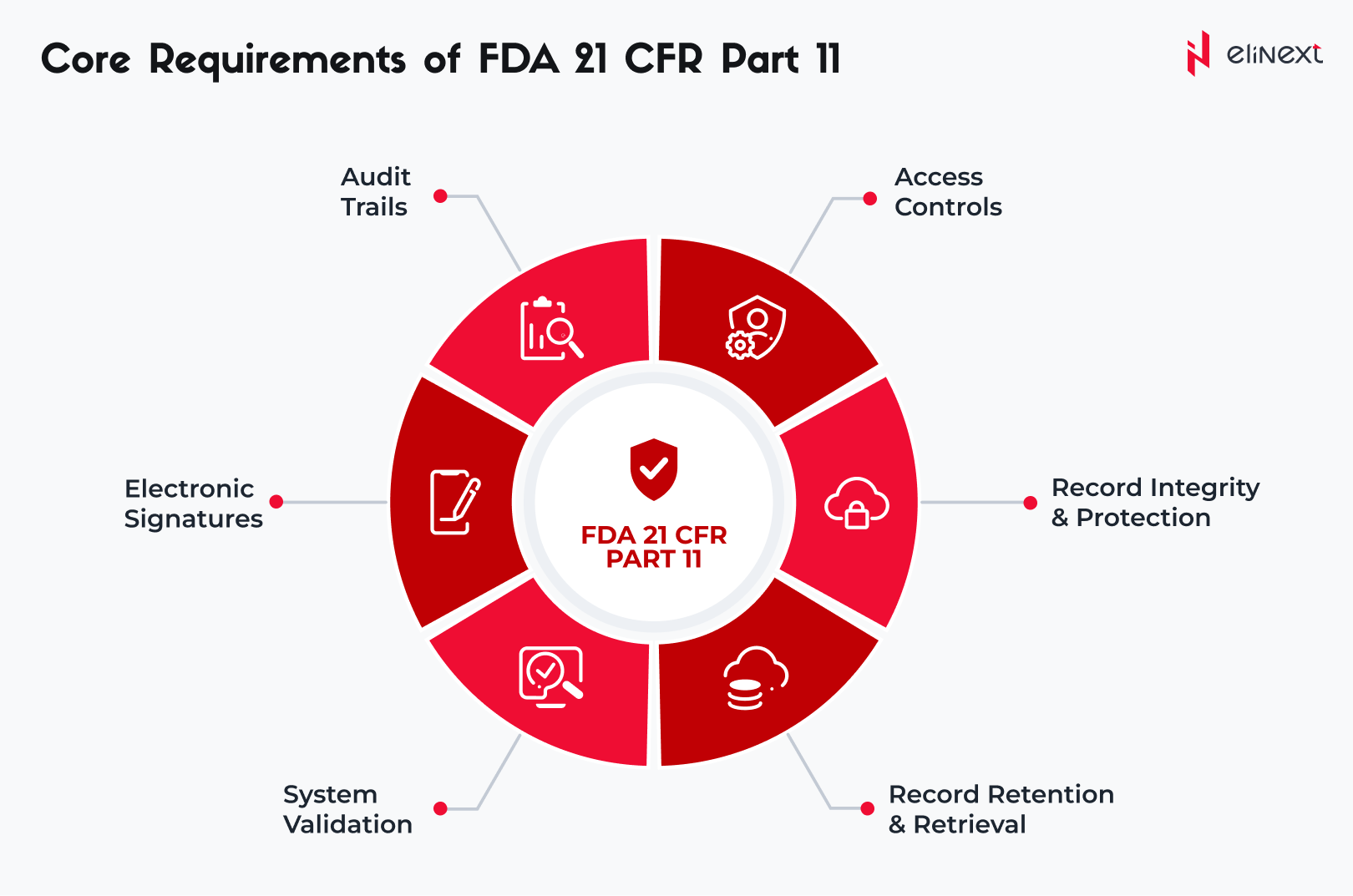
Part 11 was written for electronic records and signatures generally, not for machine learning specifically. This is exactly why most PdM teams under-build for it. Four areas carry the practical weight: audit trail granularity, access control, computer system validation, and electronic signatures.
Audit Trail Granularity: What §11.10(e) Actually Requires
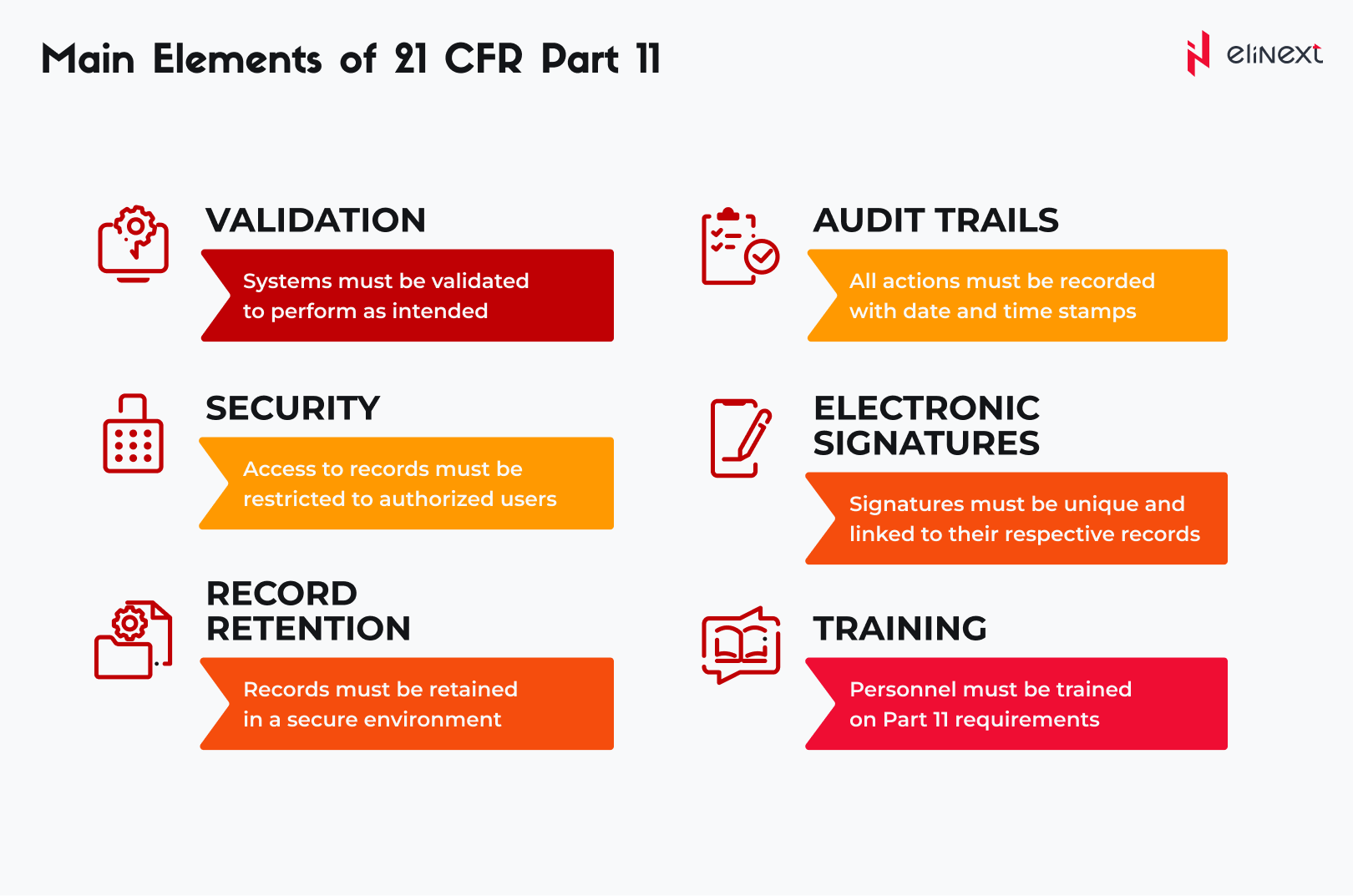
FDA 21 CFR §11.10(e) requires audit trails to be computer-generated, time-stamped, and to attribute each record change to the individual responsible, including the reason for the change. For a PdM system, this means logging: every change to a sensor reading in the database; every ML model retrain event, including who initiated it, the model version before and after, and the validation summary. Every alert override by a maintenance technician, with who, when, and why; and every calibration record. This is the practical core of FDA audit trail ML model requirements. Architecturally, the audit log must be implemented as an append-only database table, a cryptographic hash chain, or an equivalent write-once storage mechanism. Under ALCOA+ (Attributable, Legible, Contemporaneous, Original, Accurate, plus Complete, Consistent, Enduring, Available), “Attributable” means every record ties to a specific individual user account, never a shared service account. Retention must cover the full service life of the device plus two years, consistent with 21 CFR Part 820 device history record requirements.
Access Control: Why Service Accounts Fail Part 11
A common failure pattern: a PdM system writes all sensor data through a single service account, so every record is attributable only to “the system,” not to a person — a direct violation of §11.10(d). The fix is architectural: every human interacting with the system needs a unique, individual user account; automated processes, such as the ML pipeline, get their own service account, scoped to have no write access to the audit trail itself. §11.300 then governs password-based authentication specifics: password policy, account lockout, and session timeout. Multi-factor authentication isn’t strictly mandated by Part 11 text, but it is de facto expected in current FDA inspection practice.
Computer System Validation for ML Components
Computer system validation predictive maintenance work follows the classic IQ/OQ/PQ structure, but ML components strain the model built for static software. Installation Qualification confirms infrastructure, software versions, and network security are installed correctly. Operational Qualification confirms alert accuracy sits within validated thresholds and that audit trail and access control function as specified. Performance Qualification confirms consistent performance under actual production conditions. The ML-specific problem: traditional CSV assumes the software doesn’t change on its own, but model retraining is exactly that kind of change, and it requires documented change control and re-validation before any new version reaches production. FDA’s 2021 AI/ML SaMD Action Plan introduces the concept of a predetermined change control plan — a mechanism to permit updates within pre-specified boundaries without a full new submission each time.
Architecturally, this means model versioning (via a tool like MLflow), an automated validation test suite that runs before any new model version is promoted, and a documented, auditable approval workflow that gates promotion.
Electronic Signatures: When and What Format
Signatures are required at specific decision points in a PdM workflow: confirming a maintenance action clears a device for use, approving a calibration record, or signing off on a model validation summary. FDA 21 CFR §11.50 and §11.70 require the signature to carry the signer’s printed name, role, the meaning of the action, and date/time, and to be functionally equivalent to a wet-ink signature. This should be a username-plus-password re-entry, not a bare “click approve” checkbox. Architecturally, this calls for a dedicated e-signature service, with the signature captured and stored as an integral part of the electronic record rather than in a separate table.

“In our medical device software projects, the most common gap between a working PdM demo and a Part 11-compliant system isn’t the ML model itself — it’s audit trail granularity for retraining events, which teams treat as an ops log rather than a regulated record. Elinext’s healthcare engineering teams build the immutable audit layer and model versioning gate as a shared service from day one, so retraining is provable and reviewable rather than reconstructed after the fact during an audit. For clients, that has meant walking into FDA pre-submission meetings with the change-control evidence already assembled, instead of scrambling for it.”

What the EU AI Act Actually Requires From Your Predictive Maintenance Medical Equipment Architecture
Where Part 11 is about records, the EU AI Act is about the AI system’s behavior and governance across its lifecycle. Four articles carry the architectural weight for a High-Risk PdM system.
Article 14: Human Oversight Is an API Requirement, Not a UI Requirement
The architectural conclusion here matters more than the legal text: EU AI Act Article 14 human oversight does not mean a dashboard button. Article 14(4)(b) ― EU AI Act Article 14 human oversight ― requires that human operators be able to disregard the AI system’s output. This means a maintenance work order triggered by a PdM recommendation needs an explicit “Reject” action alongside “Accept,” exposed as a programmatic API endpoint that a CMMS or ERP can call. Article 14(4)(e) requires that the system can be shut down by a human. It should be implemented as a kill switch at the inference API level, not merely in the front end. Override events should feed back into post-market monitoring under Article 72: override frequency is itself a useful proxy metric for model reliability.
Article 13: Explainability Is Not Optional for High-Risk AI
Under Article 13, every maintenance recommendation the model produces needs to carry a confidence score (for example, an 87% probability of bearing failure within 72 hours), the top contributing features via a method like SHAP or LIME (for example, vibration at 3x running speed up 40% from a 30-day baseline), and a data staleness warning if the relevant sensor hasn’t reported recently. This explainability layer belongs in standard inference output and the methodology itself needs to be documented in the technical file under Annex IV §2(f). It should include a stated limitation: the system was trained on a specific date range and equipment set, and performance may degrade on variants outside that set.
Article 10: Training Data Governance
Article 10 requires documented training data governance: which equipment models are covered, the date range, sensor types used, how failure events were labeled, and the operational and geographic conditions represented. This is where representativeness gaps become compliance gaps. A model trained on three CT scanner models will not satisfy Article 10 if deployed across fifteen. Annex IV §2(d) requires documentation of data collection methodology, preparation steps, and bias assessment outcomes. Architecturally, this means data lineage tracking built into the data pipeline itself, not reconstructed after the fact.
Article 72: Post-Market Monitoring — the FDA Difference
Article 72 is where the EU AI Act diverges most sharply from the FDA’s pre-deployment validation mindset: it requires continuous tracking of inference quality on live production traffic, not just at validation time. At minimum, that means tracking false positive rate on active maintenance alerts, override rate by maintenance teams, and time from alert to confirmed failure as a leading indicator of model accuracy. This calls for an ML monitoring pipeline distinct from ordinary application monitoring — one that detects both data drift (distribution shift in sensor readings) and concept drift (degrading model accuracy against recent labeled events). Article 73 adds a hard deadline of its own: if a PdM failure contributes to a serious incident involving patient safety, it must be reported to the relevant national market surveillance authority within 15 days.
Systems built to monitor connected clinical devices at this level of detail often share infrastructure with broader hospital data platforms. You can see our work in EHR Software Development Company engagements, where the same lineage and monitoring patterns apply to clinical records.
Where FDA 21 CFR Part 11 and EU AI Act Overlap, and Where They Conflict
If you’re building for both the US and EU markets at once, this section is the one that actually changes your architecture.
Shared Requirements: Build Once
Four components satisfy both regulatory regimes without duplication, forming what amounts to EU AI Act EU MDR interaction made concrete at the architecture layer: an immutable audit trail with user attribution and timestamps, required by both §11.10(e) and Article 72; a human override mechanism, required by both §11.10(d) access control logic and Article 14(4)(b) disregard capability; model versioning with deployment gates, required by both CSV change control and EU AI Act substantial-modification rules; and data lineage tracking, required by both ALCOA+ and Article 10 data governance. Build these four once, correctly, and they serve both jurisdictions.
The Core Conflict: Pre-Validation vs. Continuous Monitoring
The genuine tension: FDA expects a “validated state” fixed at the point of deployment, while the EU AI Act expects a “monitored state” that evolves post-deployment, with updates permitted as long as they’re documented. For a model that retrains on new data, each retrain is a change requiring validation under FDA rules. At the same time, under the EU AI Act, it’s permissible if it stays within predetermined change boundaries and gets documented in the post-market monitoring report. FDA’s predetermined change control concept and the EU AI Act’s substantial modification concept point at the same problem from different directions, but the implementation details differ. The practical resolution is to define model change boundaries upfront (for example: “retraining on new data within the original sensor types, same equipment models, accuracy metrics within ±5%”). Changes within those boundaries get a lighter validation path; changes outside them trigger full re-validation plus an EU AI Act substantial modification assessment.
Jurisdiction-Specific: What Each Regulator Requires Alone
Some obligations don’t overlap at all. FDA-only: the §11.50 electronic signature format, Computer System Validation documentation per GAMP 5, and FDA-specific predicate rule records. EU AI Act-only: conformity assessment under Article 43, registration in the EU AI Act database under Article 49, an EU declaration of conformity under Article 48, and a post-market monitoring plan submitted to the Notified Body, alongside EUDAMED registration where EU MDR also applies.
Our medical device software development services team can walk through where your current architecture already covers shared requirements, and where it doesn’t.

Compliance-Ready Predictive Maintenance Medical Equipment Architecture: Core Components
Everything above resolves into seven concrete services. Build these, and both FDA 21 CFR Part 11 and EU AI Act obligations are structurally addressed rather than bolted on late.
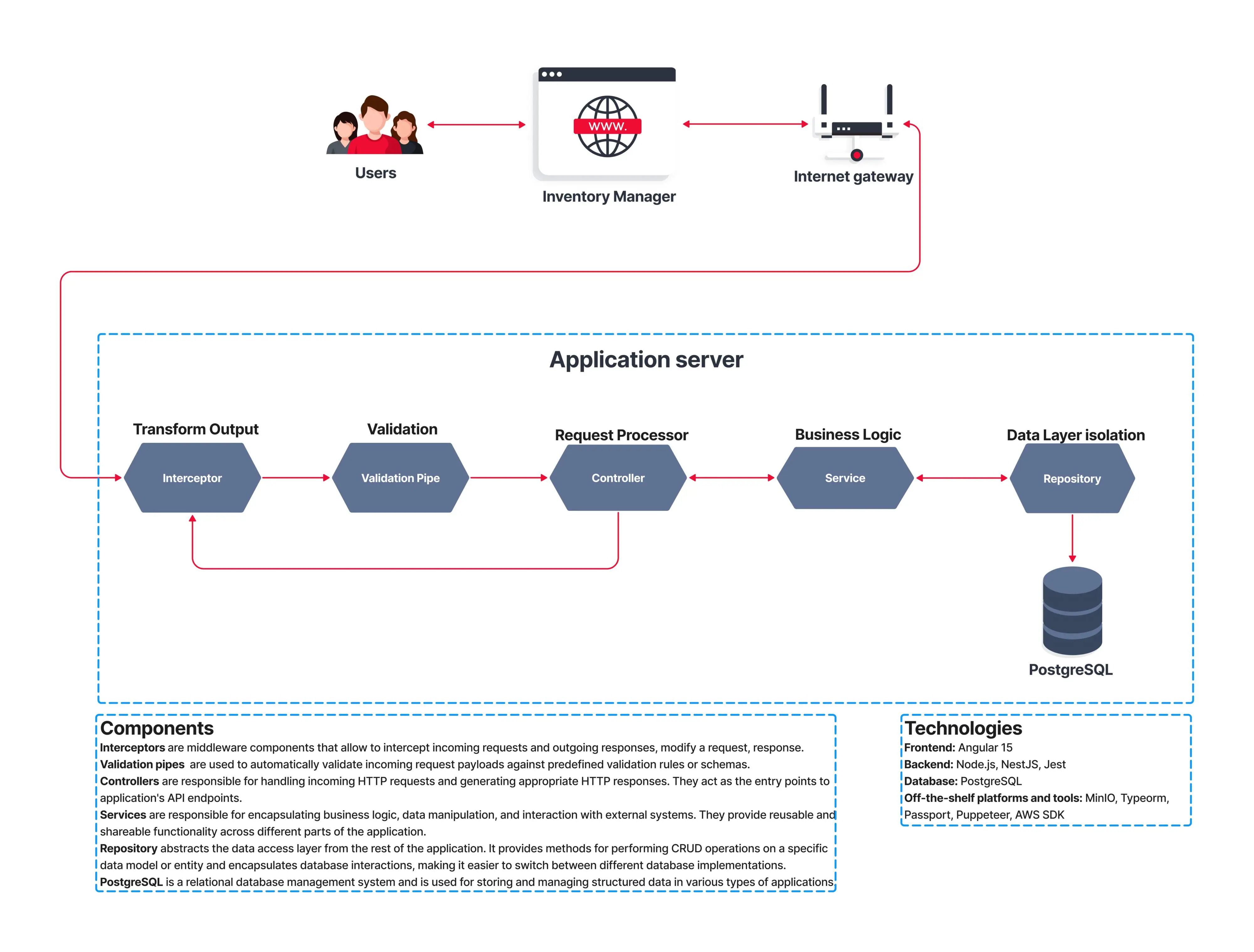
- Immutable Audit Trail Service — an append-only store (e.g., an event-sourced database or hash-chained log) capturing every sensor change, retrain event, and override with user attribution and timestamp. Satisfies §11.10(e) and Article 72 simultaneously.
- Role-Based Access Control (RBAC) + Individual User Accounts — enforced via an identity provider (e.g., Keycloak or Azure AD) with no shared service accounts writing to regulated records, addressing §11.10(d) and §11.300.
- Human Oversight API — a programmatic Accept/Reject/Pause endpoint callable by CMMS or ERP systems (not UI-only), directly implementing Article 14(4)(b) and (e).
- Explainability Layer — SHAP- or LIME-based feature attribution and confidence scoring attached to every inference output, meeting Article 13 transparency requirements.
- Model Versioning + Deployment Gate — a registry such as MLflow paired with an automated validation suite and documented approval workflow before any model promotion, covering both CSV change control and EU AI Act substantial modification tracking.
- ML Performance Monitoring Pipeline — dedicated drift and concept-drift detection (e.g., via Evidently AI or a custom statistical monitor) feeding the Article 72 post-market monitoring report.
- FDA E-Signature Service (US-only) — a dedicated signing service capturing printed name, role, meaning of signature, and timestamp per §11.50, stored as part of the electronic record itself.
“When a client’s PdM platform went through Notified Body review for EU MDR, the first question was whether the ML model qualified as MDSW under MDCG 2019-16. The second was whether the override mechanism was documented in the technical file, not just present in the UI. Elinext’s approach is to design the audit trail, oversight API, and monitoring pipeline as one compliance layer shared across FDA and EU AI Act obligations, rather than as separate deliverables per regulator. The result for clients has been fewer review cycles with the Notified Body and a technical file that holds up on the first submission.”
Key Takeaways: Predictive Maintenance Medical Equipment Architecture for Dual-Jurisdiction Compliance
- FDA 21 CFR Part 11 applies to a PdM system when it creates electronic records required by a predicate rule (21 CFR Part 820, 211). ML model retraining events are “changes” that require audit trails with previous value, reason, and user attribution per §11.10(e).
- EU AI Act High-Risk AI classification likely applies under Annex III Point 5(a) when a PdM system monitors medical equipment regulated under EU MDR 2017/745. Full compliance deadline: August 2, 2026.
- Four architectural components satisfy both regulations simultaneously: immutable audit trail, RBAC with individual accounts, human oversight API, and model versioning with deployment gates.
- The core conflict between regulations: FDA requires pre-deployment validation (CSV/IQ/OQ/PQ); EU AI Act requires post-deployment continuous monitoring (Article 72). FDA’s AI/ML predetermined change control framework bridges this gap.
- EU AI Act Article 14 requires human oversight to be implemented as a programmatic API callable by CMMS/ERP. It cannot just be a UI element that could be bypassed in automated maintenance workflows.
Our Healthcare Software Development Services group has run this exact dual-jurisdiction. We’ve scoped exercises for medical device manufacturers and hospital systems alike.
FAQ
-
No. It applies when the PdM system creates or manages electronic records required by a predicate rule, such as device maintenance or calibration records under 21 CFR Part 820. A PdM tool that only generates internal analytics without producing records that an inspector would audit is unlikely to be in direct Part 11 scope. However, this determination should be confirmed on a case-by-case basis.
-
Not automatically, but often. If the monitored equipment is itself a medical device under EU MDR 2017/745 and the PdM system functions as a safety component, it typically falls under Annex III Point 5(a) as High-Risk AI. Systems that only produce non-safety-related operational analytics may fall outside this classification. Again, a case-by-case determination tied to intended use. That determination is really an EU AI Act medical device software classification exercise, and it’s worth doing before development starts, not after a Notified Body review.
-
Each retraining event is treated as a change to a validated system. It must be logged in the audit trail with who initiated it, the model version before and after, the reason, and the validation results. It is consistent with §11.10(e) and standard computer system validation change-control practice.
-
For systems classified as High-Risk AI, full compliance with EU AI Act Regulation (EU) 2024/1689 is required by August 2, 2026.
-
Largely, yes. An immutable, user-attributed, timestamped audit trail satisfies §11.10(e) on the FDA side and feeds directly into Article 72 post-market monitoring reporting on the EU AI Act side. The signature format and a handful of jurisdiction-specific submissions still need to be built separately, but the audit trail itself is a shared component.