



Understanding the difference between LLM vs generative AI (Large Language Models and Generative Artificial Intelligence) is key to grasping today’s AI landscape. While these terms are often used interchangeably, there is a distinct difference that underlines LLM vs generative AI concepts. LLMs are a type of generative AI focused on language, but generative AI includes a broader range of tools that create text, images, audio, and more using machine learning.
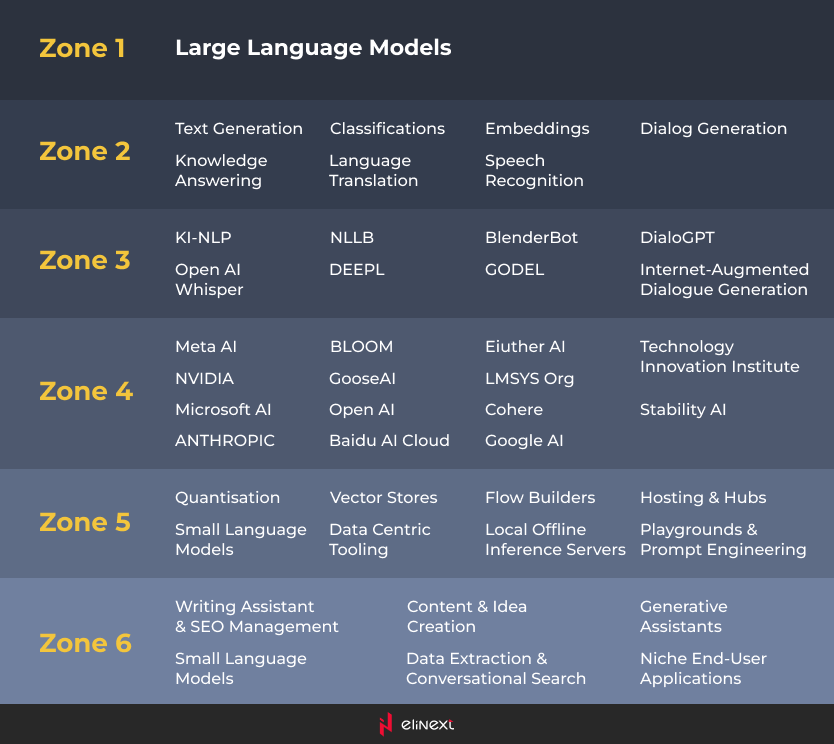
How do Large Language Models Work?
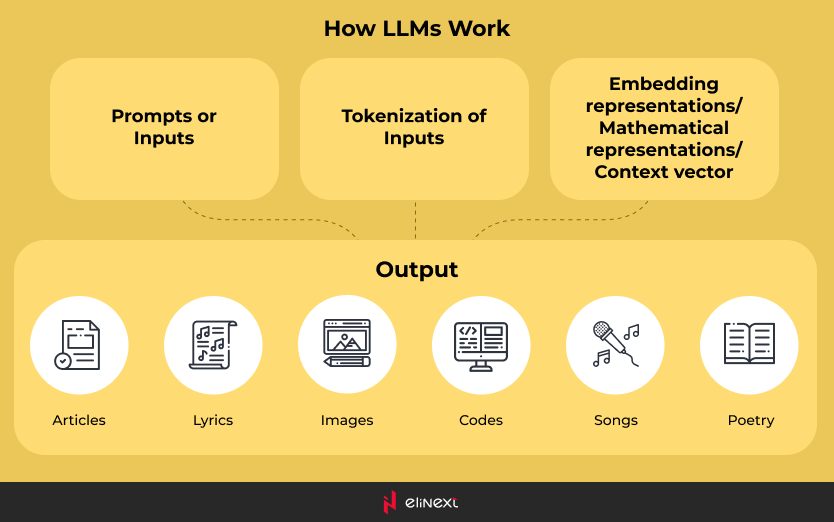
A Large Language Model (LLM) is an advanced type of AI trained on vast amounts of text data to understand and generate human-like language. It can perform tasks like answering questions, writing articles and lyrics, translating languages, summarizing content, creating codes, and generating text based on prompts.
Some Examples of Popular LLMs
Several powerful LLMs have been developed by leading tech companies, each with unique capabilities and uses across industries.
GPT Series (Generative Pre-trained Transformer)
Developed by OpenAI, the GPT series powers tools like ChatGPT. These models are trained on massive datasets to understand and generate human-like text, enabling applications like writing assistance, coding help, and conversational agents.
LLaMa (Large Language Model Meta AI)
Created by Meta (formerly Facebook), LLaMa is designed for research and academic use. It’s known for being open-source and efficient, boasting strong performance even with smaller model sizes, which makes it accessible to a broader AI community.
Gemini
Gemini is Google DeepMind’s LLM family, designed to integrate text, code, and multimodal capabilities. It combines Google’s AI advancements with powerful language understanding and aims for deep reasoning, advanced coding, and real-world application support.
Claude
Claude, developed by Anthropic, focuses on safety and usability. Named after Claude Shannon, it’s designed to be helpful, harmless, and honest, with strong conversational skills and a high level of contextual understanding in long-form text interactions.
Mistral
Mistral is an open-weight LLM developed in Europe, known for its speed and efficiency. It provides powerful performance in a compact design, catering to developers who want flexible, high-quality models without relying on large-scale infrastructure.
Discover how you can use LLM vs generative AI in your business
What is Generative AI
Generative AI refers to artificial intelligence systems that can create new content, such as text, images, music, code, or video, based on patterns learned from data. It uses models like LLMs, diffusion models, and GANs to generate human-like or original outputs across media.
Types of Generative AI Models
Generative AI encompasses a variety of model types, each using different methods to learn data patterns and generate new outputs. Here are some of the key categories:
Autoregressive Models
Autoregressive models predict the next element in a sequence based on previous elements. Widely used in language models like GPT, they generate coherent text by estimating probabilities one token at a time, making them ideal for sequential data like speech or language.
Gaussian Generative Models (GGMs)
GGMs use Gaussian distributions to model data. They assume that data points come from a mixture of normal distributions. Though simpler than deep learning models, GGMs are useful in unsupervised learning tasks like clustering and anomaly detection.
Probabilistic Generative Models
These models use probability distributions to represent and generate data. Examples include Variational Autoencoders (VAEs) and Bayesian networks. They offer interpretability and are used for tasks like image generation and feature learning.
Hidden Markov Models (HMM)
HMMs are statistical models that represent systems with hidden states. They’re useful for modeling time-series or sequence data, like speech, handwriting, or biological sequences, where the system state isn’t directly observable but influences visible outcomes.
Flow-Based Models
Flow-based models use invertible transformations to map complex data distributions into simpler ones. They allow exact likelihood computation and high-quality sampling, making them powerful for image generation and density estimation tasks.
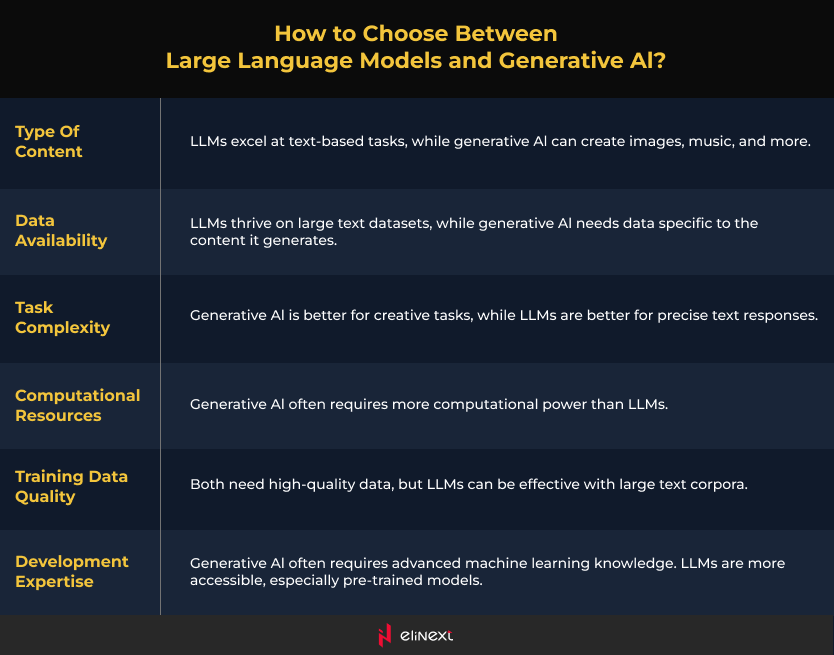
When to Choose LLM Over Generative AI
Generative AI and LLMs work together by combining strengths: LLMs handle complex language tasks, while broader generative AI models create diverse content like images and audio. Together, they enable richer, multimodal AI experiences by integrating language understanding with creative generation.
How Generative AI and LLMs Work Together
Generative AI and LLMs complement each other by blending language understanding with creative content generation. LLMs specialize in processing and generating human-like text, while generative AI covers images, audio, and more. Together, generative AI vs LLM create versatile AI tools that produce rich, multimodal outputs.
Unlock the power of advanced AI for your business
7 Key Differences Between LLM and Generative AI
LLM vs generative AI means the following: while LLMs are a core part of generative AI, they differ in scope, function, and specialization. Here’s a breakdown of the key difference between LLM and generative AI and how they compare across key dimensions:
Scope of Application
LLMs focus on language tasks like text generation, summarization, and translation. Generative AI covers a wider range, creating not just text but also images, audio, video, and code using different model types.
Training Data and Learning
LLMs are trained primarily on large text corpora from books, websites, and documents. Generative AI models use diverse data types, such as text, images, sound, etc., depending on their output goals and architecture.
Functionality and Output
LLMs generate coherent and context-aware language. In contrast, generative AI produces a broader variety of outputs, including pictures, music, and even 3D models, depending on the task and model.
Techniques and Networks
LLMs typically rely on transformer-based neural networks. Generative AI models use a variety of techniques like GANs, VAEs, diffusion models, and transformers, depending on the content type and application.
Domain Specialization
LLMs are tailored for language-specific tasks and can be fine-tuned for sectors like law, medicine, or customer support. Generative AI models may specialize in domains like art, gaming, or music composition.
Adaptability
LLMs adapt well to new language-based tasks with prompt tuning or few-shot learning. Generative AI models vary in adaptability depending on the complexity of the data and output type.
Output Control
Controlling LLM outputs involves prompt engineering and fine-tuning for tone or style. Generative AI often requires more complex control mechanisms, like conditioning, to guide outputs across media types.
The Future Trends of Generative AI and LLM
The future of generative AI vs LLM points to deeper integration across industries, with advancements in multimodal models that combine text, visuals, and audio. We’ll see more personalized, context-aware AI tools, enhanced ethical safeguards, and open-source development. As models grow more efficient and accessible, businesses will adopt them for everything from automation to creative collaboration.
Ready to build smarter software? Partner with us to develop AI-powered solutions
Conclusion
Understanding the LLM vs generative AI is essential for leveraging the full potential of generative AI and LLM. While LLMs excel at language-based tasks, generative AI offers a broader range of creative capabilities. If this is something that inspires you to build next-generation software, reach out to Elinext. Elinext is a software development company that provides generative AI development services, chatbots development services, AI software development services, ML software development services, LLM Development Services, ChatGPT Development Services, and AI integration services.
FAQ
1. Are Generative AI and LLMs the same thing?
No, there is a difference between generative AI and LLM. LLMs are a type of generative AI focused on text. Generative AI includes models that create images, audio, video, and more.
2. Are there overlaps between Generative AI and LLMs?
Yes, there is an overlap, and not just the difference between generative AI and LLM. LLMs fall under generative AI. They both generate content, but generative AI covers more media types beyond language.
3. Do LLMs understand language like humans do?
No. LLMs mimic understanding by recognizing patterns in text, but they don’t truly comprehend meaning like humans.
4. How is training different between Generative AI and LLMs?
There is a training difference between generative AI and LLM. LLMs are trained on text with transformers. Other generative models use images, audio, or video and different architectures like GANs or VAEs.
5. What skills should I learn to work with Generative AI and LLMs?
Learn Python, ML frameworks (PyTorch/TensorFlow), NLP, prompt engineering, and neural network basics like transformers.
