










































































































































IoT programming languages are specialized or adapted languages used to write code for connected devices, gateways, edge nodes, and cloud services within the IoT ecosystem. Teams use them to build smart homes, industrial sensors, wearable medical devices, and enterprise IoT platforms. Using four leading languages enables faster prototyping, reduced hardware costs, robust software, and scalable cloud integration across the entire IoT product stack.
Each programming language used in IoT plays a role: C/C++ is responsible for software, Python accelerates analytics, Java powers gateways, and JavaScript enables cloud dashboards. These four languages form the foundation of modern IoT systems. Companies creating smart devices, wearable medical devices, or industrial sensors need to address every layer. Java developers for hire provide scalable backend development, while C engineers ensure real-time device control.
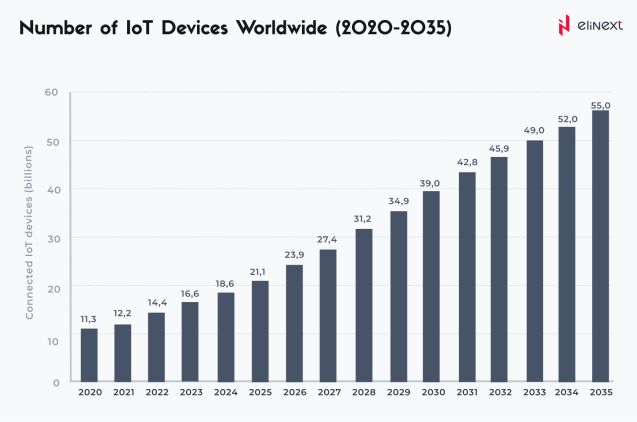
Choosing the right programming languages for IoT improves efficiency at all levels of the system. The IoT market will reach $1.18 trillion by 2026 (Statista). IoT development services reduce time to market by choosing C++ for the edge, Python for analytics, and Java for the backend.
What is the Internet of Things (IoT)?
The Internet of Things (IoT) is a network of physical devices – sensors, appliances, vehicles – connected via the internet to collect and exchange data. A smart thermostat reads the room temperature, sends the data to the cloud, and automatically regulates the heating. Building such systems requires mastering IoT programming languages, as each layer – device, gateway, and cloud – requires different technical capabilities.
Choose the best language for IoT development and build faster, smarter connected products.

Even if IoT (the Internet of Things) might be considered as a relatively new domain, little by little, we are getting familiar with smart devices. It’s all about human nature: we get used to everything. Anyway, it’s still funny: could you imagine, say, ten years ago having a home appliance that can regulate its performance? Back then, this kind of technology was available only in sci-fi movies.
On paper everything looks innovative and futuristic. However, the industry has its flaws in development, and its speed of IoT implementation across the world is relatively low. One of the major factors contributing to the current state of things is the lack of professionals. The demand for engineers with IoT skills is high, and there’s a serious gap in the job market.
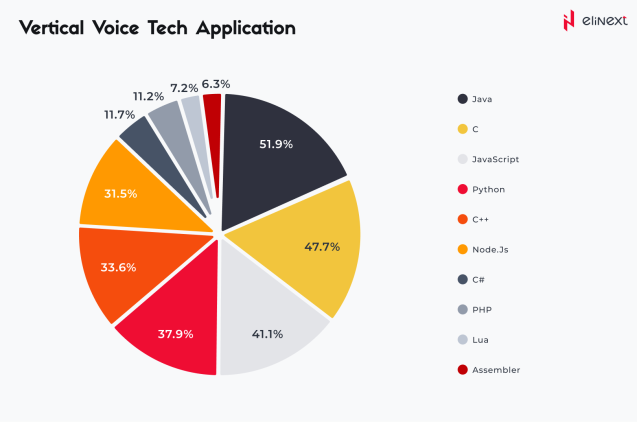
It doesn’t come as a surprise. Behind every technological innovation stands a programming language. The most popular programming languages for IoT are Java, C, C++, Python, JavaScript and Go – always in-demand languages in their own right – so no wonder that there’s a shortage of job resumes.
Java
Java is omnipresent. Its field of application varies from back-end programming to mobile apps.
Its main competitive advantage lies in the fact that Java isn’t subjected to any hardware limitations. In other words, the language offers a high level of portability meaning that it’s possible to write and debug a code written in Java and deploy it to any computer that runs Java Virtual Machine. No wonder that it is a popular programming language used in IoT and lots of companies employ Java developers for their IoT projects.
Its main competitive advantage lies in the fact that Java isn’t subjected to any hardware limitations. In other words, the language offers a high level of portability meaning that it’s possible to write and debug a code written in Java and deploy it to any computer that runs Java Virtual Machine. No wonder that lots of companies employ Java developers for their IoT projects.
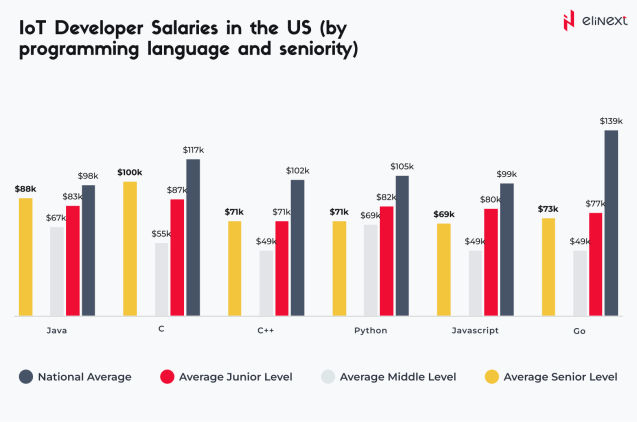
This paradigm results in salaries. According to Payscale, a medium salary for Java developers in the US is about $88.000. It’s worth noting that these results don’t provide an exact image. When talking about paychecks, a developer’s experience and status are the points to rely on when calculating. For example, the gap in salaries between a junior and a senior Java developer in the USA may be around $30.000 (from $66.000 to $97.000 respectively). The geographical factor is also a point to consider. For instance, Java developers in California where the mecca of innovation and technology aka the Silicon Valley is located, get the highest salary nationwide –$133.000.
C
C is regarded as a low-level programming language used in IoT (however, it’s high-level enough to make programming simple), but that’s exactly what the IoT development process demands. If you consider the fact that C allows direct cooperation with hardware using a human-readable syntax, it’s a good match for many IoT-oriented companies. Besides, C is highly flexible and swift in comparison with other programming languages for IoT, and that’s good news for IoT systems with limited processing power.
These particular features make C a “second best” among programming languages for IoT development. Besides:
- C is a weapon of choice when it comes to constrained device development;
- C provides direct access to low-level hardware APIs;
- The language is available on almost every advanced embedded system platform;
Python
Ironically enough, but just a few years ago, Python was considered as a language for developing web applications with no apparent application for IoT on the horizon. Nowadays, the situation has changed: Python is frequently mentioned as an easy programming language to understand and utilize in IoT projects. Some even claim that it is more flexible than C or Java, which have a lot of requirements and rules built up over the decades.
All in all, Python works as a charm for developing data-intensive applications, particularly if there’s a need to manage and organize volumes of complex data. Similar to Java, the source code written in Python is compact and highly readable due to the clean syntax of the language. Despite the fact that it’s not as fast as C or C+, you might consider Python if you work with small devices that have limited computational power and memory. Python is really popular for many SBCs (or Session Border Controllers) because of its convenience and the variety of simple libraries and Internet features.
JavaScript
A recognized king of modern web development for the past several years, JavaScript has been one of the most popular programming languages with multiple fields of application.
In the IoT sector, JavaScript is most commonly used to build event-driven systems. Thanks to JavaScript, it is possible to manage immense networks of connected devices. This language is highly efficient in terms of resources: for instance, it is possible to process a number of tasks simultaneously without waiting for each separate task to be completed.
No wonder that both international corporations like Samsung or IBM and midsize companies all over the world are actively using JavaScript for their Internet of Things projects. This trend creates a sort of shortage of available personnel as the demand for experienced JavaScript developers is always high.
Some other honorable mentions include:
- Go
- C++
- Swift
- Php

Choosing the wrong programming languages for IoT results in months of wasted development. For firmware development, you need a C++ development company; for the backend, Java development services; for the API, Node.js. When teams lack these skills, integration fails. Elinext bridges this gap and you can find your PHP development team, C++ and Java experts under one roof, reducing risks and accelerating delivery.

Conclusion
Choosing the right programming language for IoT directly determines the quality and speed of a product. By 2026, the IoT market will reach $1.18 trillion and connect over 18 billion devices. C/C++ remains the best language for IoT development at the embedded level, while Python, Java, and JavaScript dominate in analytics, gateways, and cloud environments. A smart factory using Python-based predictive maintenance reduced downtime by 30%. Partnering with an experienced Python development company ensures that your data pipelines and automation logic are reliable, scalable, and ready for the next wave of connected devices.
IoT Programming Languages: Terms Explained
-
Embedded C
Embedded C is a simplified extension of C adapted for microcontrollers and resource-constrained hardware. It provides developers with direct register access and precise timing control, making it indispensable for sensors and real-time IoT devices, such as industrial monitors.
-
MicroPython
MicroPython is a compact Python implementation designed for microcontrollers such as the ESP32 and Raspberry Pi Pico. It brings the readable syntax of Python to resource-constrained IoT hardware, enabling rapid prototyping of sensors, actuators, and peripheral scripts.
-
Arduino Programming Language
The Arduino Programming Language is a simplified dialect of C/C++ for Arduino boards. It abstracts hardware complexity with built-in libraries, allowing beginners to control LEDs, motors, and sensors ideal for prototyping smart home projects or wearable IoT devices.
-
JavaScript (Node.js)
JavaScript (Node.js) is often considered the best language for IoT development at the cloud and dashboard levels. Its event-driven, non-blocking model handles thousands of concurrent device connections, efficiently powering real-time IoT dashboards and REST APIs.
-
Rust
Rust is a systems programming language that provides memory safety without garbage collection, making it an increasingly popular choice for building secure IoT software. It eliminates common errors such as buffer overflows during compilation, making it ideal for mission-critical applications like connected medical devices.
FAQ
-
The most common programming languages for IoT are C/C++, Python, Java, and JavaScript. They are used to build every layer of an IoT system firmware, data pipelines, gateways, and dashboards. Enterprises use them to deploy scalable and secure connected products; for example, a logistics company uses C++ for edge sensors and Python for cloud-based fleet analytics.
-
Embedded C is the primary programming language used in IoT firmware development. It is used to write low-level drivers, interrupt handlers, and real-time control logic on microcontrollers with kilobytes of memory. Enterprises use it to create robust industrial sensors and medical devices where deterministic timing and minimal size are essential.
-
Python is one of the most versatile IoT programming languages, designed for edge analytics and automation. It is used to process sensor data streams, perform machine learning inference, and automate device control using libraries such as MicroPython, asyncio, and TensorFlow Lite. Enterprises use it to speed time to market; for example, smart agriculture platforms use Python to analyze soil data and automatically trigger irrigation.
-
JavaScript is one of the most flexible IoT programming languages for web-based platforms. It is used to build real-time dashboards, RESTful APIs, and MQTT-based device interfaces using Node.js. Enterprises use JavaScript development services to connect thousands of devices to cloud platforms; for example, a smart building operator uses Node.js to stream sensor data to real-time energy dashboards.
-
Java is a powerful choice among IoT programming languages for gateway and enterprise-grade applications. It is used to build secure, multithreaded middleware, device management platforms, and backend services using frameworks such as Eclipse IoT and Spring Boot. Enterprises use it to integrate IoT with ERP systems; for example, a manufacturer uses Java middleware to connect factory sensors with SAP in real time.
-
Python is widely regarded as the most accessible of programming languages for IoT beginners. It is used for prototyping sensors, automating scripts, and processing data with minimal boilerplate code thanks to its readable syntax and rich library ecosystem. Enterprises use it for quick proof-of-concept projects; for example, a startup used MicroPython on ESP32 to build a smart plant irrigation system in less than a week.
-
C++ is recognized as the best language for IoT development when maximum performance is required. It is used to write firmware for real-time operating systems, device drivers, and latency-critical control loops on resource-constrained hardware. Enterprises are using it in automotive and industrial IoT environments; for example, a self-driving car manufacturer uses C++ to aggregate sensor data with sub-millisecond accuracy.