
Spec driven development is a software engineering approach where a formal specification becomes the primary source of truth for building systems. It is designed for product owners, architects, and engineering teams looking for predictable delivery and alignment. The result is transparent requirements, faster execution, and fewer defects. As systems grow more distributed and AI-assisted coding accelerates releases, businesses increasingly rely on specification-first practices to reduce ambiguity and control risk.
What is Spec Kit?
Spec Kit is a structured toolkit used in spec driven development to create, store, and validate specifications. It centralizes contracts, schemas, and acceptance criteria in one governed environment. By turning requirements into executable artifacts, it supports automation and reduces misinterpretation.
What is Spec Driven Development (SDD)?
Spec driven development (SDD) is a methodology where development begins with a detailed, machine-readable specification that guides implementation. Instead of writing code first, teams define contracts, rules, and validations upfront. For those asking what is SDD, it means building software from agreed specifications rather than assumptions.
Clarify your product vision with structured specifications
How Does Spec Driven Development Work?
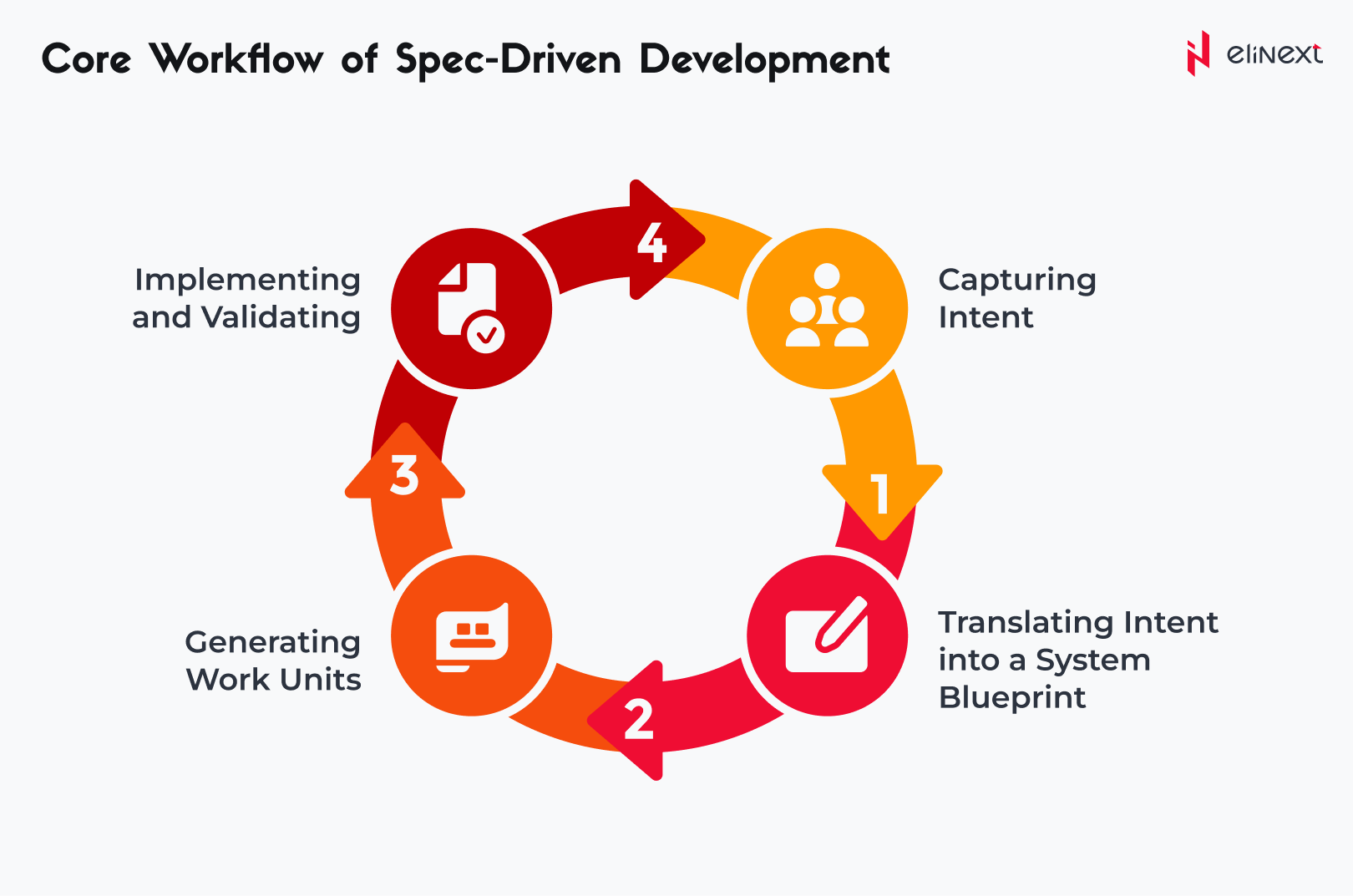
Spec driven development works by defining a formal specification before coding begins and using it as the foundation for generation, validation, and deployment. The specification acts as a contract between stakeholders and systems, enabling automation and ensuring consistency from idea to release.
Write Specification
Everything starts with translating business needs into a precise, structured specification. This document captures expected behavior, rules, and constraints, giving both stakeholders and engineers a single point of reference.
Review & Approve
Stakeholders then examine the specification to confirm it reflects real objectives and technical realities. Their approval formalizes alignment and reduces uncertainty before any code is written.
Generate Scaffolding
With agreement in place, tools use the approved specification to automatically create the project’s base structure. This jump-starts development while preserving consistency across components.
Implement Code
Developers build functionality on top of the generated foundation, guided closely by the defined contracts. Clear boundaries help maintain focus and prevent unintended deviations.
Validate Against Spec
Each completed feature is checked against the original specification through automated tests and reviews. These validations ensure the implementation truly matches the agreed requirements.
Deploy
After successful validation, the solution moves to production. Because every step traced back to the same specification, the release is controlled, transparent, and aligned with business expectations.
“Data modernization is difficult because legacy systems embed undocumented logic and hidden dependencies. Elinext addresses this by translating business rules into formal specifications before transformation begins. This structured foundation reduces migration risks and enables measurable improvements in delivery speed and operational resilience.” — Alexey Trigolos, Enterprise Architecture Consultant
The Benefits of Spec Driven Development (SDD)
Spec driven development improves collaboration, transparency, and delivery speed by formalizing requirements. By understanding the SDD meaning as specification-first engineering, organizations gain stronger governance and reduced operational risk across distributed and fast-scaling teams.
Accelerated Onboarding
New team members gain clarity quickly because specifications clearly describe system behavior and structure. Instead of relying on verbal explanations, they work with documented contracts that shorten ramp-up time and reduce dependency on senior staff.
Seamless Cross-Team Integration
Shared specifications act as common ground for distributed teams working on interconnected components. With clearly defined contracts, collaboration becomes more predictable, and integration issues are identified before they affect delivery timelines.
Legacy System Evolution
Modernizing older platforms becomes safer when changes are guided by formal specifications. Clear contracts help teams refactor or extend functionality without disrupting critical dependencies or introducing hidden regressions.
Efficient Code Reviews
Reviews shift from subjective opinions to objective validation against agreed specifications. This structured approach reduces friction, speeds up approvals, and keeps discussions focused on compliance and quality.
Self-Maintaining Documentation
Because documentation is generated directly from specifications, it evolves together with the system. As updates are introduced, records remain accurate, eliminating the common problem of outdated technical documentation.
Eliminate ambiguity from your development process
How SDD Solutions by Elinext Can Help Your Business
Elinext applies spec driven development to align stakeholders, automate scaffolding, and ensure traceable validation. By embedding structured specifications into delivery pipelines, we help businesses reduce rework, modernize legacy platforms, and maintain compliance. Additionally, we offer AI integration services and machine learning development services.
“Modernization initiatives often fail because requirements are scattered across documents and tribal knowledge. Elinext introduces specification-first workflows that convert informal expectations into enforceable contracts. This clarity reduces integration failures and creates predictable business impact.” — Maxim Dadychyn, Digital AI Transformation Advisor
How Traditional Development Creates Problems
Traditional development often starts with loosely defined requirements, which leads to interpretation gaps and inconsistent implementation. Without a formal contract, teams rely on memory and documentation that quickly becomes outdated.
Interpretation Drift
When requirements are loosely defined, teams gradually form different understandings of the same feature. Over time, these small deviations accumulate, leading to inconsistent functionality and results that no longer reflect the original intent.
Knowledge Loss
Critical system logic often lives in developers’ experience rather than structured artifacts. When key contributors leave or change roles, valuable context disappears, making maintenance slower and riskier.
Integration Failures
Without clearly defined contracts, components evolve independently and stop fitting together. This mismatch causes unexpected errors, delays releases, and increases the cost of coordination between teams.
Documentation Decay
Traditional documentation quickly becomes outdated as code changes but documents remain static. As trust in written materials declines, teams rely on guesswork, increasing errors and compliance challenges.
How is SDD Different from Test-Driven Development (TDD)?
Spec driven development defines system behavior through comprehensive specifications before coding, while Test-Driven Development (TDD) focuses on writing tests before implementation. For those exploring what is SDD, it emphasizes full contracts and architecture, whereas TDD validates small functional units. SDD governs system-wide behavior; TDD ensures code correctness.
Discover how specification-first engineering transforms delivery
Conclusion
Spec driven development enables organizations to build predictable, scalable, and transparent software systems. By treating specifications as enforceable contracts rather than static documents, businesses reduce ambiguity and strengthen governance. Understanding the SDD meaning helps leaders shift from reactive coding to structured engineering, ensuring measurable outcomes, smoother integrations, and long-term system resilience.
Spec Driven Development: Terms Explained
Specification (Spec)
A formal, structured description of system behavior in 150–200 characters that defines requirements, constraints, and expected outputs.
Contract
A binding agreement between systems or teams describing interfaces, inputs, outputs, and responsibilities in a verifiable format.
Contract-First Development
An approach where contracts are defined before implementation, guiding architecture and reducing integration conflicts.
API Schema
A machine-readable definition of API structure, endpoints, parameters, and responses used for automation and validation.
Acceptance Criteria
Clear, testable conditions that define when a feature is considered complete and compliant with requirements.
Validation
The process of verifying that the implementation matches the agreed specification or contract.
Contract Testing
Automated testing that ensures services adhere strictly to defined interface contracts.
Versioning
A structured method of managing changes in specifications without disrupting dependent systems.
Breaking Change
A modification in a specification that disrupts compatibility with existing consumers or integrations.
Spec Drift
Gradual deviation between the implemented code and the original specification due to unmanaged changes.
FAQ
What counts as a “spec” in SDD?
A specification in spec driven development is a structured, machine-readable document defining system behavior. It is used to guide implementation and validation. Businesses apply it to align stakeholders and automate development workflows.
Why is spec driven development important?
Spec driven development is a methodology that formalizes requirements before coding begins. It is used to reduce ambiguity and integration risks. Businesses apply it to ensure predictable releases and stronger governance.
Is spec driven development only for APIs?
Spec driven development is not limited to APIs but applies to full systems. It is used for backend services, integrations, and even UI logic. Businesses apply it wherever contracts and traceability are required.
What is “Contract-First” development?
Contract-First development is an approach where system contracts are defined before implementation starts. It is used to align teams early. Businesses apply it to prevent integration mismatches and costly redesigns.
What tools are used in spec driven development?
Spec driven development tools are platforms that create, validate, and automate specifications. They are used for schema design, contract testing, and scaffolding generation. Businesses apply them to enforce consistency.
How does SDD prevent breaking changes?
Spec driven development prevents breaking changes by validating updates against existing contracts. It is used to detect incompatibilities early. Businesses apply versioning and automated checks to maintain stability.
Can SDD work in Agile teams?
Spec driven development is compatible with Agile methodologies. It is used to define clear increments and enforce acceptance criteria. Businesses apply it within sprints to maintain clarity while iterating quickly.
About the Author
Alexey is an ERP consultant at Elinext with over 25 years of experience in enterprise IT. He specializes in ERP implementation, IT service delivery, and building long-term client partnerships — helping businesses align technology with their operational goals and navigate complex digital transformation projects.