
The bmad method is a structured approach to building custom AI agents that directly connect business models with system architecture and governance. Created for startups, product teams, and enterprises, it replaces fragmented experimentation with scalable, transparent design. Using the bmad framework, companies transform AI initiatives into systems that deliver measurable value, reduce technical debt, and support long-term digital modernization.
What is the BMB Toolkit?
BMB (BMad Builder) is an engineering environment used to design and scale AI agents. It structures prompts, integrations, and architectural controls. In bmad method AI development, BMB converts strategic models into executable systems aligned with governance and business goals.
What is the BMAD Ecosystem?
The BMAD ecosystem is a layered system that unites strategy, architecture, governance, and execution under one operating logic. Instead of treating AI as an experimental add-on, the bmad framework embeds intelligence into the enterprise structure. This creates continuity between vision, implementation, and measurable business results.
BMad-CORE
BMad-CORE ensures AI initiatives reflect business capabilities and value streams. Within the bmad method software development model, CORE prevents structural drift and maintains enterprise-wide consistency.
BMM (BMad Method)
BMM maps business models directly to solution architecture. It connects value propositions with system capabilities and delivery mechanisms. The outcome is structured bmad method AI development that produces a measurable impact.
BMB (BMad Builder)
BMB is the implementation layer where architectural logic becomes operational AI agents. BMB ensures that engineering execution remains traceable to business objectives.
CIS (Creative Intelligence Suite)
CIS expands agent capabilities and enhances creativity while respecting governance constraints. Businesses gain innovation without sacrificing architectural discipline.
Build AI agents with structure, not guesswork. Connect strategy and engineering from day one.
What Problems BMAD Actually Answers?
The bmad method addresses structural weaknesses that commonly undermine AI initiatives. Many organizations face opaque decision-making, fragmented systems, and loss of context across lifecycle stages. By introducing system-level discipline, the bmad framework replaces ad-hoc experimentation with architectural clarity and governance.
Removes AI Black-Box
Introduces transparency by defining traceable reasoning paths and structured data flows. In bmad method AI development, outputs link to domain rules and strategy, increasing trust and auditability.
Reduces Hallucinations
Applies contextual boundaries and validation layers to control generation. The bmad method improves consistency, ensuring reliable and business-relevant AI responses.
Preserves Lifecycle Context
Maintains alignment between strategy, architecture, and delivery. In bmad method software development, this prevents fragmentation and supports sustainable scaling.
Why Use BMAD for Building AI Agents?
The bmad method provides a disciplined alternative to fragmented AI experiments by uniting business architecture, governance, and engineering in one system. Instead of isolated prompt work, bmad method AI development starts with value modeling and capability mapping, reducing technical debt and improving scalability. With the bmad framework, organizations align IT investments to strategy, ensuring bmad method software development supports sustainable modernization and long-term growth.
“Data modernization is difficult because legacy systems, fragmented ownership, and inconsistent data models create structural misalignment. Without architectural discipline, AI amplifies those weaknesses. Through the bmad method, Elinext structures modernization around capability mapping and governance alignment. This approach reduces complexity and delivers measurable improvements in reliability and operational efficiency.” ― Maxim Dadychyn, Independent AI and Data Strategy Advisor
How BMad Works in Practice
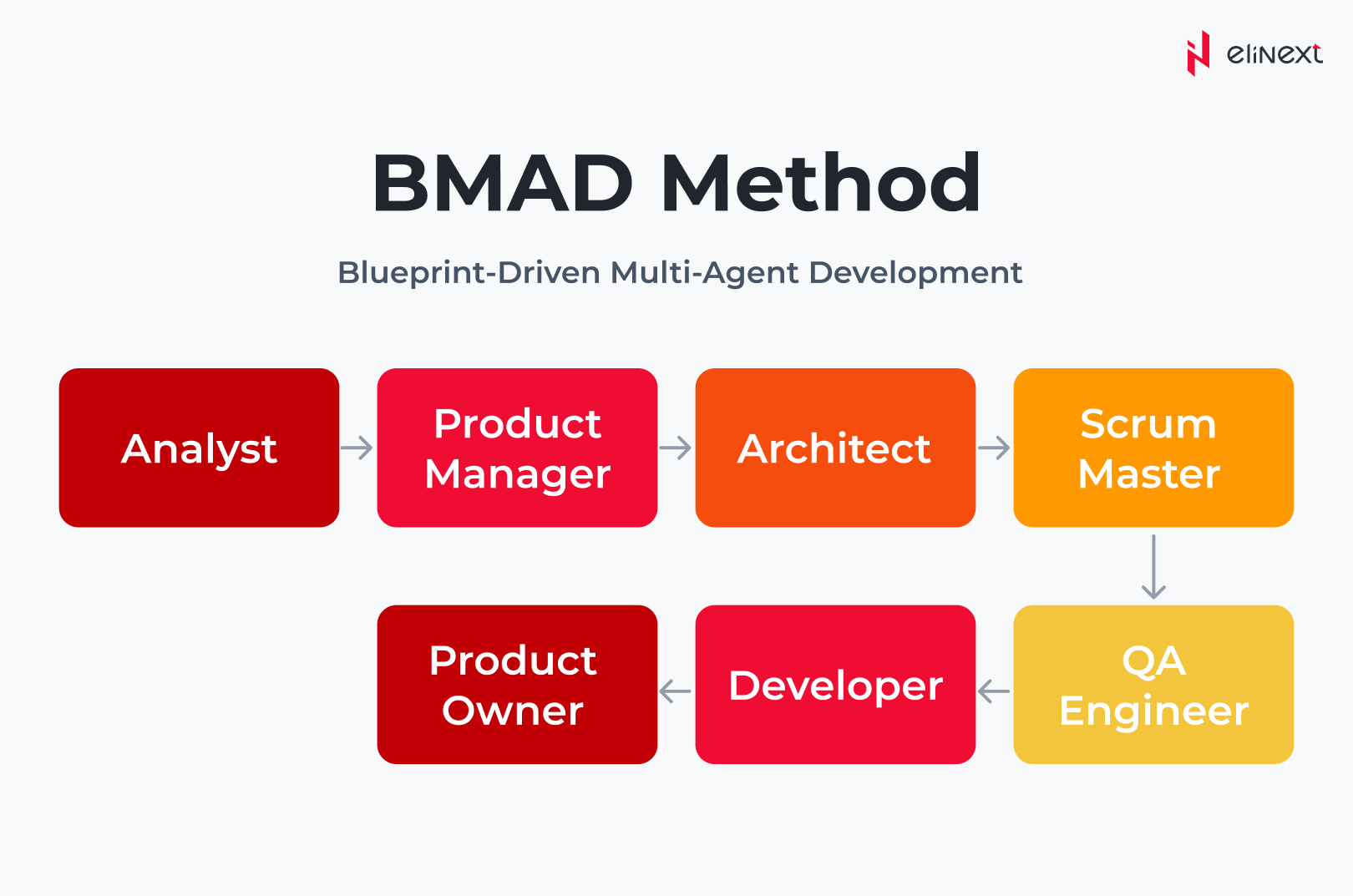
The bmad method works by linking business models directly to system architecture before development begins. It defines value streams, maps capabilities, and aligns governance layers. Only then does implementation start. This sequence ensures that the bmad method AI development produces stable, scalable AI agents instead of fragile experiments.
In a Startup:
- Used before scaling
- Prevents fragile architecture
- Clarifies monetization early
In an Enterprise:
- Used during digital transformation
- Guides modernization
- Aligns IT with strategy
Explore Agentic AI Development Solutions by Elinext
Elinext applies the bmad framework to deliver structured, enterprise-grade AI systems. We also offer AI integration services, AI software development services and machine learning development services as a part of our AI expertise.
Move from experimentation to architectural AI
Build AI agents that scale with your business strategy.
Conclusion
The bmad method transforms AI agent creation into a structured, business-aligned discipline. By embedding governance, architecture, and lifecycle thinking into bmad method ai development, organizations gain transparency and scalability. AI becomes a strategic asset rather than a technical experiment.
BMad Method: Terms Explained
Business Model
A structured description of how a company creates, delivers, and captures value within its market ecosystem.
Value Proposition
A clearly articulated benefit that explains why customers choose a product or service.
Value Stream
A sequence of coordinated activities that deliver measurable value from concept to outcome.
Capability Map
A visual model outlining organizational abilities required to execute strategic objectives.
Domain
A defined business or technical context governed by specific rules, logic, and data structures.
Architecture Alignment
The process of ensuring technology systems directly support business strategy.
Traceability
The ability to track requirements, design decisions, and outputs across development stages.
Roadmap
A structured plan defining milestones, priorities, and phased implementation.
Governance
Policies and controls that ensure responsible, compliant, and secure operations.
Lifecycle Context
The preservation of strategic and architectural intent throughout all stages of development.
FAQ
What does BMad stand for in this context?
BMad stands for Business Model aligned Architecture and Design. It connects business strategy with system architecture. Organizations apply it to ensure AI initiatives remain scalable and strategically aligned.
Who should use BMad?
The bmad framework is designed for startups and enterprises building AI-driven systems. It supports structured modernization and scalable growth. Businesses use it to reduce architectural risk and improve governance.
How does BMad reduce hallucinations?
BMad reduces hallucinations through architectural boundaries and structured context management. It connects outputs to domain rules and governance logic. Companies apply it to increase reliability and traceability.
Can BMad work with any AI model?
The bmad method AI development approach is model-agnostic. It integrates with various AI technologies and language models. Organizations use it to maintain alignment regardless of the technical stack.
Does BMad replace agile or other frameworks?
No, it does not replace agile frameworks. It complements them by adding architectural alignment and governance discipline. Businesses combine both to balance flexibility with structure.
About the Author
Maxim leads the Generative AI practice at Elinext, helping companies design and deploy AI-powered solutions — from custom LLM integrations and conversational systems to full-scale AI transformation. He bridges deep technical expertise with a pragmatic focus on business outcomes, guiding clients through every stage of the AI adoption journey.