





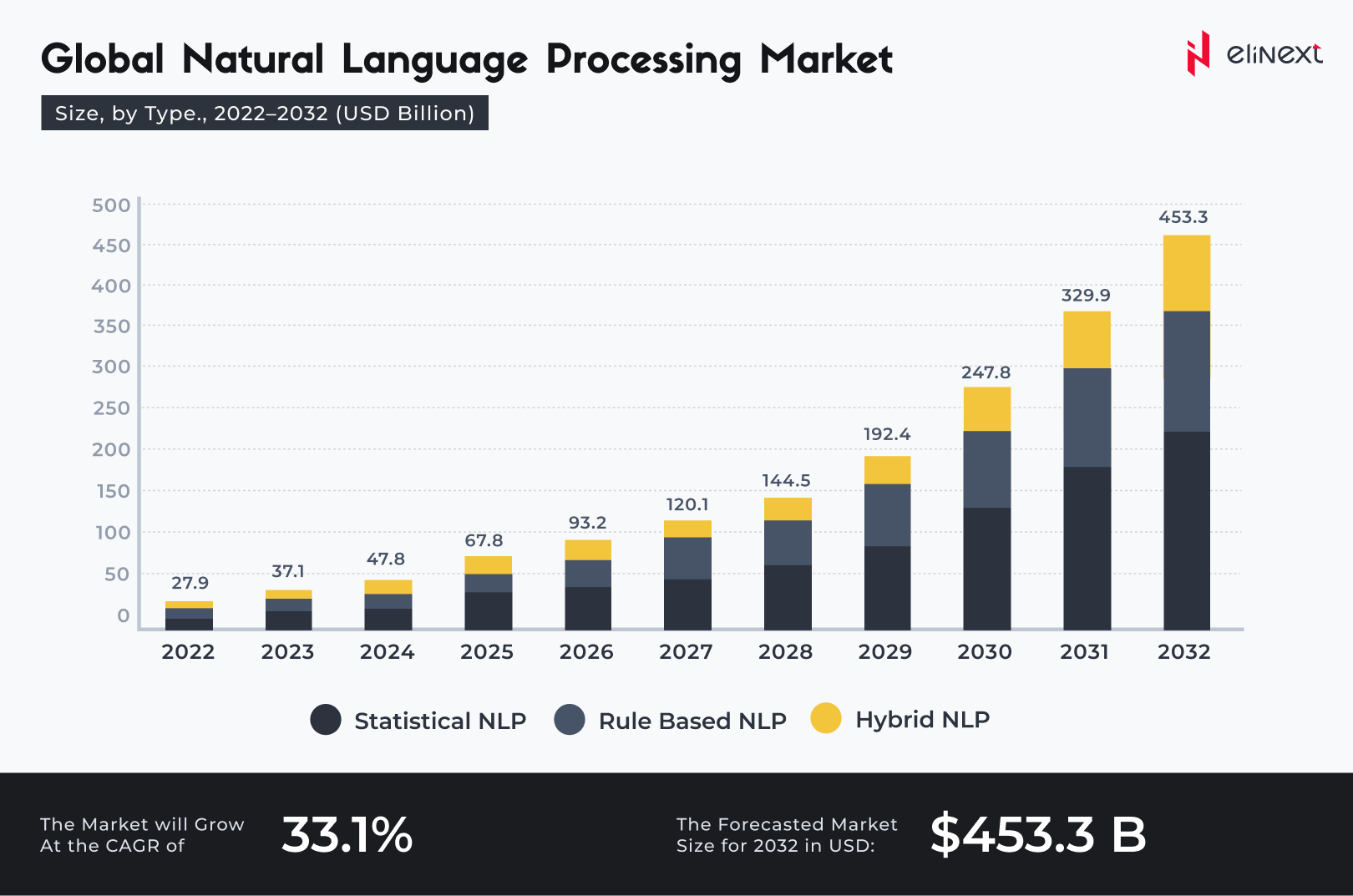
The global natural-language-processing (NLP) market is about to expand. As it’s driven by surging volumes of unstructured data and the push for smarter human-machine conversations, the industry is expected to soar to around USD 453.3 billion by 2032 from USD 37.1 billion in 2023. With a growth rate of over 30% annually, today’s breakthroughs in speech recognition, text analytics, and conversational AI promise to reshape how we work, connect, and automate. The future of natural language processing is, therefore, big and beautiful.
What is Natural Language Processing?
Natural language processing (NLP) is a field of artificial intelligence focused on enabling computers to understand, interpret, and generate human language. It blends linguistics, machine learning, and computational techniques to analyze text or speech, allowing systems to perform tasks like translation, sentiment analysis, and conversational interaction. By bridging communication and systems, NLP powers tools from chatbots to search engines.
The Evolution of Natural Language Processing (NLP)
NLP has evolved from early rule-based systems to today’s data-driven models powered by machine learning and deep neural networks. Early methods relied on handcrafted grammars, while statistical approaches later improved accuracy. The emergence of transformers and large language models has enabled more fluent, context-aware understanding. It promises rapid advances in the natural language processing future.
Improve your products with Elinext’s custom NLP-driven solutions. Be part of the future of NLP.
Industrial Applications of NLP
NLP is transforming industries by turning unstructured text into actionable insights. From healthcare to finance, it streamlines workflows, boosts accuracy, and enhances decision-making across complex, data-heavy environments.
Clinical Documentation
NLP automates the extraction of key details from medical notes, improving accuracy and reducing administrative load for clinicians. It structures patient data efficiently, enabling faster documentation and supporting more reliable healthcare records.
Clinical Decision Support
By analyzing patient histories, lab results, and clinical notes, NLP helps identify patterns and risks that support timely medical decisions. It enhances diagnostic accuracy and guides providers with evidence-based insights at the point of care.
Drug Discovery
NLP accelerates research by mining scientific literature, trial data, and genomic information to reveal relationships between compounds and diseases. It helps scientists uncover new drug targets faster and optimize development pipelines.
Information Retrieval
NLP enables quick access to relevant information across vast datasets by understanding context and meaning. It improves search precision in research, healthcare, and enterprise environments, saving time and boosting productivity.
Text and Sentiment Analysis
NLP interprets opinions, emotions, and themes within customer feedback, social media, and reviews. It helps businesses gauge public sentiment, improve services, and make data-informed decisions based on real-time user perspectives.
Security and Fraud
Through analysis of communication patterns, logs, and reports, NLP detects anomalies and suspicious behavior. It strengthens security systems by identifying potential threats and fraudulent activities before they escalate.
Financial Document Processing
NLP streamlines the extraction of figures, terms, and clauses from complex financial documents. It reduces manual review time, increases accuracy, and ensures consistent data handling for compliance and reporting workflows.
Trading and Algorithmic Analysis
NLP analyzes news, reports, and market sentiment to support predictive trading strategies. It helps algorithms react to real-time information, offering traders insights that enhance speed, precision, and market responsiveness.
Risk Assessment and Credit Scoring
NLP evaluates unstructured financial data, customer histories, and behavioral patterns to improve risk modeling. It supports more accurate credit scoring and helps institutions make fair, data-driven lending decisions.
What is the Role of Human-AI Collaboration in NLP
Augmenting Human Creativity
The future of NLP depends on human-AI collaboration. Human-AI collaboration in NLP expands creative potential by generating ideas, refining content, and offering alternative perspectives. AI handles repetitive language tasks while humans ensure nuance, originality, and emotional depth in the final output.
Facilitating Personalized Learning Experiences
NLP-driven systems adapt content to individual learning styles, offering tailored explanations, feedback, and study paths. Humans guide the educational context and goals, while AI adjusts learning materials dynamically for better engagement and comprehension.
Enhancing Decision-Making Processes
AI analyzes large volumes of text data to surface insights, patterns, and recommendations, while humans provide judgment, context, and domain expertise. Together, they enable faster, more informed decisions across fields like healthcare, finance, and research, and form the future of NLP.
Addressing Ethical Dilemmas Through Collaboration
Human oversight ensures that NLP systems operate responsibly by reviewing potential biases, fairness issues, and unintended outcomes. Collaboration helps guide AI development toward ethical standards, ensuring transparency and accountability in real-world use.
Transform your operations with smart NLP tools.
What is the Global Impact of NLP Technologies
NLP technologies are reshaping global communication, economies, and social systems by enabling machines to interpret and generate human language at scale. Their impact spans accessibility, productivity, and cultural exchange, influencing how people learn, work, and interact worldwide, and how the future of natural language processing will look.
Bridging Language Barriers
NLP-powered translation and communication tools enable people from different linguistic backgrounds to connect seamlessly. They support global collaboration, improve access to information, and reduce misunderstandings across cultures.
Empowering Underserved Communities
NLP expands access to education, healthcare, and digital services for marginalized groups. By simplifying complex information and supporting multilingual content, it helps bridge gaps for communities with limited resources.
Economic Opportunities and Challenges
NLP drives innovation, automation, and new business models, boosting productivity and creating high-tech jobs. At the same time, it introduces challenges like workforce displacement and the need for new digital skills.
Social Implications of NLP Adoption
As NLP influences communication and information flow, it shapes public discourse and social behavior. Its adoption raises questions about privacy, bias, and trust, requiring thoughtful governance to ensure equitable outcomes.
“Natural Language Processing is not just a technological advancement. It’s a catalyst for global connectivity. By breaking language barriers and making information universally accessible, NLP has the power to transform economies, education, and social inclusion on an unprecedented scale.” ― Arjun Mehta, AI and Language Technology Specialist
The Future of Natural Language Processing Solutions
The future of NLP promises smarter, more adaptive systems that understand context, emotion, and intent. Natural language processing future promises advances in AI, machine learning, and large language models, which are already driving innovations across industries.
Contextual and Emotionally Intelligent Systems
Next-generation NLP will recognize context, tone, and emotional cues, allowing systems to respond naturally and empathetically. By understanding subtle language nuances, these tools enhance communication, improve user experience, and support sensitive applications like mental health and customer service.
Conversational Interfaces Everywhere
Conversational AI is set to become ubiquitous, powering voice assistants, chatbots, and immersive interfaces across devices. Seamless, human-like interactions will redefine how people access services, manage tasks, and communicate with technology in daily life.
Quantum-Accelerated NLP
Quantum computing promises to revolutionize NLP by processing massive datasets at unprecedented speeds. This enables faster model training, more complex language understanding, and breakthroughs in tasks like real-time translation, predictive analytics, and deep semantic comprehension.
Tightly Integrated Human-AI Collaboration
Future NLP solutions will focus on human-AI partnerships, where AI handles data-intensive tasks and humans provide creativity, judgment, and oversight. This collaboration maximizes efficiency, ensures ethical outcomes, and enhances problem-solving across industries.
Industry-Specific LLMs
Large language models tailored for specific sectors will offer domain expertise, improving accuracy and relevance. From healthcare to finance, these specialized LLMs streamline workflows, support critical decision-making, and deliver actionable insights unique to each industry.
Transform your operations with cutting-edge Elinext solution.
Conclusion
The future of NLP is set to redefine how humans and machines interact, offering smarter, context-aware, and emotionally intelligent systems. As AI continues to advance, businesses and industries can harness these tools to boost efficiency, enhance decision-making, and create more personalized experiences. At Elinext, we offer artificial intelligence development solutions, Internet of Things (IoT) solutions, and Machine Learning development services to make sure you don’t fall behind.
FAQ
What is the future of NLP?
NLP will become more context-aware, emotionally intelligent, and integrated into daily workflows, enabling seamless human-AI interactions across industries.
How will NLP evolve in AI applications?
Natural language processing future will power smarter assistants, real-time analytics, and industry-specific solutions, enhancing automation, decision-making, and personalized user experiences.
What role will large language models (LLMs) play?
LLMs will drive advanced understanding, content generation, and predictive insights, providing domain-specific knowledge for more accurate and efficient AI systems.
Will NLP replace human jobs?
NLP will automate repetitive tasks but mainly augment human work, enabling people to focus on creativity, strategy, and complex problem-solving.
What are the biggest challenges for NLP in the future?
Key challenges include bias, privacy, data quality, handling ambiguity, and ensuring fairness and ethical deployment across diverse applications.
How will NLP handle multilingual and low-resource languages?
Advances in transfer learning and cross-lingual models will expand NLP capabilities to underserved languages, improving accessibility and global communication.
What is the role of NLP in healthcare?
NLP streamlines clinical documentation, supports decision-making, and accelerates research, enhancing patient care and operational efficiency.
How is NLP impacting education?
It enables personalized learning, automated feedback, and content adaptation, making education more engaging, accessible, and effective for diverse learners.
What ethical considerations are critical for NLP’s future?
Ensuring fairness, transparency, privacy, and responsible AI use is vital to prevent bias, misuse, and unintended societal impacts.
