



AI-based customer recommendation engines are transforming marketing by delivering hyper-personalized experiences and driving revenue growth. In 2025, companies using AI integration services report a 32% increase in conversion rates and a 27% boost in average order value.
These engines analyze vast datasets—purchase history, browsing behavior, and real-time interactions—to suggest products or content tailored to each user. E-commerce platforms leverage AI to recommend complementary products, while streaming services use it to personalize playlists. As AI evolves, generative models and emotion-aware systems further enhance engagement, making recommendations more dynamic and contextually relevant. The adoption of AI-based customer recommendation engines is now a key differentiator in competitive markets, with 78% of top-performing brands integrating these solutions into their digital strategies.
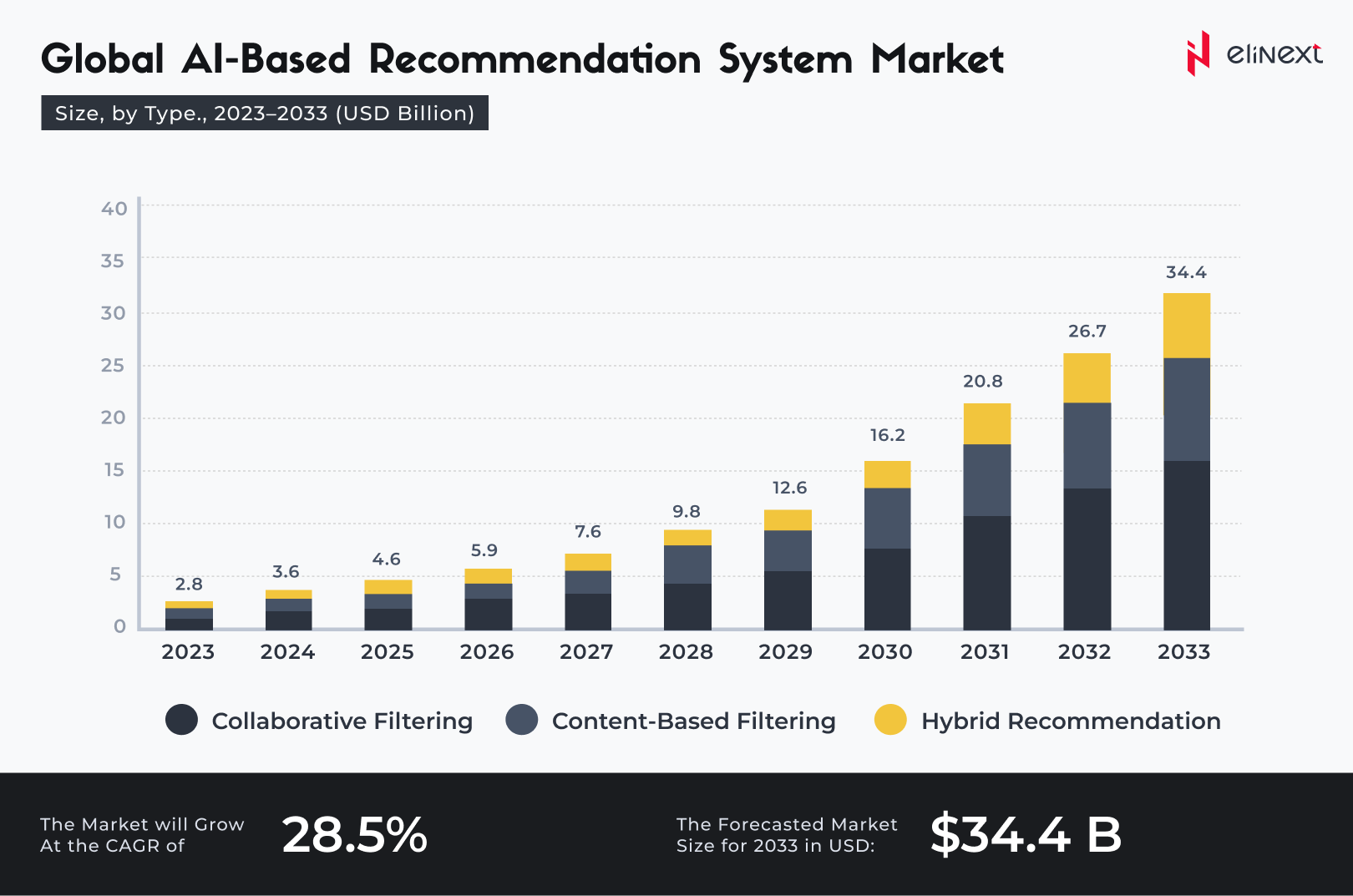
What is an AI-based Customer Recommendation Engine?
A customer recommendation AI engine, built with AI Software Development, uses machine learning to analyze user data and predict which products or content customers will enjoy. Netflix’s system suggests TV shows based on viewing history, while Amazon recommends products tailored to each customer. These systems process massive amounts of data in real time, enabling companies to deliver relevant, personalized experiences that increase engagement and sales.
Unlock the full potential of AI-based customer recommendation engines —invest in their development to increase conversions, personalize marketing, and stay ahead in the competitive digital market.
AI-based customer recommendation engines you’re familiar with
- People You May Know (Facebook)
- Other Movies You May Enjoy (Netflix)
- Jobs You May Be Interested In (LinkedIn )
- Customer Who Bought This Item Also Bought … (Amazon )
- Visually Similar Images (Google)
- Recommended Videos (YouTube )
Recommendation engines (also known as recommender systems) gained attention thanks to the online retail/eCommerce industries. The most common usage is definitely the Amazon’s section on “Customer who bought this item also bought …”
Generally speaking, a recommendation engine may be regarded as an intelligent and sophisticated sales person who knows the customer’s habits well: preferences, taste, and style. Based on this knowledge, it can make more intelligent decisions on recommendations that would benefit both a particular customer (reasonable advice) and a business itself (increased possibility of a conversion).
Being originally labelled “an eCommerce thing”, customer recommendation AI are now gaining popularity in other industries, most notably in Entertainment and Media. YouTube’s “Recommended Videos” or Netflix’ “Other Movies You May Enjoy” are among the most popular use cases. It’s worth noting that Netflix doesn’t just take into account what movies a person has watched – they’re also analyzing, which movies have been watched multiple times, rewound or fast-forwarded.
These behavioral patterns, when correlated and assessed over millions of other users, help to draw out the most appropriate recommendations. In fact, it’s not about the industry: it’s all about data. “It could be an insurance form or a banking form, anything that has a lot of data entry in it and has the ability to use recommendation engines to make suggestions — and make it easier for people to fill things out,” commented Sacolick.
From the technical perspective, AI-based customer recommendation engines rely on algorithms that learn from previous data: preferred, liked or bought products by a particular customer or even by customers with similar behavior.
This way, a customer recommendation AI may be regarded as an excellent tool for proper filtering: customers only see relevant data according to their taste, style, and preferences. That’s why a good recommendation system should be able to continuously learn and adapt itself to a new user behavior. Secondly, it has to be supplied with fresh data in real time.
For example, a large (and updatable) list of special offers may turn accurate recommendations into obsolete info shortly after some changes have been made. Thus, a reliable recommendation engine must “learn” in a highly dynamic environment.
The dominant approaches in creating customer recommendation AI engines
Collaborative Filtering
Collaborative Filtering helps engines “understand” what users may like based on the articles and information two users like in common. In this case, the similarities are being defined by the behavior of the user/customers. This conduct serves as a basis for building stronger connections with every piece of content users share with each other and, consequently, may increase the chances of further engagement.
The flexibility is the key to keep up with a variety of requirements. A good recommendation system has to be scalable to process an increasing number of users and items and reflect seasonal or regional changes in real-time. The most popular methods of making recommendations are:
Content-Based Filtering
The similarities of the products are created in correlation to all available data, such as brand, price, description, color, and size. The content data of each article is regarded by the system as a set of descriptors, typically the words that occur in a document. The user profile is represented with the same terms and built up by analyzing the content of items, which have been seen by the user.
Hybrid Recommendation Systems
The following technique is the combination of the two methods listed above. As there is no need for a description of recommended items, the system can deal with any kind of information. Furthermore, the system is able to recommend items to users, which may have very different tastes from what they have shown before. Finally, because recommendations are based on the opinions of others, it is a perfect match for subjective domains like art markets.
Demographic-Based filtering
In this type of system, recommendations are based on customers’ demographic info. In this case, the system will suggest items that have been selected by other users fitting the same demographic profile. The benefit of a demographic approach is that it does not require a history of user ratings like that in collaborative and content-based systems.
Utility-Based filtering
This type of system is based on the value that the user will get from the product. The main advantage of using a utility-based approach lies in the processing of non-product attributes like vendor reliability and product availability. Utility-based recommendations systems are very precise in “calculating” this value for the user.
In a nutshell, a proper recommendation engine must provide:
- quicker and better business insights
- personalized and connected user experiences
- better round-the-clock customer service
- automated and personalized marketing campaigns
Customer recommendation AI systems are revolutionizing marketing. Using real-time data and advanced algorithms, companies can deliver hyper-personalized experiences that drive loyalty and sales.” The future belongs to brands that harness the predictive power of AI to deliver more intelligent and engaging customer experiences.
Elinext Expert
What future trends are emerging in AI recommendation technology?
AI-based customer recommendation engines are evolving, incorporating generative AI to dynamically deliver messages, emotion-based suggestions, and real-time personalization. By 2025, 65% of e-commerce leaders will use AI to deliver contextual, conversational, and highly granular recommendations.
-
Real-time Personalization
Real-time personalization uses AI to instantly adapt recommendations based on user behavior. E-commerce platforms like Zalando adjust product suggestions as users browse, increasing conversions by 20%. AI integration services allow companies to analyze data in milliseconds, ensuring customers receive the most relevant offers at the right time.
-
Generative AI for Dynamic Messaging
AI-based customer recommendation engines create personalized, dynamic messages. AI can generate email subject lines or product descriptions based on user preferences, increasing click-through rates by 18%. This trend is changing the way brands interact with customers.
-
Emotion-aware Recommendations
Emotion-Aware AI analyzes customer sentiment to refine recommendations. AI can identify frustrations during customer interactions and suggest reassuring content or solutions. This approach increases customer satisfaction and loyalty by addressing their emotional needs in real time.
-
Voice-based and Conversational Recommendations
AI-powered customer recommendation systems are now integrating with voice assistants like Alexa or Google Assistant. Users can request product recommendations, and AI offers personalized suggestions. This conversational approach increases accessibility and engagement, especially in smart home systems.
-
Hyper-granular Segmentation
AI enables hyper-fine-grained segmentation by analyzing microbehaviors and preferences. Netflix segments users by viewing habits, genres, and even time of day, providing highly personalized recommendations. This precision increases engagement and retention rates.
-
Predictive Personalization (before customers show intent)
Predictive personalization anticipates customer needs before they even express intent. AI-powered customer recommendation systems suggest products based on past behavior and trends, such as predicting when a customer will need a refill or upgrade, which improves convenience and sales.
Conclusion
Generative AI development services and AI-powered customer recommendation systems are transforming marketing. Sure enough, recommendation systems must evolve. At first sight, they may discourage non-technical marketing people as the math and analytics behind their creation are advanced even in its simple forms.
However, that level of complexity should not be a red flag for marketers. “We believe that recommendations have much further to go, to model the relationship between a person and the products they use. Today ‘deep learning’ is beginning to let us find spaces where people and products coexist, where they have a relationship, although it might not be obvious by using immediate logic.” summarizes Juan Arévalo, Data scientist at BBVA Data & Analytics and expert in recommendation systems.
FAQ
What is an AI-based customer recommendation engine?
It’s a system that uses AI to analyze customer data and suggest relevant products or content. Amazon’s system recommends products based on purchase history, which accounts for 35% of the company’s revenue.
How do AI-based customer recommendation engines work?
They analyze user data (e.g., browsing history, preferences) using machine learning to predict and suggest relevant products. Spotify recommends songs based on listening habits.
Why are AI recommendation engines important in marketing?
They increase engagement, sales, and customer retention by providing a personalized experience. Netflix’s AI maintains user engagement by suggesting personalized content.
What benefits do businesses gain from using AI recommendation engines?
Companies report increased sales, increased customer loyalty, and higher ROI. E-commerce platforms report a 35% increase in revenue thanks to AI-powered recommendations.
How do AI-based customer recommendation engines improve customer experience?
They provide personalized, relevant suggestions, saving customers time and increasing their satisfaction. AI suggests products that customers are likely to like.
Can AI recommendation engines help with cross-selling and upselling?
Yes, they analyze purchase history to suggest complementary or premium products. Amazon recommends accessories for purchased items, increasing cart size.
Are AI recommendation engines difficult to implement?
AI integration services simplify implementation. Companies can integrate AI systems into existing platforms with minimal disruption, ensuring a rapid return on investment.
