







Today, expectations for Agentic AI or AI agents – software systems that boast of autonomy and reasoning – are great.
Powered by the advent of large language models and large reasoning models, AI agents that can adapt to new environments and execute multistep tasks with limited supervision are more often seen not as tools, but as valuable team members, representing deep transformation in enterprise productivity and growth.
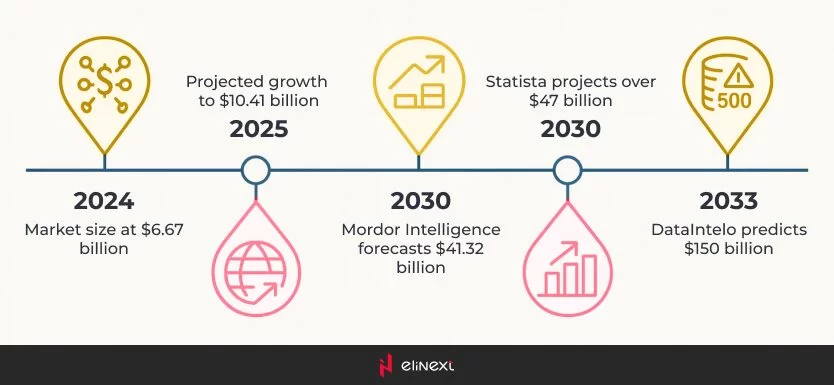
According to data from Statista, Mordor Intelligence, and DataIntelo, in the next 5-8 years, the agentic AI tools market will see explosive growth, with an increase from $6.67 billion in 2024 to $150 billion in 2033.
What is an Agentic AI?
Agentic AI is an AI-based system designed to operate with less human intervention. Unlike traditional AI models that rely on human prompts to perform specific tasks, AI agents can plan, manage and execute complex end-to-end processes almost independently, in an adaptive way.
The Importance of Agentic AI for Business Transformation Today
Across industries, embedding and scaling agentic AI for business processes helps augment human effort and optimize such key functional areas like administrative tasks management (e.g., responding to emails, meeting scheduling, business travel arrangements), document reconciliation and processing, customer support and ticket resolution, supply chain monitoring, etc., fueling business transformations.
Key Takeaways
- USD 47,680.4 million – Agentic AI in Business Automation Market projected value by 2034 (CAGR since 2025: 41.8%)
- 38.49% – Agentic AI in Business Automation Market share captured by North America compared to the rest of the world, 2024.
- 36.7% – the share of Agentic AI in the Business Automation Market held by the Customer Interaction Automation segment, 2024.
How Agentic AI Differs from Traditional and Generative AI
Artificial intelligence and Generative AI have been quite a hot topic in business circles for the past 10 years, but now agentic AI for business transformation is taking center stage.
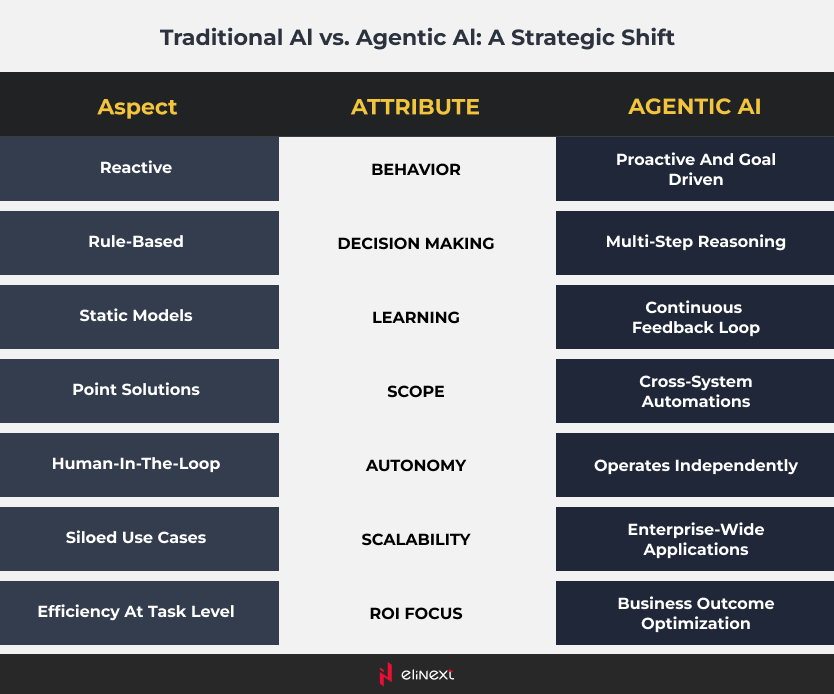
Let’s take a closer look at the key differences between traditional, generative and agentic AI.
Traditional AI
Traditional AI systems (like Alexa, Siri, or Netflix’s recommendation system) that have grown from simple rule-based programs excel in specific tasks like classification, optimization, and predictions. Yet, such systems lack adaptability to new situations, have difficulties handling unstructured data and are not good at performing creative tasks.
Generative AI
Generative AI development services and tools powered by deep learning models have been gaining popularity for the last 5 years and have emerged as great helpers for producing original content, including text, images, music, and even code. However, Gen AI is limited by its inability to generalize beyond training data.
Agentic AI
Agentic AI systems are distinguished from their predecessors with their ability to make decisions and act autonomously by using NLP, ML, reinforcement learning and knowledge representation. An expert AI agent development company, Elinext, can create flexible AI agents that assess situations and solve complex issues with minimal physical intervention.
Being an expert AI software development services and ML software development services provider, we see more and more companies turning to agentic AI for business transformation.
Yet, the reality is that any AI augmented automation introduces inherent risks. From misinterpretation to bias, context errors, flawed logic, cyberattacks, and more, enterprise-wide deployment of agentic AI is challenging and requires robust infrastructure and extensive end-user training.
Leveraging insights from 75+ completed relevant projects, we help our clients adopt autonomous agents with minimal friction and maximum impact. – Elinext expert.
Which Industries Benefit from Agentic AI Solutions
Finance and Banking
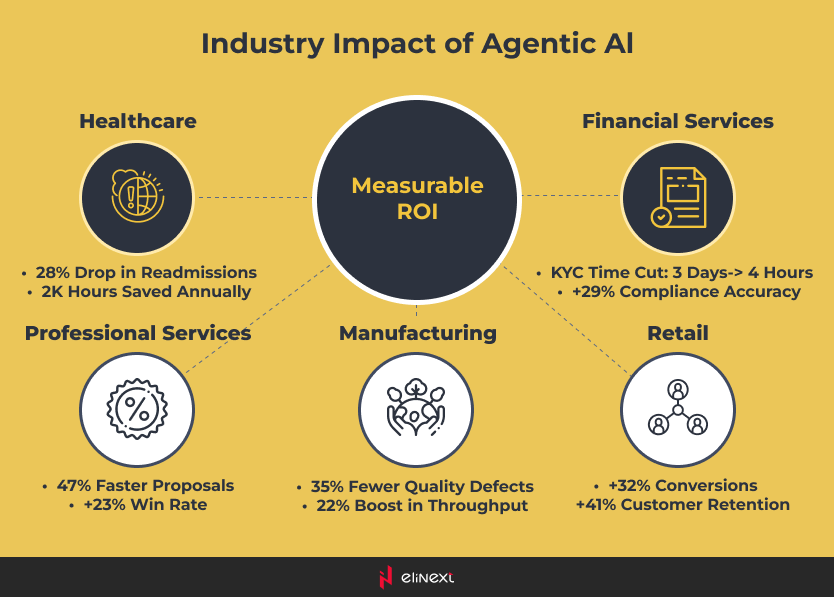
The Finance & Banking industry is one of the earlier adopters of agentic AI for business transformation. From enhancing customer onboarding with tailored, adaptive journeys to reducing mortgage approval timelines, tracking transactional anomalies, responding to fraud threats in real time, and more, adaptive and intuitive AI agents go far beyond traditional banking automation.
Retail and eCommerce
When it comes to Retail and e-commerce, AI agent use cases in business processes include autonomous returns and refunds handling, price adjustment in response to declining sales or competitor activity, dynamic homepage personalization, etc. Leaders like Walmart, Amazon, Levi’s, Ocado, and Sainsbury’s are already reaping the benefits of implementing agentic AI for business transformation.
Drug Discovery
Integrating an AI agent for business operations related to drug discovery also ensures tangible benefits for companies that have to spend years and billions of dollars to bring a new drug to market. Acting with autonomy, agentic AI systems accelerate drug discovery by identifying novel targets, conducting virtual screening of millions of compounds, running complex simulations, orchestrating tasks across multiple R&D labs and data systems and more.
Healthcare and Life Sciences
Implemented in healthcare settings, agentic systems can free practitioners from manual data entry and help them gеt a more detailed and insightful view of patients. So far, AI agent use cases in businesses operating across healthcare and life sciences domains stretch from autonomous appointment scheduling to summarizing details of an examination, coding treatment plans, managing patient follow-up, and much more.
Supply Chain & Logistics
The introduction of agentic AI for business transformation becomes a new norm for global logistics and supply chain companies, too. Virtual agents manage inventory, optimize shelf layouts, and automate order fulfillment. The systems can also proactively detect stock shortages, monitor shipments in real time, dynamically adjust delivery routes and reduce fuel consumption.
Manufacturing & Industrial Automation
Deploying agentic AI for business processes is an imperative for COOs looking to raise productivity across manufacturing operations, including product development, material flow, energy consumption, supply chain, etc. Here, autonomous systems generate and adjust production plans, continuously monitor the health of machinery, control robotic systems, inspect production defects in the process and suggest actions to operators.
How Elinext’s AI Agent Solutions Help Transform Your Business
Armed with 10+ years of experience in AI (providing AI integration services, ML software development services, chatbots development services, etc.) Elinext can engineer adaptive, super-intelligent AI agents to raise productivity across every aspect of clients’ business operations by automating HR processes, document management, financial management, asset maintenance, production management, sales and marketing, supply chain planning and monitoring, customer onboarding and more.
Kick-start your agentic AI journey confidently with an experienced LLM development services and ChatGPT development services provider by your side.
The Future of Agentic AI for Business Transformation
Agentic AI is revolutionizing industries by combining AI, real-time data, and domain expertise, shifting human roles from operators to AI-enabled orchestrators.
Companies of all sizes are already leveraging AI agents to boost productivity, with some executives using AI as digital labor while others focus on augmenting human skills. From personalized concierge services to automated HR processes, agentic AI for business transformation will continue to unlock new capabilities, workflows and customer experiences.
As organizations refine agent tuning, prompt engineering, and human-AI collaboration, the future promises smarter, more empathetic, and highly differentiated agentic AI systems.
Conclusion
Agentic AI represents a transformative leap in business automation, enabling AI systems to autonomously achieve complex objectives with minimal human intervention.
By leveraging a specialized AI agent for business capabilities, an organization can access real-time data, enhance productivity, and reduce labor costs.
Yet, challenges such as a lack of contextual awareness, ethical concerns, as well as data privacy and legal risks (especially in applications for regulated industries) must be addressed. As major tech players advance this technology, businesses must adopt strategic governance and orchestration to harness its full potential responsibly.
FAQ
Why is Agentic AI important for business transformation?
Deploying self-directed AI agents capable of making real-time decisions and solving complex business tasks with minimal human oversight streamlines operations, enhances enterprise efficiency, and enables better strategic planning and faster innovation cycles.
Which business functions benefit most from Agentic AI?
Across industries, agentic AI streamlines and improves diagnosing & treatment, document reconciliation & processing, financial management, production management & quality control, supply chain planning & monitoring, sales & marketing, customer support & ticket resolution, etc.
How do agentic systems learn and adapt?
A learning agent improves its performance and optimizes its decision-making over time by adapting to new experiences and continuously absorbing new, vast amounts of data. Also, in multi-agent architectures, such systems can learn by sharing knowledge with each other.
Are there risks in using Agentic AI?
Like any other technology, agentic AI comes with its downsides, including limited contextual understanding, potential for bias and discrimination, privacy concerns, legal issues, and security vulnerabilities.
How does Agentic AI impact workforce roles?
Intelligent agents automate routine, rule-based tasks like data entry, basic customer interactions, some administrative functions, etc. Roles requiring creativity, critical thinking, and complex decision-making – such as advanced technical profiles, clinicians, or educators – remain less exposed to automation.
