



In simple terms, RPA in telecom is all about robots using software to handle repetitive work across billing systems, CRM platforms, and network tools. RPA helps carriers, MVNOs, and service teams deal with huge volumes of data every day, so they can focus on their customers instead of admin stuff.
Right now, the global telecom sector is huge but under pressure. Worldwide revenues have already reached up to $4.98 billion in 2025, with forecasts to cross $44.56 billion in 2035. At the same time, digital networks are everywhere. 5G coverage, IoT connections, and mobile broadband continue expanding, and demand for speed and quality keeps rising.
Key Takeaways
According to projections by The Insight Partners, the global RPA market is set for strong expansion, rising from about $4.48 billion in 2024 to nearly $20.83 billion by 2031.
A study by Nokia reports that network traffic grows by about 30 to 45% each year, forcing telecom providers to upgrade their infrastructure to keep service stable
About 53% of companies have already started using RPA, and another 19% plan to do so within two years, according to the Deloitte Global RPA Survey.
What is RPA in the Telecom Industry?
RPA in telecom is software that acts like a digital employee, one that clicks, copies, checks, and updates data across systems just like a human would, but faster and without mistakes. Think of it as a tireless back-office assistant that follows clear rules to handle billing, order entry, number porting, or ticket updates. It does not replace core systems. Instead, it works on top of them and connects the gaps.
Still rely on manual workflows that slow your team down?
Opt for telecommunication software development services that really drive growth.
How Robotic Process Automation (RPA) Transforms Telecom?
RPA transforms telecom by automating core operational flows such as order provisioning, SIM activation, billing validation, and fault ticket routing across OSS and BSS systems. Bots work across multiple platforms at once, which shortens service delivery cycles, reduces revenue leakage, and improves SLA compliance. This helps operators respond faster to network events and customer requests without overloading internal teams.
What are the Key RPA Use Cases in Telecommunications
RPA in telecommunications covers daily operational pain points across network, billing, and customer service. It handles routine digital tasks that slow teams down and create risk. Below are the core areas where bots deliver clear business impact.
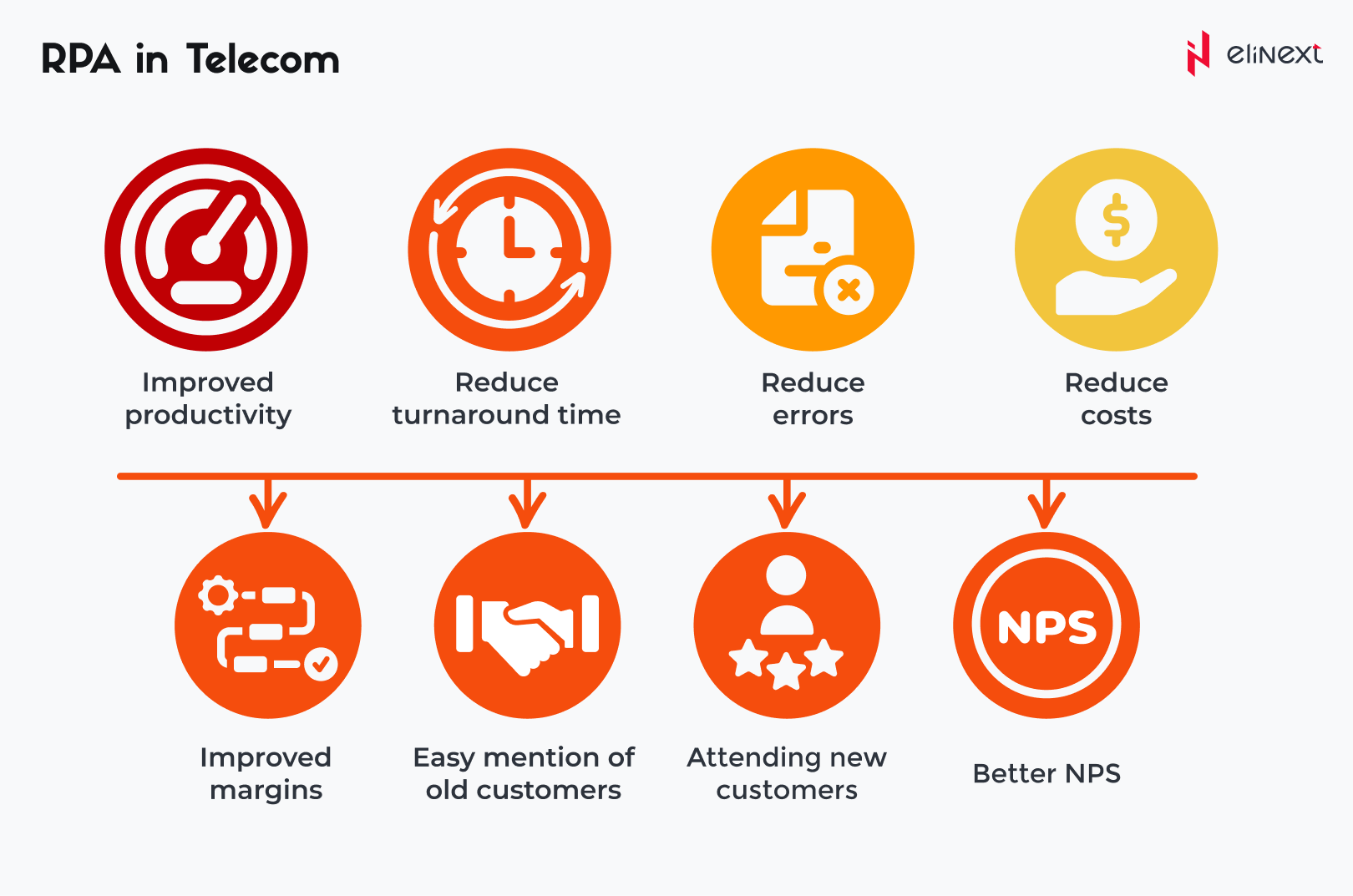
Improved Productivity
RPA handles repetitive tasks such as data entry, ticket updates, usage checks, and report generation across OSS and BSS platforms. This frees telecom teams from routine admin work and lets them focus on network optimization, customer cases, and revenue-related tasks, which lifts overall operational output.
Reduce Turnaround Time
Bots process service orders, SIM activation, number porting, and change requests across multiple systems at once. Instead of waiting for manual handoffs, workflows move instantly, which shortens service cycles and helps operators deliver faster responses to customers and partners.
Reduce Errors
RPA in the telecom industry follows predefined rules when validating invoices, updating customer records, or reconciling usage data. Since bots do not skip steps or overlook fields, data stays consistent across systems, which lowers billing disputes and revenue loss.
Reduce Costs
Automation reduces the need for large teams to manage high-volume back-office processes such as claims handling or account updates. With fewer manual interventions and less rework, telecom providers cut operational expenses while keeping service quality stable.
Improved Margins
RPA supports revenue assurance tasks like usage verification, tariff validation, and partner settlement checks. By catching discrepancies early and ensuring accurate billing, operators protect income streams and strengthen profitability without major system upgrades.
Easy Mention of Old Customers
Bots gather historical data, contracts, past interactions, and usage patterns from different platforms in seconds. This gives service agents a full view of existing customers, which supports smarter retention strategies and reduces churn risk.
Attending New Customers
RPA automates onboarding steps such as identity verification, account setup, credit checks, and number allocation. The activation process becomes faster and more consistent, which creates a smooth start for new subscribers.
Better NPS
Automation speeds up issue resolution, keeps customer data accurate, and ensures status updates move across systems without delay. When service works as promised, and problems get solved quickly, customer satisfaction grows, and NPS scores improve.
“RPA in the telecom industry is not simple because operators run on legacy OSS and BSS systems that rarely integrate well, and processes often change midstream. If you automate chaos, you scale chaos. At Elinext, we first map and stabilize workflows, then deploy bots where they bring real control. The impact is fewer failures, cleaner data, and operations that finally feel manageable.” – Alexey Trigolos, expert in telecom software development.
Agentic AI vs RPA for Telecommunications
RPA and agentic AI solve different layers of telecom automation. RPA follows clear rules and executes structured tasks such as billing checks or order updates across OSS and BSS systems. Agentic AI goes further: it can analyze context, make decisions, and adapt to new inputs. In practice, RPA acts as the execution engine, while agentic AI becomes the decision layer that guides what actions should happen next. Elinext, as an AI software development company, makes the best use of advanced technology to strike the perfect balance between RPA and agentic AI.
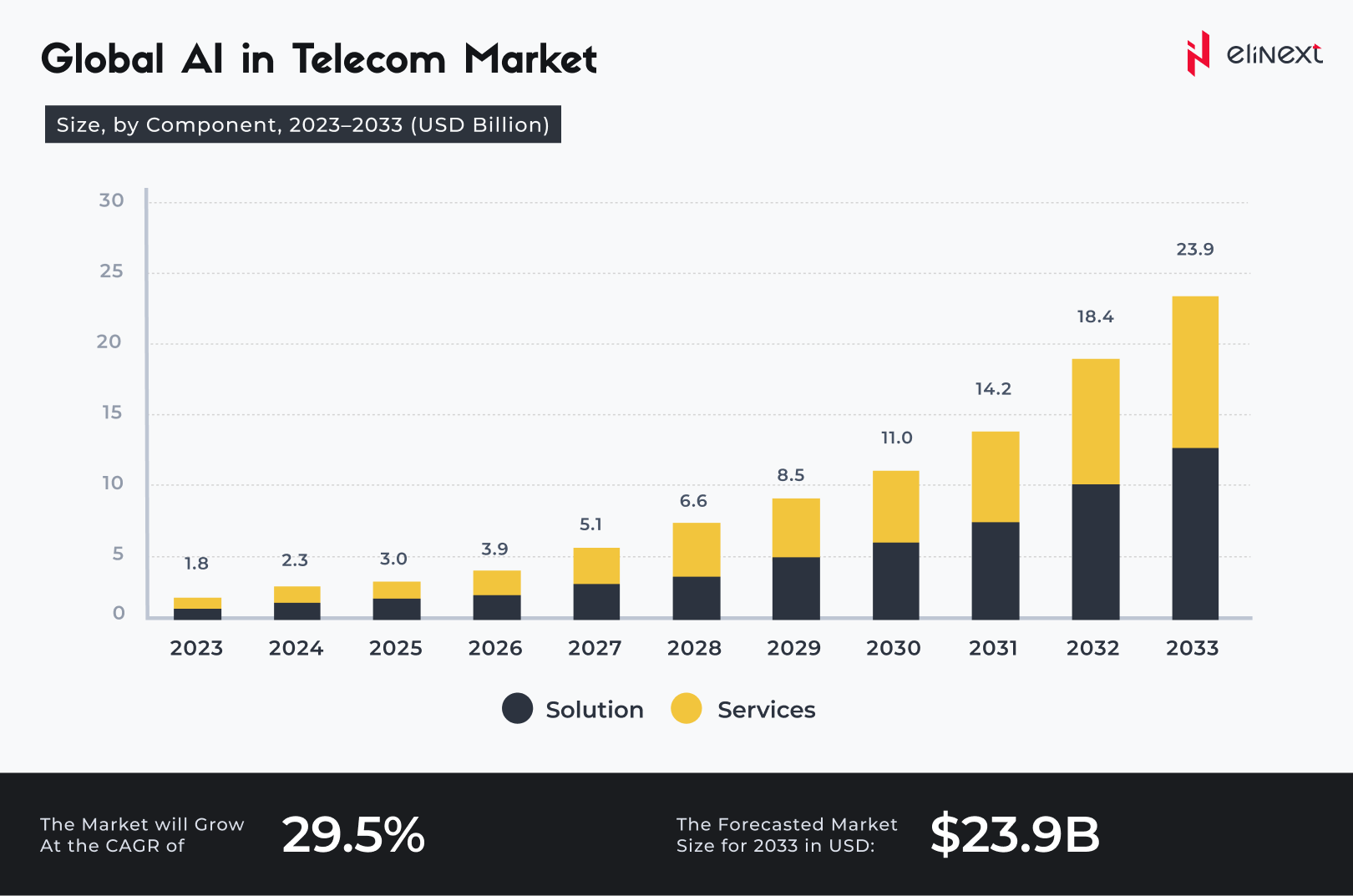
Right now, agentic AI is still at an early adoption stage in telecom. Many operators run pilots focused on network analytics, predictive maintenance, and smart support. The market grows fast, with a forecast to reach $ 8.74 billion by 2031. Though driven by AI investment and 5G complexity, most companies still rely more on RPA than agentic AI as the stable foundation for large-scale automation.
Elinext RPA Development Solutions for the Telecom Industry
Elinext delivers RPA in the telecom industry solutions tailored for telecom environments with complex OSS and BSS landscapes. Our custom RPA development services combine automation expertise with deep domain knowledge in billing, provisioning, and network operations. We analyze real workflows, design stable bot architectures, and ensure secure integration with legacy systems. The result is reliable automation that supports growth without disrupting core telecom processes.
Ready to bring real automation into your telecom operations?
Let’s build RPA that works in your environment, and not just on paper.
The Benefits of RPA in Telecom
RPA in telecommunications strengthens core operations across OSS and BSS by automating provisioning, billing validation, revenue assurance, and fault management flows. Bots move data between legacy systems without heavy integration work, which improves SLA compliance and limits revenue leakage. Operators gain better process visibility, stable audit trails, and the flexibility to scale service volumes without constant headcount growth.
What is the Future of RPA in Telecom?
RPA in telecom moves beyond simple task automation and becomes part of a broader digital strategy. Operators now look at automation as a long-term capability that supports AI, cloud adoption, and stronger operational control across network and customer domains.
Integration with AI & Intelligent Automation
RPA will work side by side with AI models that analyze traffic patterns, detect anomalies, and predict churn. AI decides, RPA executes. In telecom, this means smarter fault resolution, automated root cause analysis, and dynamic customer offers based on generative AI development services and above.
Cloud & RPA as a Service (RPAaaS)
More operators shift automation to cloud environments to scale faster and reduce infrastructure overhead. RPAaaS allows telecom providers to deploy bots on demand, manage updates centrally, and support distributed teams without heavy on-prem setups.
Human with Bot Collaboration
Future telecom operations rely on mixed teams where bots handle structured flows and employees step in for judgment calls. Agents receive pre-filled cases, validated data, and clear next steps, which improves speed and reduces stress in high-volume environments.
Enhanced Security and Governance
As automation expands, telecom firms put strong governance in place. Central bot control, access management, and full audit logs become standard. This ensures compliance with industry regulations and protects sensitive customer and network data.
“Telecom looks structured from the outside, but inside, you often find dozens of micro-processes built over years of quick fixes. That makes RPA tricky, because bots need clarity and stable logic. At Elinext, we start with process discovery and performance analysis before we touch automation. Once the flow makes sense, bots deliver real gains in SLA control, revenue assurance, and team workload balance.” – Alexey Trigolos, expert in telecom software development.
Conclusion
RPA in telecommunications turns complex, fragmented operations into structured, measurable digital workflows. It does more than cut costs. It exposes weak spots in OSS and BSS chains, reduces revenue leakage, and brings discipline to provisioning, billing, and support.
The real challenge is not automation, but process clarity and governance. As networks grow with 5G and IoT, operators that treat RPA as a strategic backbone, not a quick fix, will build faster, leaner, and more resilient telecom businesses.
RPA in Telecom: Terms Explained
RPA
Robotic process automation is software that mimics human actions in digital systems to execute rule-based telecom tasks with speed and accuracy.
Bot Orchestration
Bot orchestration is the centralized control of multiple RPA bots to manage schedules, workloads, and process dependencies.
BSS (Business Support Systems)
BSS are telecom platforms that handle billing, customer data, product catalogs, and revenue-related operations.
OSS (Operations Support Systems)
OSS are systems that support network operations such as provisioning, fault management, and service monitoring.
CRM (Customer Relationship Management)
CRM solutions for the telecom industry are platforms that store customer data, interaction history, and service records to support sales and marketing teams.
Order Management System (OMS)
OMS is a platform that tracks and processes service orders from request to activation across telecom systems. It can be a part of ERP software for the telecom industry.
RPA as a Service (RPAaaS)
PAaaS is a cloud-based automation model where bots run and scale without heavy on-prem infrastructure.
API Automation
API automation uses system interfaces instead of screen actions to trigger data exchange and execute telecom workflows.
AHT (Average Handling Time)
AHT measures the average time an agent spends resolving a customer request from start to finish.
FCR (First Call Resolution)
FCR shows the percentage of customer issues solved during the first interaction without follow-up.
SLA (Service Level Agreement)
SLA is a contract that defines service performance targets such as uptime, response time, and resolution speed.
FAQ
What is RPA and why is it important for telecom?
RPA is software that automates rule-based digital tasks. It is used to handle billing, provisioning, and support workflows. Telecom companies apply it to reduce errors, protect revenue, and improve service speed.
Which telecom processes benefit most from RPA?
High-volume rule-based processes benefit most from RPA. Operators use it for order entry, SIM activation, billing validation, and ticket routing to improve accuracy and cycle time.
How does RPA improve customer experience?
RPA supports faster issue resolution and accurate data updates. Telecom providers use it to reduce wait times and raise service consistency for customers.
Can RPA work with legacy telecom systems?
Sure. RPA is a technology that works on top of existing systems without deep integration. It interacts through user interfaces or APIs.
How does RPA reduce operational costs?
RPA in telecommunications reduces rework, billing disputes, and processing time. Telecom operators apply it to lower labor costs and limit revenue leakage.
How is RPA combined with AI in telecom?
RPA is task execution software, while AI handles analysis and decisions. Telecom companies combine them so AI detects patterns and RPA performs actions such as updates or notifications.
What are the common challenges of RPA in telecom?
RPA faces challenges when processes lack structure. Telecom environments often have fragmented systems and changing rules. Companies address this with process mapping and governance before automation rollout.
