





















































































































































Voice technology in healthcare leverage AI software development services to enable seamless clinical documentation, patient engagement, and support mental health app development services. Designed for physicians, patients, and administrators, they save physicians up to 2 hours per day, reduce burnout, and improve the quality of care—for example, AI assistants transcribe visit notes 3 times faster than typing.
Hey Alexa, what’s the weather like today? From getting our weather forecasts and morning dose of news to playing our favorite tracks or even ordering groceries, we increasingly rely on smart speakers and voice assistants, making them an integral part of our everyday lives.
Voice technology in healthcare supports faster documentation in electronic medical records and 55% of US hospitals will implement them by 2026. Healthcare software development services enable real-time transcription, saving physicians hours daily.
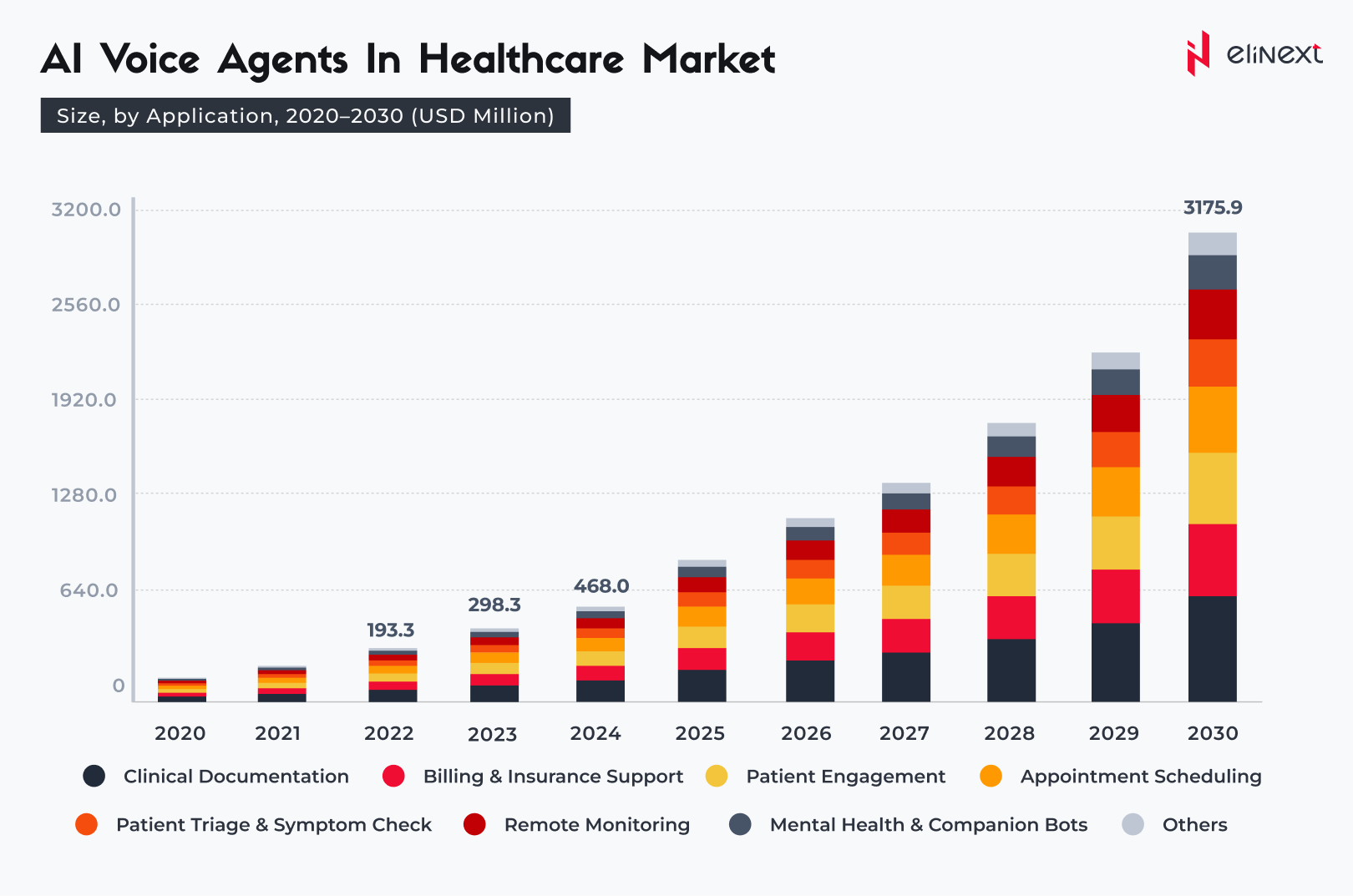
Key Takeaways
- The voice technology in healthcare market will reach $8.5 billion by 2026, growing at a CAGR of 22.5%
- More than 60% of North American healthcare organizations will implement voice technology in healthcare by 2026, transforming clinical workflows.
- AI voice agents in healthcare are projected to surpass $7.2 billion by 2026, driven by demand for hands-free documentation.
Partner with a telemedicine app development company to address voice technology challenges and unlock its full potential.

Fueled by AI-based speech recognition and natural language processing (NLP), voice technology in healthcare supports a variety of industries — online shopping, voice-based banking, etc. Healthcare too can leverage voice technology to benefit in a number of ways. Let’s see how.
Digital front door
In healthcare, a digital front door is a strategy that aims to effectively engage patients across all touchpoints and allow them to interact with healthcare, via their device of choice, using the self-service technology.
Conversational AI and voice assistants in healthcare can add another dimension to these interactions and help healthcare providers connect with patients in more meaningful ways. From helping patients discover health services to connecting them with the right healthcare provider to setting an appointment, voice assistants can streamline communication and reduce the risk of patients falling through care gaps.
Case in point
Orbita, a provider of conversational voice and chat solutions for healthcare, has launched a feature-rich digital front door solution that streamlines access to care and reduces staff burden. The platform leverages conversational AI to connect patients with the appropriate level of care, schedule and appointment, check on patients pre- and post-visits, and more.
Streamlined clinical workflows
The pandemic has generated an enormous demand for health services, stretching the healthcare industry too thin. In addition to the shortage of staff and resources, healthcare is riddled with time- and labour-intensive processes. The cost of inefficient healthcare systems is staggering — US hospitals waste over $12 billion per year as a result of poor communication among care providers.
Custom healthcare solutions enhanced with voice technology in healthcare can significantly accelerate internal processes so that physicians can focus on patients instead of paperwork. With the ability to recognize speech and convert it into text, voice assistants in healthcare can automatically capture doctor-patient conversations and turn them into EHRs. These capabilities can further extend into coding, billing, prescription management and other processes. Nurses, too, can benefit from voice assistant for healthcare providers by leveraging it to search relevant data on doctors and patients, even on the go.
To accelerate internal workflows even further, healthcare providers can use voice-enabled CRM systems. All routine transactions like updating patient records or getting personalized reports can be performed conversationally, which enables the staff to save valuable time and focus on patients.
Case in point
Suki, a provider of voice solutions for healthcare, has developed a digital agent that leverages NLP and machine learning to retrieve information from health records, create medical notes and quickly complete administrative tasks. Armed with these capabilities, the voice assistant allows physicians to accelerate clinical workflows and reduce documentation time by 76%.
Improved accessibility
Voice technology can help health systems better keep up with the evolving patient needs and reduce friction.
Voice-based passwords can help patients streamline access to their health records and personal information while protecting it from unauthorized use. Furthermore, conversational AI can improve accessibility and promote inclusion for patients with speech and hearing difficulties. By converting spoken words into text and vice versa, voice technology in healthcare enables patients to see who said what.
In diverse, multicultural countries voice assistants can improve access to care by reducing linguistic barriers and facilitating patient-doctor communication. By translating the conversations between practitioners and patients in real time, voice-powered solutions eliminate the need for an interpreter and minimize diagnostic errors caused by misunderstanding.
Case in point
Ava, a voice technology startup, offers a live captioning solution to empower deaf and hard-of-hearing people with a 24/7 accessible life. The solution leverages artificial intelligence as well as professionals to deliver 99% accuracy.
In France, Aalia.tech has launched Aaliatalk, a medical voice assistant, to support communication between patients and care providers who don’t speak the same language. Designed with privacy in mind, Aaliatalk also takes into account the cultural context of the patient to ensure accurate translation and effective communication.
Medication management
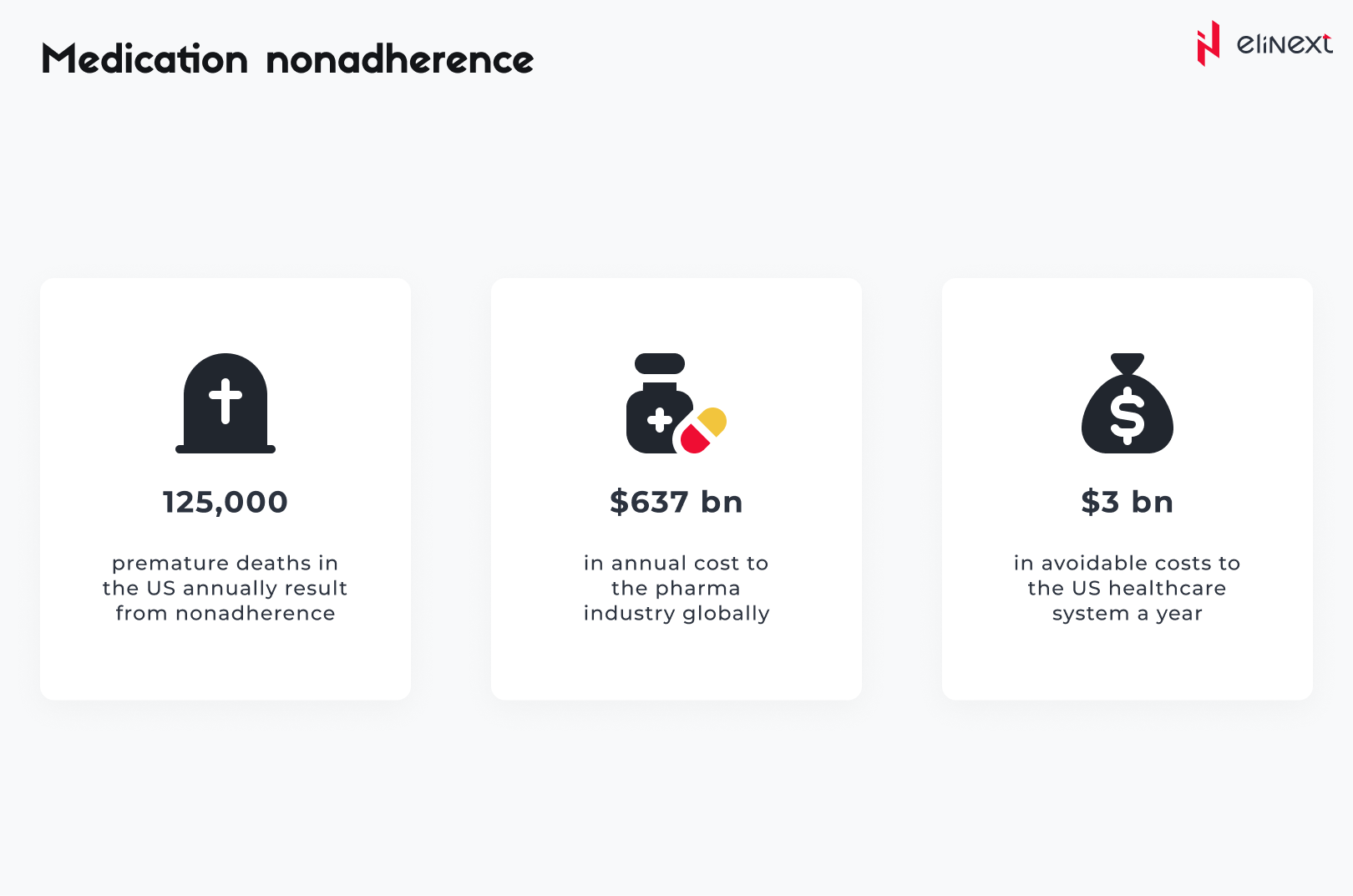
Medication nonadherence is on the fast track to becoming an out-of-control epidemic. And the burden on the healthcare system is significant, too, as shown on the graphics below.
Voice technology in healthcare can help improve medication adherence by interacting with patients in a comfortable way and regularly reminding them which medication to take and when. They can also inform the patients on the importance of complying with a health care regime, notify on the refill and schedule a visit to renew the prescription.
Case in point
Aiming to streamline in-home care, Pillo Health has launched a voice-activated assistant that helps users better manage their medication regimen by reminding them about dosages at predefined time and offering research-based care plans. In addition, the solution leverages facial recognition to deliver the medication information to the right person.
Care for senior citizens
Another challenge that health services today are faced with is the rapid aging of the global population. Increasing life expectancies, declining fertility rates are among the factors that contribute to the situation — by 2050, the senior population is expected to reach 2.1 billion.
As healthcare seeks to adapt to new challenges, voice assistant for healthcare providers comes to the rescue as a more intuitive and simple user interface. Voice assistants can help older populations to prolong their independence and improve in-home care by providing companionship, promoting medication adherence, and sending alerts to health professionals if help is needed. Voice technology in healthcare can also help with a number of routine tasks like checking a calendar or ordering a taxi, which is especially useful for the elderly with vision and mobility issues.
Case in point
Volara, a provider of voice-based customer engagement software, has partnered with LeadingAge and other healthcare organizations to support seniors living in residential communities. To that end, Volara provided 9,000 Google Nest Hub Max, voice assistants with screen, to the elders to provide instant access to information and entertainment and connect with their loved ones.
Voice-based diagnostics
A new but promising field for applying voice technology in healthcare is diagnostics based on vocal biomarkers. Essentially, a vocal or voice-based biomarker is a signal or characteristic that can be detected in one’s voice. By leveraging sophisticated machine learning algorithms, these biomarkers are assessed to find correlation with a variety of medical conditions like obstructive pulmonary disease, Parkinson’s disease, pulmonary coronary artery disease, and even COVID-19.
Case in point
Vocal biomarker startup Sonde Health is pioneering the approach with a proprietary diagnostic tech that enables doctors and patients to make more informed decisions. The solution analyzes speech segments to identify if a person is at risk for developing a range of conditions, from dementia to depression.
Challenges to implementing voice technology in healthcare
Just like any technology, voice-based applications for eHealth come with a particular set of challenges that need to be addressed from the start in a healthcare software development project.
- Voice must be treated as any other patient information and must be adequately protected. Data encryption, secure data transmission protocols, role-based access control, and other security measures must be implemented to ensure robust security.
- HIPAA compliance. Any custom healthcare solution that deals with protected health information must comply with HIPAA regulations to guarantee patients’ privacy. Amazon’s Alexa, for example, supports HIPAA-compliant skills for healthcare applications. Elinext’s article on RPA in healthcare covers how robotic process automation is being applied to claims processing, patient data reconciliation, and appointment scheduling workflows — with notes on compliance requirements, EHR integration, and the governance controls healthcare organisations need when deploying software bots in regulated environments.
- Since voice-based applications can be used by different people, they must be sensitive towards the accent of the speaker in order to accurately understand and perform the required action.
- Particular attention must be paid to the design of voice-based interactions to make navigation as seamless as possible. Include visual or vibrational cues to notify users on when voice assistants are ready for use, when they are listening or ready for response.
- And last but not least, the cost of voice tech integration needs to be affordable in order to support tech adoption and reap the benefits of voice-powered healthcare.
Voice-enabled applications appear to be the next frontier in human-technology interactions. And among the variety of industries that leverage voice technology, healthcare is particularly ripe with use cases — voice-based apps for the healthcare industry account for 47% of the voice recognition solutions market.


Voice assistants in healthcare provide efficiency but face integration and privacy challenges. With LLM development services, Elinext creates secure, EHR-compatible solutions that streamline workflows. This reduces physician burnout and improves patient satisfaction, delivering measurable business impact.

Conclusion
Patient portal software development services and generative AI development services drive adoption of voice tech, projected at $8.5B by 2026. AI scribes save doctors 2 hours/day. As adoption grows, expect improved care and efficiency, but privacy and integration challenges remain.
From improving medication compliance to accelerating hospital workflows to enhancing senior care, voice-based applications can help healthcare providers deliver better patient experiences and accelerate the shift towards value-based care. But in order to fully harness the technology, it’s important to ensure smooth navigation and ease-of-use as well as implement privacy and security controls to protect patients’ sensitive information and give them peace of mind.
Voice technologies in healthcare are transforming clinical workflows, reducing burnout, and improving patient care. While adoption is accelerating, organizations must prioritize privacy, accuracy, and unlocking the full potential of this integration.
Voice Technology in Healthcare: Terms Explained
-
Speech Recognition
Speech recognition is technology that converts spoken language into text. In healthcare, it enables clinicians to dictate notes, improving documentation speed and accuracy.
-
Natural Language Processing (NLP)
Natural Language Processing (NLP) is AI that understands and processes human language. In healthcare, NLP extracts insights from voice data for clinical decision support.
-
Voice User Interface (VUI)
A Voice User Interface (VUI) lets users interact with systems using voice commands. In healthcare, VUIs power hands-free EHR navigation and patient engagement tools.
-
Clinical Documentation
Clinical documentation is the process of recording patient care details. Voice technology automates this, allowing clinicians to dictate notes directly into EHRs.
-
Ambient Listening
Ambient listening is continuous, passive audio capture in clinical settings. It enables AI to transcribe conversations and automate documentation without manual input.
-
Voice Biometrics
Voice biometrics uses unique vocal features to verify identity. In healthcare, it secures access to patient records and authenticates users for sensitive tasks.
-
Virtual Health Assistant
A virtual health assistant is an AI-powered tool that interacts with patients via voice. It answers questions, schedules appointments, and supports chronic care management.
FAQ
-
Voice technology in healthcare is artificial intelligence that enables hands-free tasks. It is used for dictation in electronic medical records (EMRs). Doctors take notes by speaking them aloud.
-
A voice assistant for healthcare providers increases efficiency and reduces burnout. AI assistants save doctors hours on paperwork.
-
Voice technology in healthcare faces challenges with privacy, accuracy, and integration with EHRs. HIPAA compliance is critical for voice data.
-
A voice assistant for healthcare providers automates paperwork, reducing work outside of office hours. AI assistants save 1-2 hours per day.
-
Voice technology in healthcare supports quick, hands-free data entry in emergency situations. Paramedics dictate notes en route to the hospital.
-
Voice technology is helpful for elderly patients. It allows for easy medication reminders and scheduling of doctor appointments using simple voice commands.
-
AI powers voice healthcare systems by recognizing speech and processing natural thinking. AI transcribes and analyzes doctor-patient conversations.
-
Voice technology will likely become standard in hospitals. Growing adoption over 60% by 2026 shows that it is becoming essential for healthcare delivery.