



Not a buzzword anymore, blockchain, nonetheless, keeps creeping deeper into hospitals, labs, and health-tech startups.
Picture a shared medical ledger where data moves securely, updates can’t be faked, and patients stay in control. No magic, just a network of nodes validating every change. Why does this matter? Because the industry is drowning in fragmented records and trust issues, not to mention strict regulations like HIPAA. If you’re wondering where blockchain is actually proving useful – not just hyped – healthcare is the real thing. And we will explain why.
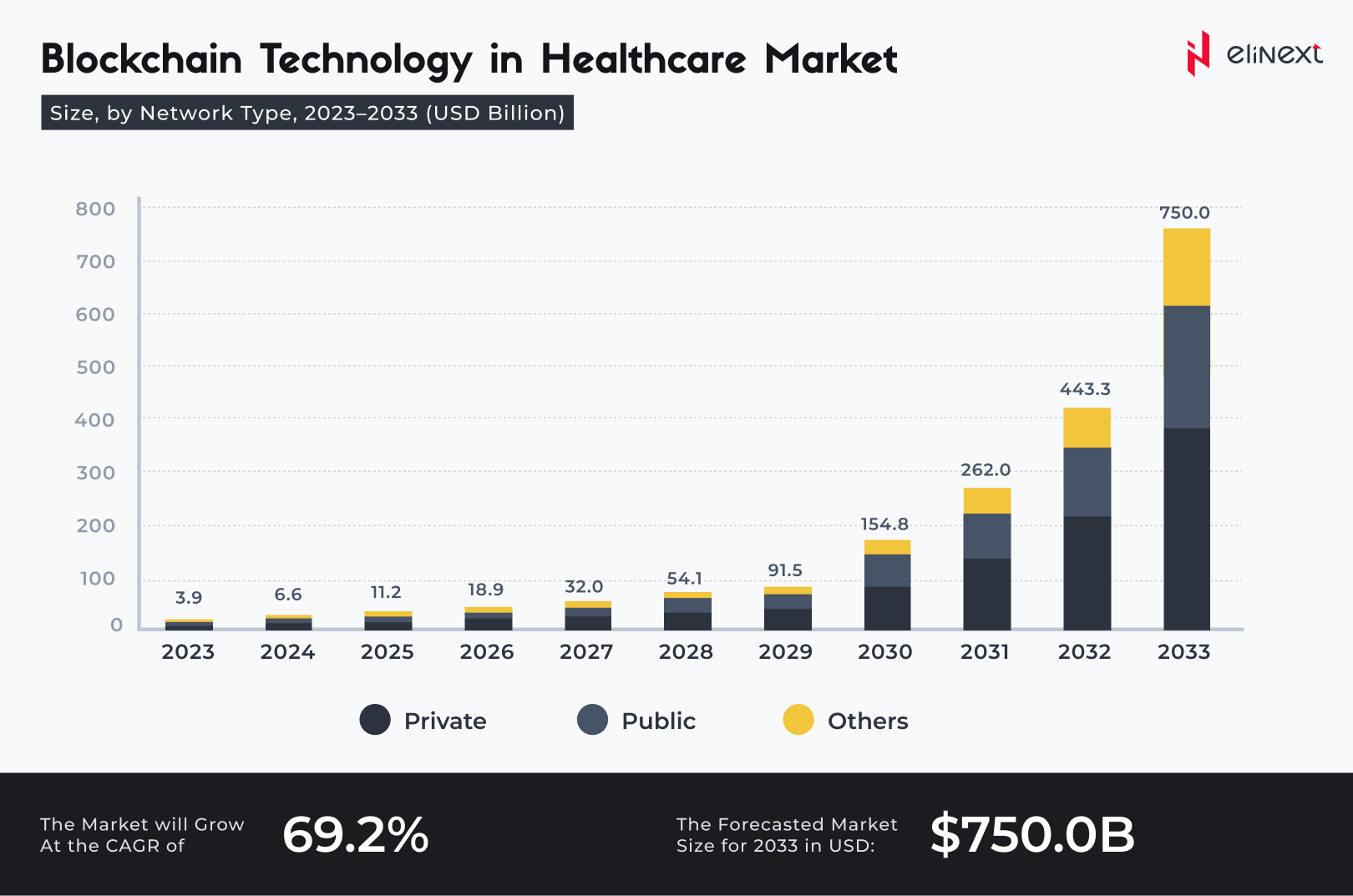
Key Takeaways
Market Growth: By 2033, blockchain-in-healthcare is expected to reach USD 750 billion, growing at 69.2% a year – far beyond its USD 3.9 billion value in 2023.
Network Type Insights: Public blockchain networks held the upper hand with roughly 56.8% market share, highlighting how crucial open, shareable data environments have become.
Application Breakdown: In terms of use cases, supply chain remained the top performer, accounting for 26.2% of the total market.
End-user Trends: Around 41.4% of the market is made up of biopharma and medical device companies, which increasingly rely on blockchain for smarter, safer data handling.
Key Blockchain in Healthcare Trends for 2026
Healthcare is hitting a turning point: data is exploding, trust is shaky, and everyone’s tired of systems that don’t talk to each other. That’s why blockchain is slipping into the spotlight – below are the trends shaping this shift in 2026.
Decentralized Electronic Health Records (EHRs)
Decentralized EHRs spread patient data across a secure network rather than burying it inside isolated hospital systems. Every update is verified, so nothing gets “lost” or quietly changed. Clinicians get consistent records, patients keep tighter control over their info, and cross-organization data sharing becomes far less chaotic.
Automated Insurance Claims via Smart Contracts
Smart contracts act like automated rule-checkers. When treatment data, coverage rules, and billing details match the preset criteria, the claim triggers payment immediately. This slashes manual paperwork, removes back-and-forth disputes, and helps both insurers and providers settle transactions in near real time.
Pharmaceutical Supply Chain Verification
Blockchain ties every handoff – manufacturing, transport, storage – into a tamper-proof trail. As each entry is locked into the ledger, counterfeiters have almost no room to alter documentation. Regulators track product journeys with precision, manufacturers detect weak links early, and patients receive medicines with verifiable authenticity.
Patient Consent and Identity Management
Blockchain-powered digital identities give patients a secure, portable profile they can use across clinics, labs, and telehealth apps. They decide who gets access, for how long, and for what purpose. Every permission change is recorded, which makes privacy audits straightforward and reduces the need for endless consent forms.
Secure IoT/IoMT Device Data Tracking
Connected health devices pump out tons of sensitive data, and much of it defines patients’ health and well-being. Blockchain anchors device outputs to an immutable ledger, so that no one can quietly alter readings. Care teams rely on cleaner data, and device manufacturers get transparent performance logs for compliance.
Clinical Trial Integrity and Auditability
Trials depend on accurate timestamps, version histories, and verified protocols. By storing this information on a blockchain, researchers eliminate the risk of retroactive edits or missing entries. Sponsors, regulators, and auditors can trace each step, from participant enrollment to final results. This makes studies more transparent and strengthens confidence in the findings.
You still hear the word blockchain popping up here and there, but for most everyday people, it’s still just seen as another name for cryptocurrency. What often gets overlooked is how blockchain changes collaboration. Hospitals, insurers, and pharma companies usually work in silos, arguing over versions of the truth. A shared ledger flips that model. As a result, fewer reconciliations, less finger-pointing, and faster decisions.
Victoria Yaskevich, Expert in Healthcare Software Development
How is Blockchain Improving Healthcare Data Security?
Blockchain doesn’t magically fix everything, but it does change the rules of the game. Instead of piling all data into one hackable vault, it spreads trust across the system.
Tamper-proof records by design
Once data is written to the blockchain, it can’t be quietly edited or erased. That’s huge for medical records, audit logs, and compliance. No more “who changed this and when?” debates.
Access control without central weak points
Blockchain enables fine-grained, cryptographic access rights. Doctors, labs, and insurers only see what they’re allowed to see, and permissions can be revoked instantly without relying on one central admin system.
Built-in breach detection and trust
Because every transaction is logged and verified across nodes, suspicious activity stands out fast. It’s less about preventing every attack and more about making attacks obvious, traceable, and far less profitable.
Elinext Blockchain Solutions for the Healthcare Industry
Elinext offers tailored blockchain development services to healthcare orgs, turning distributed ledger tech into real value. Secure medical data sharing and tamper-proof EHRs, smart contract automation, and AI and blockchain in healthcare are all among the custom healthcare software solutions we craft. Our team builds scalable, compliant systems that strengthen data integrity and trust in medical workflows.
Ready to put blockchain to work in healthcare?
Let’s talk about how it can solve real problems, not just sound cool.
Key Challenges of Blockchain Adoption in Healthcare
Blockchain sounds great on paper, but healthcare has its own realities. Legacy hospital systems don’t easily talk to distributed ledgers, and replacing them is costly and slow. Regulatory pressure is also among the challenges of blockchain in healthcare immutability clashes with data correction and privacy laws. Add scalability issues and a shortage of blockchain-savvy healthcare teams, and adoption becomes more complex than the hype suggests.
The Future Trends in Blockchain for Healthcare
Definitely, a more practical phase is coming: less hype and more quiet shifts that will change how systems work behind the scenes.
AI and blockchain in healthcare
Big deal for either any medical entity or an AI software development company. Clean, verifiable medical data stored on-chain makes training clinical AI models safer, more transparent, and easier to audit.
Cross-border health data exchange
Expect blockchain to enable international data sharing between hospitals and regulators, cutting paperwork and speeding up care while staying compliant.
Tokenized healthcare ecosystems
From rewarding patients for preventive care to funding research, token models will reshape incentives, making healthcare participation more active, measurable, and fair.
Conclusion
So, where does all of this leave us? Blockchain in healthcare is no longer a bold experiment or a buzzword borrowed from crypto. It’s quietly becoming the backbone for trust, security, and transparency across the industry. Despite some challenges of blockchain in healthcare, the tech is finding its place. And this is just the beginning – the next wave will be smarter, more integrated, and far more human-centric.
FAQ
What is driving blockchain adoption in healthcare in 2026?
Pressure is coming from all sides: tighter data regulations, rising cyberattacks, and the need to exchange data across systems without losing control or trust.
How does blockchain support patient-centered care?
It gives patients real ownership of their data. Access can be granted, revoked, or shared on their terms, without endless forms or blind trust.
Will blockchain improve healthcare interoperability in 2026?
Yes, but quietly. Blockchain works as a neutral layer that connects systems without forcing hospitals to rip out existing infrastructure.
What benefits does blockchain offer for healthcare billing and insurance?
Fewer disputes, faster payouts. Smart contracts automate verification and claims logic, cutting admin costs and reducing human errors.
How is blockchain transforming the pharmaceutical supply chain?
It creates a verifiable history for every drug unit, helping detect counterfeits, track recalls faster, and ensure regulatory compliance.
Is blockchain being used in clinical research?
More often than people think. It locks trial data, timestamps changes, and builds trust in results without slowing research teams down.
What challenges still limit blockchain adoption in healthcare?
Legacy systems, unclear regulations, and cultural resistance. The tech works aligning people, processes, and policies takes longer.
