



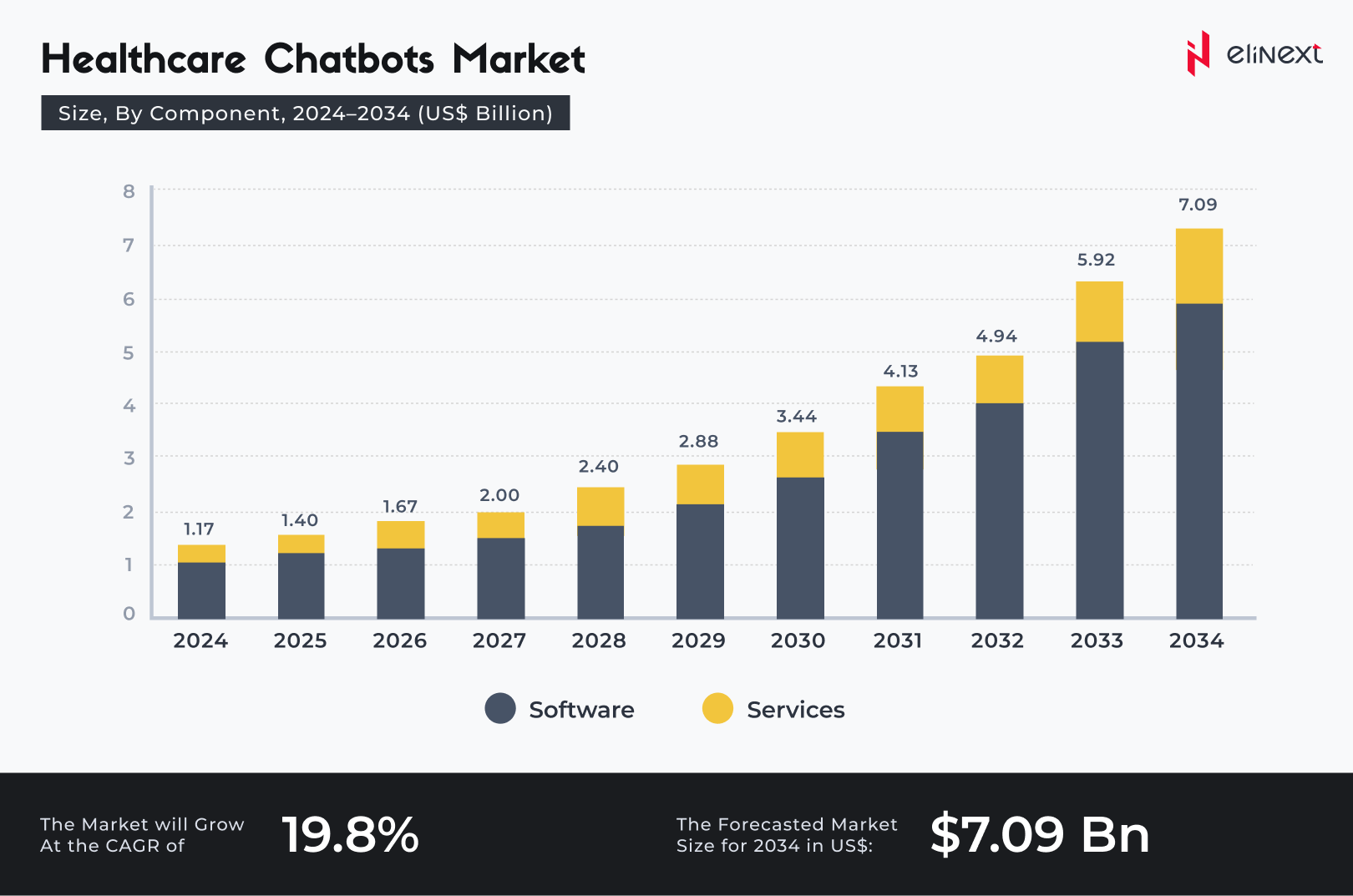
Healthcare big data startups and AI in healthcare startups are reshaping the industry in 2025. AI chatbots, like those developed by leading artificial intelligence development company, automate patient triage, reduce administrative workload by up to 30%, and boost engagement. Big data startups, such as Flatiron and RDMD, leverage massive datasets to improve cancer research and rare disease drug development, with the big data healthcare market projected to reach $66.92B in 2025. The global healthcare chatbot market size was valued at USD 363.25 million in 2024 and is expected to reach USD 1,647.20 million by 2032, growing at a CAGR of 20.80% during the forecast period.
What is a Healthcare AI Chatbot?
Healthcare chatbot companies, supported by healthcare software development services, create AI-powered virtual assistants that interact with patients via text or voice. These chatbots check symptoms, schedule doctor appointments, provide medication reminders, and provide health education. Babylon’s chatbot triages symptoms, while Florence’s reminds patients to take their medications, improving treatment adherence and reducing the number of clinic visits. Chatbots are available 24/7, increasing patient engagement and satisfaction.
What is the Role of Big Data for Healthcare?
Healthcare big data startups and AI in healthcare startups use big data to aggregate, analyze, and interpret massive volumes of clinical, genomic, and operational data. This enables predictive analytics, population health management, and precision treatments. Flatiron Health analyzes oncology data to accelerate drug development, and RDMD organizes rare disease data for research. Big data helps improve outcomes, reduce costs, and support value-based care.
Using AI in Healthcare Startups: Invest in solutions like AI-powered chatbots and big data analytics to improve patient engagement, optimize operations, and gain new insights for better treatment outcomes.
Flatiron and RDMD
Flatiron
The concept of Flatiron is fairly easy to understand. Healthcare big data startups like Flatiron partner with healthcare chatbot companies to provide oncology analytics. Flatiron’s platform analyzes real-world cancer data, supporting research and clinical decision-making for over 2 million patients.
Flatiron is an EHR (electronic health record) company that made it its goal to fight cancer by accelerating research about the disease. They do it by unifying the patient’s data so it would be easier to analyze and gain insights from.
The products of the company connect community oncologists (community clinics are providing better care for patients while remaining efficient, independent and financially successful), academics (life science companies are using real-world data to accelerate research and generate evidence), hospitals (clinicians now have access to research-grade insights from within and beyond the walls of their institution thanks to EHR system) on a shared technology platform.
“Together, we can learn from the experience of every patient, ” claims the website of the company.
RDMD
TechCrunch called RDMD “Flatiron Health for rare diseases”. The company is indeed very similar in many respects. RDMD, a leading healthcare big data startup, aggregates rare disease patient records into research-grade datasets. This accelerates drug development and improves patient recruitment for rare disease clinical trials, benefiting both patients and pharmaceutical companies.
They analyze the data from medical records and find commonalities in rare disease cases. Then they sell that data to pharmaceutical companies so they can create a cutting-edge treatment.
The company claims that their mission is in empowering patients and communities to accelerate the development of treatments for rare diseases of all kinds.
With RDMD’s app, a patient’s medical data that’s gathered across hospitals and health facilities can be compiled, organized and synthesized. If users are opting-in, the data can be anonymized and provided to research organizations, hospitals and pharmaceutical companies that pay RDMD.
So you can see how the monetization of such apps works. The companies that work with Big Data Analysis often sell the data or the insights on the analysis of this data.
Babylon and Florence
Babylon
Using AI in healthcare startups like Babylon, Babylon uses chatbots for symptom triage and telemedicine. Babylon’s AI-powered chatbot reduces unnecessary clinic visits by 15% and increases patient engagement, providing scalable digital care to millions of people worldwide.
In recent years, smart algorithm-powered, text or voice-based interfaces have multiplied, and they are also taking their place in healthcare. There is a huge possibility that they could ease the burden on doctors in primary care up.
At least that’s what Babylon Healthcare is aiming for. They think that it is possible to provide people worldwide with accessible and affordable health service.
Here is how they see doing it:
“By combining the ever-growing computing power of machines with the best medical expertise of humans to create a comprehensive, immediate and personalized health service and making it universally available”.
Babylon’s Artificial Intelligence system has been created by doctors and scientists using the latest advances in deep-learning.
They claim that they are not just some searchable database and they tackle symptoms analysis judging by the information that users provide from the most up-to-date sources.
Much more than a searchable database, it assesses known symptoms and risk factors to provide informed, up-to-date medical information.
Florence
The chatbot called Florence serves as a “personal nurse” on Facebook Messenger, Skype or Kik. Florence, one of the top healthcare chatbot companies, specializes in medication reminders and health tracking. Its chatbot increases patient adherence by 21%, contributing to improved treatment outcomes and reduced hospitalizations.
The bot reminds patients to take their pills, tracks the user’s health, for example, body weight, mood or period, and helps them to move towards the estimated goals.
Additional features of that “cyber-nurse” would allow you to find the nearest pharmacy or doctor’s office.
“Healthcare chatbot companies and healthcare big data startups are changing the way healthcare is delivered.” By combining real-time patient engagement with deep analytics, startups can deliver personalized, effective, and scalable solutions, delivering measurable improvements in patient outcomes and operational efficiency.”
Elinext Expert
Conclusion
Data engineering services and medical device software development services enable healthcare chatbot companies to integrate AI-powered chatbots with big data analytics. By 2025, this synergy will reduce administrative workloads by 30%, speed up patient triage by 20%, and improve resource efficiency by 45%. Flatiron and Babylon demonstrate how the combination of chatbots and big data accelerates research, improves patient care, and maximizes return on investment (ROI) for healthcare startups.
FAQ
Why should healthcare startups compare AI chatbots with big data solutions?
Healthcare big data startups should compare these technologies to align them with their goals. Chatbots enable fast interactions, while big data enables advanced analytics. The right combination maximizes impact and ROI.
What unique advantages do AI chatbots provide in healthcare?
AI in healthcare startups use chatbots for 24/7 patient support, automated triage, and cost reduction. Babylon’s chatbot reduces clinic visits and increases engagement.
What are the strengths of big data analytics in healthcare?
Healthcare big data startups excel at analyzing large data sets for predictions, research, and precision medicine development. Flatiron analytics improves cancer treatments and accelerates drug development.
Are AI chatbots and big data mutually exclusive?
No, AI in healthcare startups often integrate chatbots with big data. Chatbots collect real-world data that serves as the basis for analytics, while big data enhances the chatbots’ intelligence and personalization.
Which is better for early-stage healthcare startups?
Healthcare chatbot companies are ideal for early-stage startups due to lower costs, faster deployment, and immediate patient engagement. Big data is suitable for data- and research-focused startups.
What are the regulatory challenges with each?
Healthcare big data startups face strict data privacy and interoperability regulations. Chatbots must ensure HIPAA/GDPR compliance and provide secure medical consultations. Both options require robust security and regulatory compliance.
How can healthcare startups measure success with chatbots or big data?
Healthcare big data startups and healthcare chatbot companies track engagement, cost savings, predictive accuracy, and patient outcomes. Flatiron measures the impact of research; Babylon tracks the reduction in clinic visits.
Can a startup start with chatbots and later move into big data?
Yes, AI in healthcare startups often start with chatbots to increase engagement and data collection, then scale to big data analytics as resources and data sets grow, allowing for iterative value creation.
