





Choosing the best clinical decision support software in 2025 involves evaluating the quality of clinical content, integration with electronic medical records, artificial intelligence capabilities, and regulatory compliance. Hospitals using advanced CDS software with medical device software development services report a 22% reduction in medication errors and a 17% increase in diagnostic accuracy. Given the CDS software market’s CAGR of 11.3% and the adoption of cloud solutions by 94% of hospitals, platforms that provide seamless interoperability, reliable support, and customizable workflows should be prioritized to maximize ROI and patient safety.
What is a Clinical Decision Support Software
Healthcare decision support software is a digital tool that analyzes patient data and clinical guidelines to provide clinicians with actionable recommendations, alerts, and reminders. It can identify drug interactions or suggest evidence-based treatments directly at the clinician’s office, helping clinicians make safer and faster decisions and improving the overall quality of care.
Invest in digital therapy solutions like clinical decision support software to improve patient safety, reduce errors, and future-proof your hospital with smarter, data-driven care.
CDSS software: Types, Tasks, and How They Work
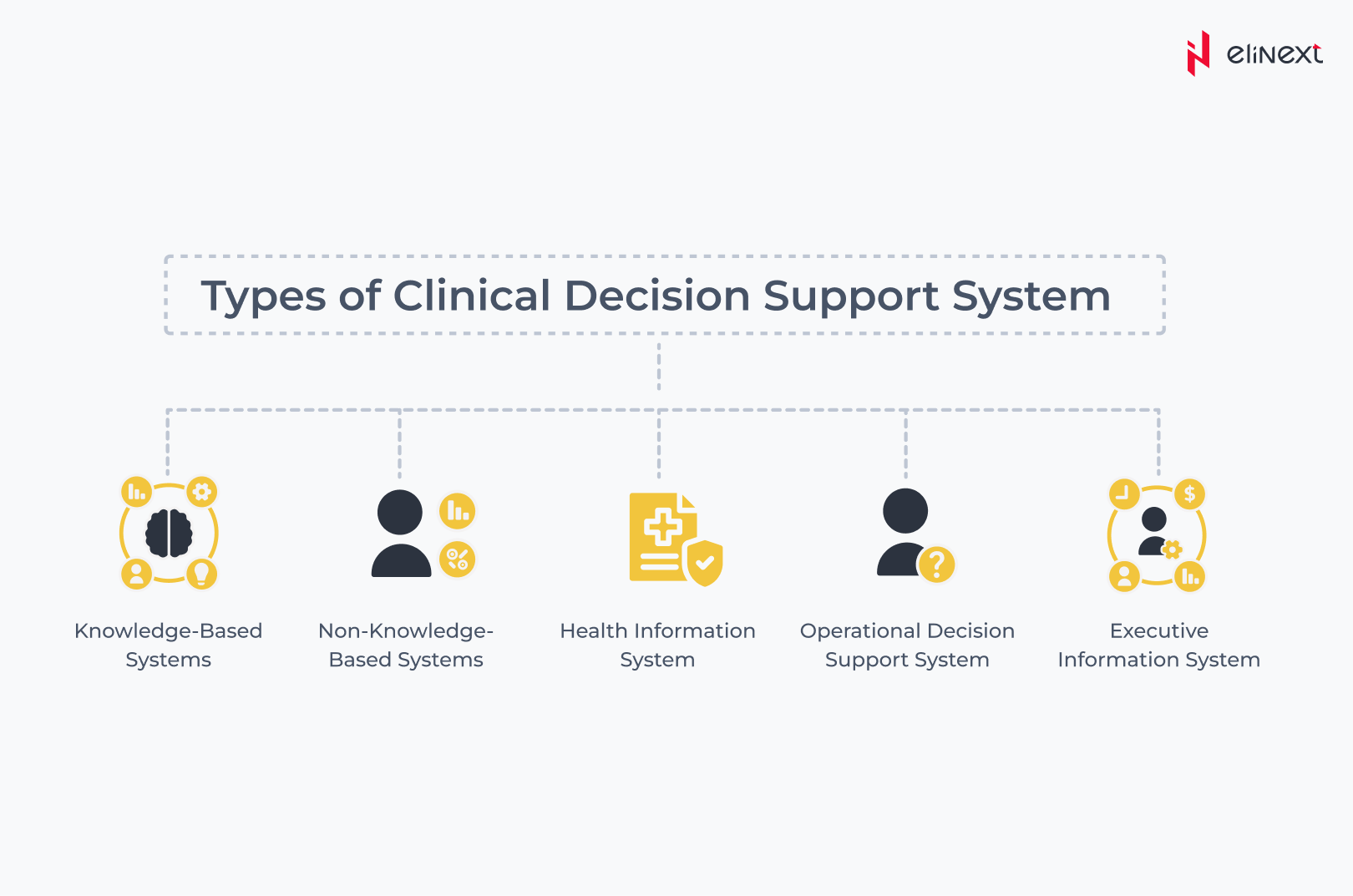
Clinical decision support applications include knowledge-based (rule-based) and non-knowledge-based (AI-based) systems. They provide alerts, diagnostic support and treatment recommendations based on analysis of patient data and clinical protocols.
To say that the term “Clinical Decision Support Systems” unites a lot of different software tools is an understatement. It could be used for a variety of tasks: from cost containment to diagnostics support, and come in all shapes and sizes.
CDSS software could be a standalone program, an integrated part of a huge Electronic Health Record System (EHR), or other types of software. They could be tackling a single issue, working on multiple complex functions, and covering a variety of processes across several modules.
Usually, modern CDSSs come from powerful computing engines, advanced algorithms, and high-class tech, such as cloud computing. They haven’t changed much over the decades on the architectural level, so they’re still similar to the early expert solutions introduced back in the 70s and 80s.
Under the hood, judging by the ways they come to a conclusion, there are two types of CDSS: knowledge-based and nonknowledge-based ones.
Knowledge-based CDSS software
Knowledge-based clinical decision support software uses medical rules and guidelines to generate alerts and recommendations. It warns about drug interactions or suggests standard treatment protocols for specific diagnoses.
These are systems that are rule-based and use “if-then” logic to generate recommendations Knowledge-based CDSS use the data they got on the diseases, treatments, and patient data, and based on it, assist healthcare professionals in decision-making.
In turn, they have these sub-types among them.
Rule-Based Systems
CDS software with rule-based systems applies IF-THEN logic to patient data. If a patient is allergic to penicillin, the system alerts the doctor before prescribing antibiotics, preventing adverse reactions.
Systems of such kind use a set of predefined rules to make decisions or provide recommendations. For instance, a rule-based CDSS might have the algorithm of a kind: “If the patient has a fever, and the white blood cell count is abnormally high, then recommend antibiotics to treat possible infections.” This is a real example from the rule-based CDSS for the diagnosis of malaria.
Bayesian Networks
Healthcare decision support software using Bayesian networks predicts disease risk by analyzing probabilities based on patient data. It estimates the likelihood of sepsis, helping doctors intervene early and improve treatment outcomes.
These networks make decisions based on probability from the variables they have in the database. The probabilities are calculated based on available data and their prior knowledge. These networks assess the likelihood of a patient having a disease based on the symptoms and test results.
Non-knowledge-based CDSS
Non-knowledge-based clinical decision support solutions with CDSS use AI and machine learning to identify patterns in large data sets. They predict patient deterioration or suggest personalized treatments that go beyond standard guidelines.
Non-knowledge-based CDSS utilize Machine Learning (ML) and data mining to generate recommendations based on the identified patterns. The systems make conclusions based on historical patient data, therefore ML algorithms for these systems are trained on this data.
As for data mining, there are techniques that are used to discover hidden patterns in large datasets.
CDSS Software Major Areas of Application
Clinical decision support software is used to ensure medication safety, provide diagnostic support, predict risks, and automate workflows. It alerts physicians to drug interactions, suggests diagnoses, and streamlines ordering.
Diagnosis Management
Clinical decision support applications assist in diagnosis by analyzing symptoms and test results. They suggest possible diseases or recommend additional tests, reducing diagnostic errors and supporting clinical decisions.
There are special so-called medical diagnosis systems (MDSs). Their main functionality is to compare the information on a specific patient’s condition with the database they use and come up with a list of possible diagnoses.
Those AI-based programs do not make the final conclusions about the problem, but they’re perfect for alerting the doctor about a certain potential patient’s condition.
Drug Management
Clinical decision support solutions improve medication management by screening for interactions, allergies, and correct dosing. They alert physicians to potential adverse reactions, ensuring safer treatments.
More than half of medication errors happen during the prescribing stage, and almost half of the studies about CDSS systems prescribing drugs show that they reduce the number of errors while being in this critical stage. Eliminating risks that come as a human factor reduces the number of errors by a mere 75%.
Besides, as CDSS has patient data, such as weight, age, allergies info, and current prescriptions, it calculates the medication dosage accurately and instantly considering all these factors.
Chronic Disease Management
Healthcare decision support software assists in the management of chronic diseases by tracking patient data, suggesting evidence-based treatments, and sending follow-up reminders, improving long-term outcomes in conditions such as diabetes or heart failure.
CDSSs are widely used for managing chronic conditions such as diabetes or hypertension, as they track patient data for long-term care plans.
The analysis of fourteen studies revealed that diabetes was the most frequently explored disease (42.8%) by the systems, and the predominant approach was diagnostic. In terms of data sources, CDSS databases were extensively used (85.7%), with sensors (42.8%) and self-reporting (28.6%) also considered. That means there are a lot of systems involved in chronic disease management, and this area is being extensively researched.
Surgical Decision Making
CDS software supports surgical decision making by providing risk assessments, recommending best practices, and flagging potential complications. It helps surgeons select optimal procedures and predict patient-specific risks.
CDSS assists surgeons in preoperative planning and intraoperative decision-making. The systems have been deployed in many hospitals due to the absence of systematic measurement of patients’ compliance in the healthcare system. Healthcare software development services play a crucial role in enhancing these systems, ensuring better data management and improved decision-making capabilities.
Public Health Surveillance
Clinical decision support software assists in public health surveillance by analyzing trends and identifying outbreaks. It identifies unusual patterns of infection, allowing hospitals to quickly respond to emerging public health threats.
CDSS used for monitoring disease outbreaks and predicting trends in public health data. The Canadians have introduced the Global Public Health Intelligence Network (GPHIN). GPHIN has created a new monitoring technique that serves as a national outbreak notification while creating new possibilities for global outbreak response.
This is especially relevant as we have fresh memories of the most recent pandemic. As we have more understanding of factors driving infectious disease emergence, and improved communications for public health surveillance, we can further enhance global surveillance.
“Choosing the best clinical decision support software requires balancing advanced AI capabilities, seamless EHR integration, regulatory compliance, and user-friendly design. Hospitals should prioritize customizable CDS solutions that align with clinical workflows, ensuring improved patient safety, greater efficiency, and measurable ROI for sustainable healthcare growth.”
Elinext software development expert
Which Options Does My Company/Hospital Go With?
In the realm of Clinical Decision Support Systems (CDSS), each type and brand offers its unique advantages. However, it is essential to conduct a thorough risk-benefit analysis before making a selection.
Given the specific nature of CDSS development and integration, a preferable approach involves engaging a remote IT team in the creation of decision support software.
At Elinext, our team of experts is proficient in developing customized CDSS solutions tailored to your specific requirements. We offer the following services:
Custom CDSS Development:
We can craft a CDSS for your healthcare facility from scratch, designed with scalability in mind to accommodate future needs.
Seamless Integration:
We ensure seamless integration of the CDSS with your existing Electronic Health Records (EHR) systems, ensuring a cohesive digital ecosystem.
Performance Monitoring:
We establish robust mechanisms to monitor the system’s performance, guaranteeing its efficiency and reliability in real-time usage.
With Elinext, you can count on a dedicated team to create and maintain a cutting-edge CDSS tailored to your healthcare needs.
Challenges on Your Back in CDSS Choice and Implementation
There is very little doubt that Clinical Decision Support Systems (CDSS) serve well in modern-day healthcare, yet they come with inherent risks and challenges.
Too Many Alerts
One major concern is alert overload; a CDSS might generate an excessive number of alerts and recommendations, leading caregivers to ignore them, regardless of their importance. It is crucial to select a solution that allows for the prioritization of critical notifications, preventing alert fatigue. That means the system should be fine-tuned, and you need professionals to do that for your hospital, which leads us to…
Integration Challenges
Having all the necessary features is not enough. A CDSS solution will not be beneficial if it cannot seamlessly integrate with the existing information system. Compatibility with Electronic Health Records (EHR), or easy workflow integration is essential. Ensuring the chosen solution aligns with the current system is vital for optimal functionality.
Interoperability Issues
Even after integration, CDSS solutions might struggle to effectively communicate with other modules due to diverse healthcare record standards. The adoption of Fast Healthcare Interoperability Resources (FHIR), the latest HL7 format for healthcare data exchange, has improved this situation for some of our clients.
To ensure smooth data exchange, it is essential to implement FHIR standards throughout the healthcare organization and with external systems.
Conclusion
To select the best clinical decision support applications and healthcare decision support software, hospitals should prioritize solutions with up-to-date clinical content, seamless integration with electronic medical records, and powerful artificial intelligence capabilities.
A hospital that implemented a cloud-based CDS platform saw a 17% reduction in diagnostic errors and increased workflow efficiency. Evaluate vendor support, scalability, and regulatory compliance to ensure long-term value. The right CDS software will improve patient safety, optimize care, and help your hospital thrive in the rapidly changing healthcare landscape.
FAQ
What is clinical decision support (CDS) software?
Clinical decision support solutions are digital tools that analyze patient data and clinical guidelines to provide recommendations, alerts, and reminders in real time. They identify drug interactions or suggest evidence-based treatments, promoting safer and faster decision making.
Why is CDS software important for hospitals?
Healthcare decision support software improves patient safety, reduces errors, and streamlines workflows. Hospitals using CDS tools report fewer medication errors and faster diagnosis, leading to better outcomes and more efficient care.
What are the key factors to consider when choosing CDS software?
Key factors include the quality of clinical content, integration with electronic health records (EHRs), user experience, support, ROI, scalability, and compliance. Choose healthcare decision support software that regularly updates guidelines and seamlessly integrates with your hospital’s electronic health records.
How important is EHR integration in selecting CDS software?
Integration with electronic health records (EHRs) is critical for real-time data access and workflow efficiency. CDS software integrated with your EHRs can provide alerts and recommendations directly at the point of care, reducing manual data entry and improving physician adoption.
What role does AI and machine learning play in CDS?
Clinical decision support software with AI and machine learning analyzes large data sets to predict risks, personalized recommendations, and automate tasks. AI-powered CDS predicts the risk of sepsis, enabling early intervention and improving patient outcomes.
What security and compliance features should CDS software have?
CDS software should provide encryption, access control, audit trails, and be HIPAA, GDPR, and FDA compliant. Secure clinical decision support software protects patient data and meets all legal requirements for healthcare IT systems.
How can hospitals avoid alert fatigue with CDS software?
Hospitals can avoid alert fatigue by customizing alerts, using AI to prioritize critical notifications, and regularly analyzing alert effectiveness. Specialized clinical decision support software reduces unnecessary interruptions and increases physician engagement.
What are the common mistakes hospitals make when selecting CDS software?
Common mistakes include ignoring workflow integration, underestimating training needs, and choosing generic tools over customized solutions. Hospitals that ignore stakeholder input or fail to align CDS software with clinical workflows experience lower adoption rates and ROI.
