
RPA in finance is a technology involving software bots that automate repetitive, rule-based digital tasks. Designed for banks, investment firms, and fintech companies, it results in 24/7 continuity and a 30-50% reduction in operational costs.
In 2026, the market has shifted from simple macro-bots to sophisticated digital ecosystems. With the global financial automation market surpassing $15 bln, firms are no longer just trying automation; they are scaling it to manage complex regulatory landscapes and the massive data influx of the mid-2020s.
Key Takeaways
- Gartner forecasts that 40% of enterprise applications will incorporate task-specific AI agents шт 2026.
- Implementing RPA in finance and banking for high-impact processes like KYC (Know Your Customer) and reconciliation reduces processing time by up to 60%.
- According to Forbes, nearly 70% of financial leaders are now embedding AI into their operations, signaling a significant surge in trust toward autonomous technologies.
What is RPA for the Financial Industry?
RPA (robotic process automation) in the financial industry is the use of specialized software bots to automate high-volume, repetitive tasks like data entry, compliance checks, and transaction processing. It allows firms to handle complex workflows, such as KYC verification and loan approvals with total accuracy and lower costs.
Scale your financial operations with our custom RPA development services
Elinext helps you automate complex workflows to drive 24/7 efficiency and compliance.
What are the Key RPA Use Cases in Finance
Financial institutions deal with high-stakes, time-consuming tasks that demand zero errors. RPA helps automate these activities, boosting throughput and significantly reducing operational costs. Below, we explore practical use cases showing how robotics simplifies the intricate processes that keep the global financial ecosystem running.
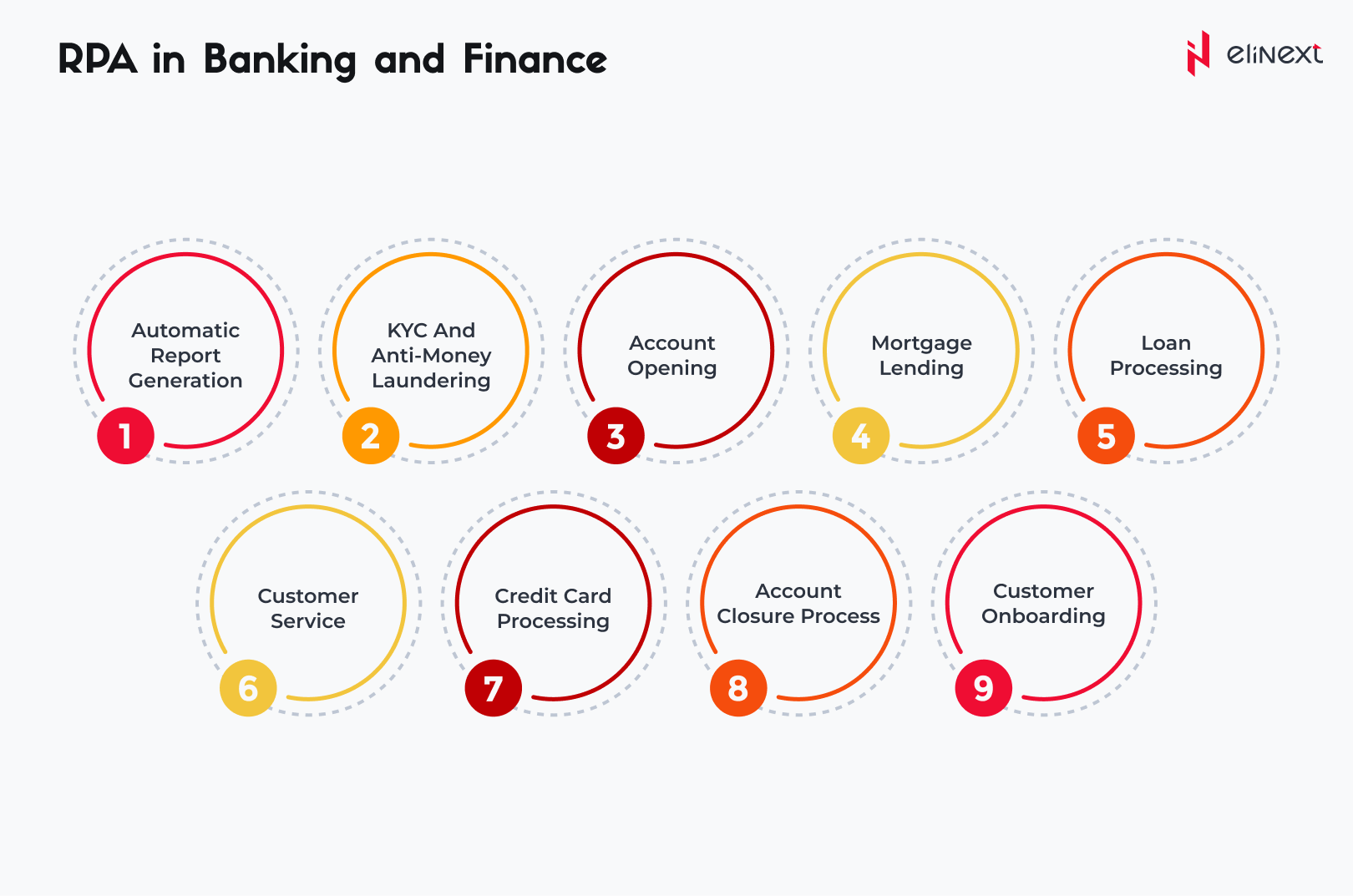
Automatic Report Generation
This system automates data collection from ERPs and spreadsheets for consolidated reporting. It eliminates manual tasks that occupy 70% of a controller’s time, delivering instant, error-free financial reports ready for immediate stakeholder analysis.
KYC and Anti-Money Laundering
This bot-driven solution scans global databases for ID verification and threat detection. It ensures compliance and cuts false positives, accelerating onboarding by 60% while minimizing the risk of massive regulatory fines.
Account Opening
This service automates ID data extraction for instant core banking updates. It eliminates manual entry errors and friction, slashing account activation time from several business days to just a few minutes.
Mortgage Lending
This tech automates doc checks, credit scoring, and background verification for mortgages. It streamlines the industry’s most document-heavy process, accelerating loan approval cycles and significantly boosting customer satisfaction scores.
Loan Processing
This bot-driven workflow automates income, employment, and debt-to-income validation. It standardizes decision-making, increasing lending throughput and scaling operations without additional headcount.
Customer Service
This software uses AI bots that handle balance inquiries, transaction history, and tech issues, resolving 80% of routine queries. This ensures 24/7 instant support, drastically reducing call center load and operational costs.
Credit Card Processing
This tool automates credit card applications, including risk assessment and card issuance. It slashes the time between application and delivery, driving transaction growth and creating a seamless one-click credit customer experience.
Account Closure Process
This RPA service verifies zero balances, cancels recurring payments, and notifies customers. It ensures data integrity and compliance, providing a fully documented, error-free, and rapid closure process for inactive or requested accounts.
Customer Onboarding
This service automates the flow from welcome emails to app access and legal disclosures. Its business value lies in creating a flawless first impression, significantly increasing customer retention and reducing early-stage drop-off rates.
“Traditional fintech development is too slow for today’s market, delaying critical product launches. At Elinext, we use RPA as a strategic catalyst within our financial software development services to automate front-to-back office integrations in weeks, not months. This agility grants banks a decisive competitive edge, ensuring unmatched service speed and a faster time-to-market for new tools.” — Anastasia Timoshenko, Consultant for Fintech Solutions
Agentic AI vs RPA for Finance
While traditional RPA in finance and accounting is the bedrock for high-volume tasks like data entry and basic reconciliation, Agentic AI shifts from scripts to goal-oriented reasoning. Unlike RPA, which fails with minor UI changes or unstructured data, AI agents easily interpret complex tax codes or negotiate vendor discrepancies. For finance leaders, this means moving beyond simple digital macros toward self-healing workflows that adapt to market volatility and evolving regulatory landscapes. Teams building financial planning tools can reference Elinext’s overview of fintech for retirement processes, which outlines the product design considerations for retirement-focused fintech — from automated contribution management and projection tools to the compliance requirements that govern the handling of long-term savings data in regulated markets.
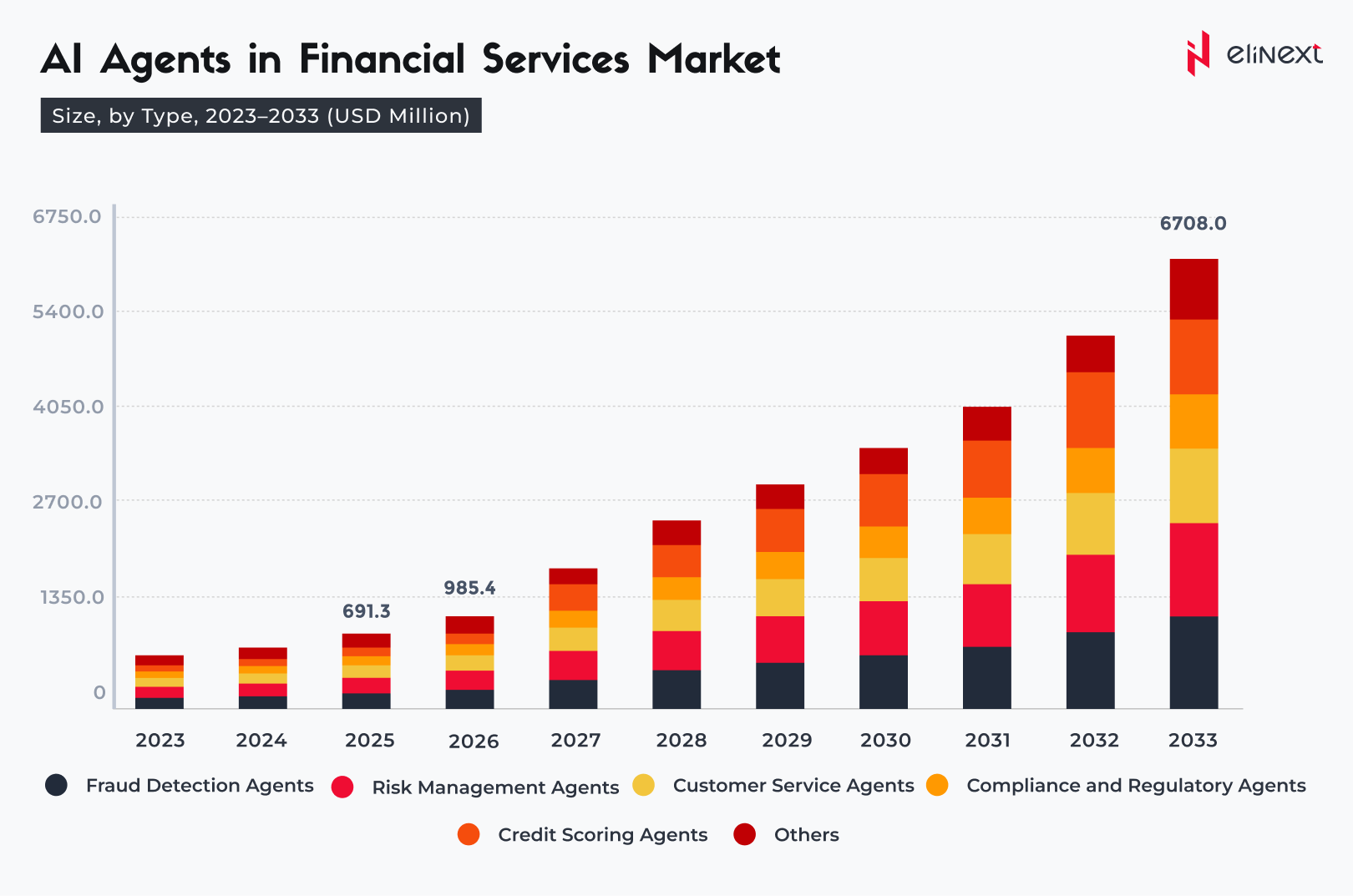
The AI agents in financial services market was valued at $691.3 mln in 2025 and is expected to surge to $6.7 bln by 2033. Adoption has shifted from experimental bots to autonomous agentic workflows in over 50% of firms. Top banks use these agents for real-time fraud detection, personalized wealth management, and automated regulatory compliance.
Elinext RPA Development Solutions for the Financial Industry
As a leading AI software development company, Elinext provides bespoke automation frameworks that go beyond simple task recording. We specialize in building secure, scalable bots that integrate deeply with core banking systems and cloud infrastructures. Our solutions prioritize security and auditability, ensuring that every automated action is logged and compliant with global financial standards.
Stop letting manual workflows slow you down
Leverage our professional generative AI development services to build autonomous agents that handle your complex financial operations.
What is the Future of RPA in Finance?
RPA was a great start for copy-paste tasks, but it’s reached its limit. Transactional bots are simply too stiff for the modern office. The future of RPA in finance and accounting belongs to autonomous systems that combine RPA’s speed with AI’s brainpower, creating a new class of intelligent apps that can adapt to change without human intervention.
Integration with AI & Intelligent Automation
RPA plus ML and NLP has birthed intelligent automation. By 2026, finance bots won’t just move data from A to B. They are getting a brain boost that lets them understand what they’re reading. Instead of just following a script, they will recognize the context of every invoice and report they handle.
Cloud & RPA as a Service (RPAaaS)
Scalability is no longer an on-premise challenge; it’s a cloud solution. RPAaaS lets small firms use pro-level automation without big costs. This means boutique investment teams can now use high-speed bots and cloud power to handle busy times like tax season just as easily as the big banks.
Human with Bot Collaboration
Bots aren’t working alone anymore, they’re co-pilots with people. They do the heavy lifting, then hand it over for a human’s final check. This teamwork combines a bot’s lightning-fast speed with human empathy and ethics, ensuring every high-stakes financial decision is both smart and safe.
Enhanced Security and Governance
Bot governance is now a proactive shield. Future RPA systems feature built-in encryption and AI that alerts you if a bot acts suspiciously. This isn’t just a checkbox; it’s a smart security layer that detects deviations from programmed parameters and stops internal fraud before it happens.
“Financial companies face a fundamental issue: their processes have scaled faster than their infrastructure. Manual checks, fragmented systems, and outdated workflows create bottlenecks that teams can’t overcome. Through our RPA, AI, and finance and accounting software development services, we close these structural gaps by automating critical operations and restoring control and predictability.” — Maxim Dadychyn, AI-driven Business Transformation Expert
Conclusion
RPA in accounting and finance is evolving from simple task automation to intelligent, adaptive systems. As AI-driven agents take on complex decision-making and unstructured data, firms gain resilience, accuracy, and operational scale. The future belongs to hybrid automation models that merge RPA’s speed with AI’s reasoning, giving financial institutions the agility required in a volatile market.
RPA in Finance: Terms Explained
RPA
Software technology that makes it easy to build, deploy, and manage software robots that emulate humans’ actions interacting with digital systems and software.
Bot Orchestration
The centralized management of multiple software bots. It ensures they work together seamlessly across different departments, balancing workloads and optimizing performance for maximum efficiency.
Record-to-Report (R2R)
A finance and accounting process that involves collecting, processing, and delivering relevant, timely, and accurate information for strategic decision-making.
Order-to-Cash (O2C)
An end-to-end set of business processes covering everything from receiving a customer’s order to the final payment. Automation speeds up fulfillment and improves the overall cash flow of the firm.
Procure-to-Pay (P2P)
The integration of purchasing systems with accounts payable to streamline the entire buying cycle. Automation creates greater efficiencies in vendor management and reduces manual document handling.
Intelligent Automation (IA)
The powerful combination of RPA and AI technologies. It expands the scope of automation beyond simple tasks, allowing systems to handle complex, judgment-based processes that require reasoning.
Optical Character Recognition (OCR)
Advanced technology used to convert various documents, such as scanned paper invoices or PDF files, into editable, searchable data that financial bots can easily process without manual entry.
Natural Language Processing (NLP)
A branch of AI that enables computers to understand, interpret, and manipulate human language. In finance, it is used to analyze contracts, emails, and customer queries with high precision.
Machine Learning (ML)
A type of AI that allows software to become more accurate at predicting financial outcomes over time. It learns from historical data patterns without being explicitly programmed for every scenario.
Cognitive Automation
High-level automation that uses AI to mimic human brain functions like learning and self-correction. It enables bots to handle unstructured data and adapt to changes in the financial environment.
Bot Governance
A vital framework of rules and procedures ensuring that bots operate securely and ethically. It maintains strict compliance with global financial regulations and prevents unauthorized system access.
RPA as a Service (RPAaaS)
A flexible, cloud-based model where RPA tools are provided via a subscription. It allows firms to scale their automation efforts quickly without heavy upfront investments in local infrastructure.
API Automation
The use of APIs to let different software systems talk to each other. It enables lightning-fast data exchange between banking platforms without using the visual interface.
Return on Investment (ROI)
A key performance metric used to evaluate the profitability of automation. It measures the financial gains and efficiency boosts achieved compared to the initial cost of implementing the bots.
Straight-Through Processing (STP)
An entirely automated process for financial transactions, performed purely through electronic transfers. It eliminates human intervention, ensuring faster execution and near-zero error rates.
FAQ
What’s the outlook for RPA in finance by 2026?
The outlook for RPA in finance focuses on hyper-automation and cloud-native services. It is used to create a more resilient, 24/7 financial environment. Businesses apply it to scale operations rapidly while maintaining strict regulatory compliance.
Is RPA still relevant with AI and generative technologies emerging?
RPA remains highly relevant as the execution engine that carries out the physical tasks AI decides upon. It’s used to bridge the gap between AI insights and legacy system actions. Firms use it alongside Gen AI to ensure that thinking leads to doing.
Will RPA replace finance jobs?
RPA in finance is a tool for job augmentation rather than total replacement. It offloads tedious, repetitive tasks from human employees. It allows finance teams to focus on high-value advisory roles and strategic financial planning.
How is AI changing the future of RPA?
The merger of AI and RPA has moved beyond pilots to a total finance transformation. We are shifting from dumb bots that just move data to Agentic AI, intelligent systems that can think, reason, and adapt to complex changes.
How will RPA help with fraud and risk management?
RPA in accounting and finance provides continuous, real-time monitoring of transactions. It flags anomalies that periodic human audits often miss, creating an always-on security layer that reacts instantly to any financial threats.
Will RPA still matter long-term?
Yes, because RPA is the essential connective tissue for digital firms, maintaining interoperability between disparate tools. It serves as a foundational layer that ensures operational stability even as front-end technologies evolve.
About the Author
Anastasia is a financial and banking IT consultant at Elinext with over 10 years of experience in fintech project delivery. She specializes in client management, RFP bidding, and cross-functional coordination for complex financial sector solutions — helping businesses bridge the gap between regulatory requirements and scalable software implementation.