


About Client
Our client provides AI & Data Science solutions from real-time data. They help manufacturing enterprises by providing data engineering, machine learning, and Aveva PI application development services. Our client is an expert in turning raw data and unstructured data into a profit-making business opportunity for their end clients with the help of our partners SEEQ and Aveva.
The company we partnered with has extensive industrial experience coupled with a strong presence in the energy domain. They have their presence felt in many major American and international power and Oil & Gas companies and offer a wide variety of services across these sectors and more. They were looking for opportunities to increase their project data management software development capacity.
Business Challenge
In the oil & gas industry (the one in which the end client operates), even seconds of system malfunction can lead to serious operational, safety, and financial consequences. The end customer faced multiple issues within their existing data landscape that limited reliability, scalability, and effective change management. Some of these issues definitely could be resolved with the help of project data management software development.
Key technical and delivery challenges of project data system development included:
- Multiple poorly synchronized systems of record (SORs), each with its own data model
- Document-centric workflows (PDFs, spreadsheets, paper) instead of structured, data-centric processes
- Slow change request closure, missing updates, and growing inconsistencies across SORs
- Fluid and evolving requirements, especially during the early stages of solution definition
- Need to design proofs-of-concept using mock data and a simplified ontology, later refined into a production-grade data model
- Adoption of a new technology stack for project data system development (ontology modeling, knowledge graphs, AVEVA AF) with no prior team experience
- Dependency on client-side experts for highly specialized components (e.g., AVEVA AF drivers)
- Communication and feedback delays on the client side, impacting planning and iteration speed
Process
Project data management software development was happening with close and frequent collaboration with the client. This included discovery workshops and alignment sessions to clarify goals and requirements, as well as regular synchronization meetings held up to three times per week, with daily standups introduced when needed to maintain momentum. To support deep domain understanding and data quality, a dedicated engineer was onboarded specifically for end-customer data analysis, ensuring accurate interpretation of source data and faster progress during both discovery and development phases.
Phase 1 – Discovery & Requirements Definition
Included: Requirements gathering, clarification, and documentation for our AI software development services.
Phase 2 – Development
Included: Core software development and system implementation, including delivering UI/UX design services, AI integration services, and other web development services.
Phase 3 – Extended Capabilities (Planned)
Scope: Additional developments, including simulation features and MOC validation improvements
Deadline: 10 months
Final Product Overview
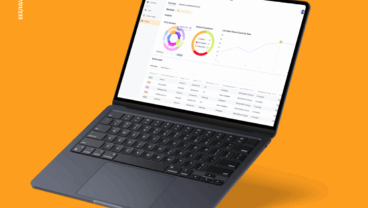
The final result of project data management software development is a web-based Intelligent Project Data System designed to centralize, structure, and govern complex project data. It replaces fragmented, document-heavy workflows with a unified, data-centric platform (generative AI development services were implemented) that serves as a single source of truth.
After executing our data science development services, the system integrates seamlessly with the client’s existing enterprise ecosystem:
- Microsoft Admin Center is used for user synchronization and credential management.
- Corporate SharePoint serves as the document repository and storage layer.
- A knowledge-graph-based backend ensures consistency, traceability, and scalability of project data.
The project data system development platform enables project leaders, engineers, and specialists to access reliable, up-to-date technical, financial, and legal information at appropriate levels of detail, supporting faster and more confident decision-making while reducing operational risk.
The solution includes the following modules:
1. Common Model Definition
Defines a canonical ontology covering core entities, attributes, relationships, and constraints. It establishes a shared data language for the business while providing developers with a stable foundation for ingestion, validation, and system evolution.
2. Model Registry & Versioning
Manages ontology versions, tracks consumer compatibility, and enforces deprecation rules. This enables safe evolution of data models for the business and controlled schema changes for software teams.
3. Parser / Ingestion
Maps data from multiple systems of record into Common Model instances, handling normalization and semantic alignment. It reduces manual effort for business users and decouples source systems from internal data structures for developers.
4. Validation & Rules Engine
Applies schema constraints and cross-entity logic to ensure data consistency. This increases trust in operational data and provides a centralized, maintainable rule enforcement mechanism.
5. Instance Store (Neo4j)
Stores Common Model instances as a knowledge graph with identity, provenance, and versioning. It serves as a single source of truth for the business and supports efficient relationship-heavy queries for developers.
6. Knowledge Graph Projection
Creates optimized graph views tailored for frontend consumption. This simplifies data exploration for users while preserving a clean separation between core data and UI models.
7. Sync & Reconciliation
Detects changes, resolves conflicts, and keeps systems of record aligned with the Common Model. It improves data consistency for the business and enables deterministic synchronization logic for developers.
8. API / Access Layer
Provides secure, controlled access to data for internal and external consumers. It supports system integration for the business and enforces access and validation rules at the technical level.
9. Admin & Tooling
Handles authentication, authorization, logging, and diagnostics. It ensures enterprise-grade security and observability while simplifying system operations and maintenance.
Business Effects for Client
As a result of the project data management software development, the client secured a contract with their end customer (oil and gas enterprise), validating both the technical approach and the commercial viability of the solution. The delivered frontend application now serves as a working product that the client actively uses to demonstrate the concept to other potential customers, supporting further business development and sales efforts.
Once fully deployed, the Management of Change (MOC) validation tool is expected to significantly accelerate the MOC close-out process. Given that end0sutomer’s reported costs associated with MOC-related delays were approximately $8 million in the previous year, the project data system development has the potential to materially reduce facility downtime and associated financial losses by improving data consistency, validation, and decision speed.
Beyond direct business impact, the project data management software development results demonstrated the client’s ability to evolve toward a data-centric, product-oriented offering in a traditionally document-driven environment, strengthening their long-term competitive position. Elinext strengthened its portfolio as an oil and gas software development company.