


About Client
Elinext is a globally recognized software engineering and IT consulting group, a custom healthcare software development company with development centers and business offices across Europe and the Asia-Pacific region.
This initiative began as an internal R&D project aimed at simplifying the interpretation of lab test results for the end-user. By providing a medical AI chatbot development, we worked at an LLM-powered agent capable of explaining medical data in clear, personalized language, Elinext developers created a base product. Much like Elinext’s previous internal frameworks that later evolved into accelerators for healthcare, fintech, and IoT solutions, this project is designed with future scalability in mind and its application in the future.
Business Challenge
The project set out to create a chatbot capable of helping patients understand their lab test results in simple, accessible language. Essentially, medical AI chatbot development.
Beyond answering questions, the solution aimed for
- analyzing uploaded PDFs and images of medical reports
- extracting the relevant data
- providing personalized explanations that patients could easily act upon.
On the technical side of medical AI chatbot development, one of the main hurdles was the limited flexibility of certain LlamaIndex components when tailoring the retrieval-augmented generation (RAG) pipeline. Achieving the desired level of customization required deep exploration of documentation, reviewing source code, and engineering targeted workarounds—ensuring the solution delivered accurate, context-aware responses without compromising system stability or compatibility.
The Process
Stage 1: Basic bot – 1 week
Built an initial conversational assistant capable of handling PDF and image uploads of lab results, parsing the data, and providing answers based on its internal knowledge.
Stage 2: RAG pipeline – 3 weeks
Developed scripts to scrape authoritative medical sources about lab tests and store them in the Qdrant vector database. Implemented an advanced RAG pipeline with techniques for improved retrieval and tested its performance.
Stage 3: Feedback collection and preference optimization – 4 weeks
Researched LLM fine-tuning and preference optimization methods, implemented the feedback collection system, and developed scripts for fine-tuning using DPO with QLoRA, alongside delivering quality assurance software services
Final Product Overview
We delivered custom software development services to our client. The result is a chatbot medical assistant, a monolithic application built on a modern technology stack: FastAPI powers the back end, Qdrant serves as the vector database for semantic search, and the front end is implemented with Angular and Tailwind CSS (TypeScript).
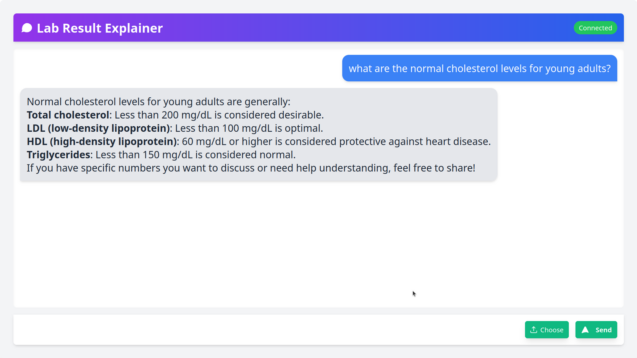
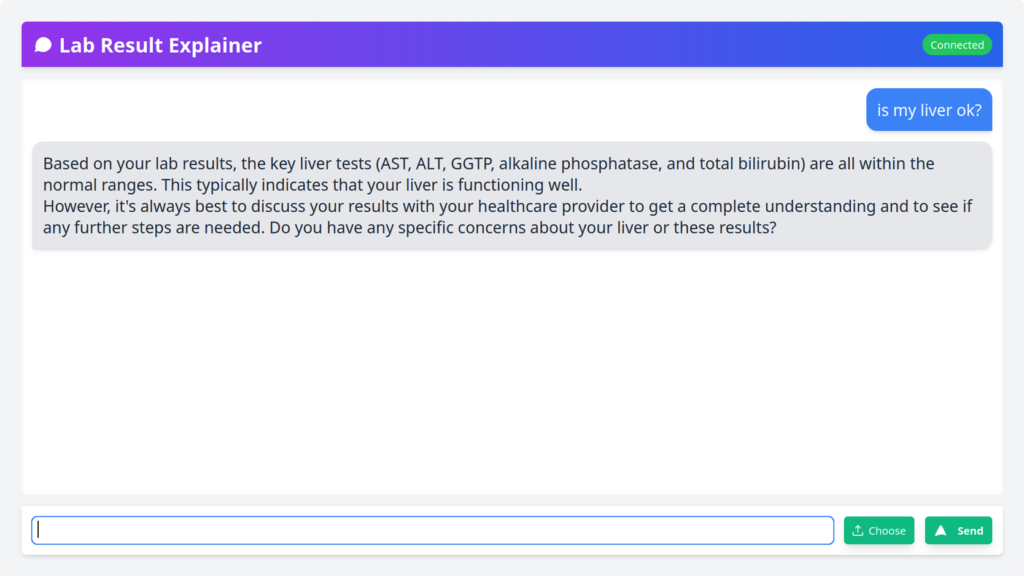
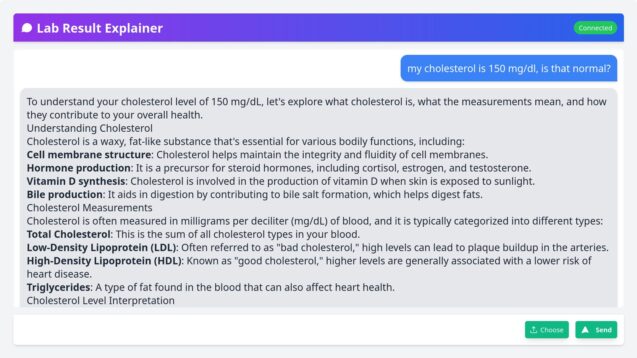
The chatbot medical assistant helps patients interpret and understand their lab test results in simple, accessible language.
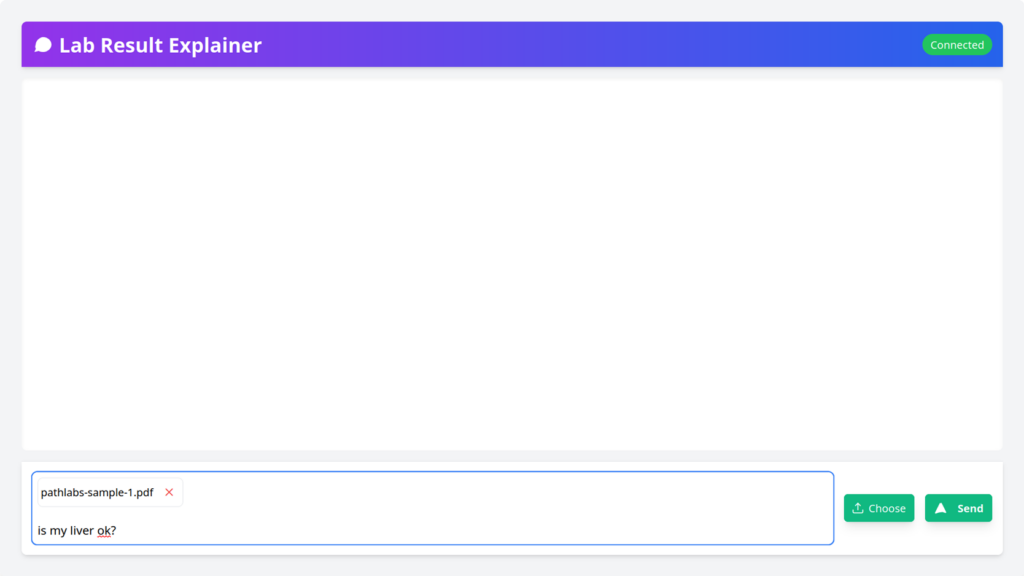
Through a natural language interface, thanks to our medical AI chatbot development, users can:
- Upload PDF or image files containing their lab reports
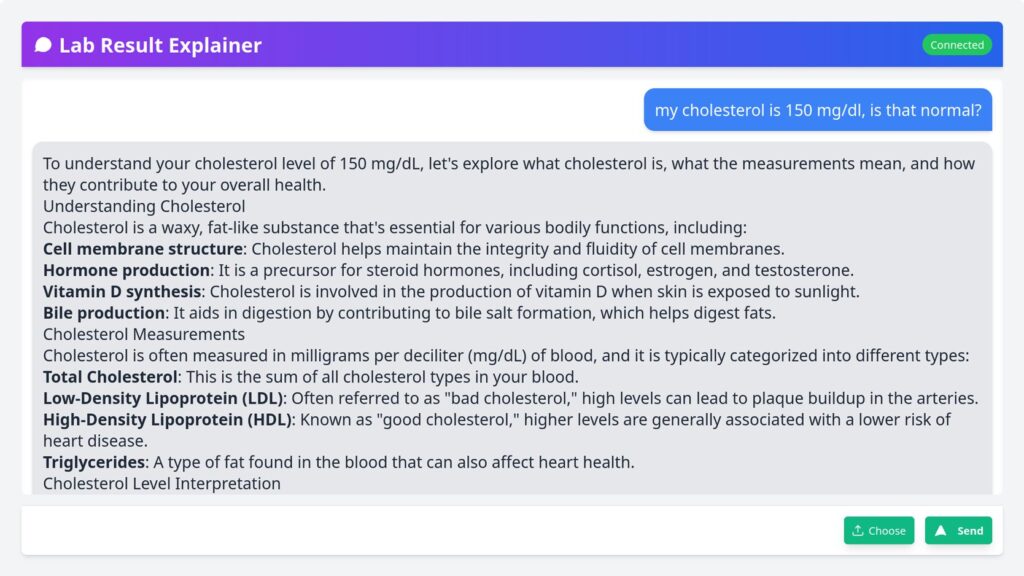
- Receive clear explanations of medical terms and test values
- Ask follow-up questions for additional context or clarification
- Access trusted medical information related to their results
- Get responses instantly, without waiting for a healthcare professional
- Use the tool anytime to better prepare for consultations with their doctor
The system combines prior experience with LangChain and LangGraph for rapid prototyping and validation, a robust RAG pipeline with hybrid search and semantic chunking for precise retrieval, and fine-tuning methods such as DPO with QLoRA for improved reasoning and communication. To validate performance, the Ragas library was integrated to benchmark retrieval quality on synthetic datasets.
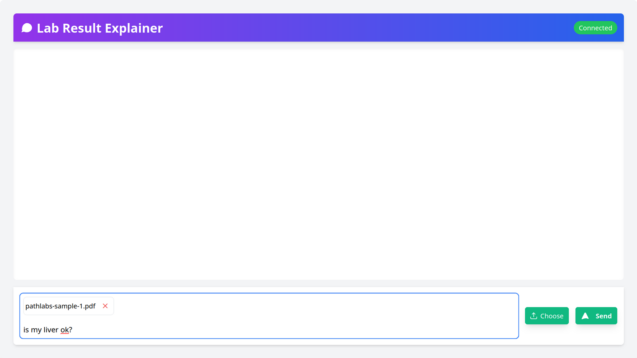
The final product is a chatbot medical assistant, not only an internal innovation but also a scalable foundation for future healthcare-oriented software solutions, enabling clear, patient-friendly communication of complex medical information. At the same time, the system is designed as an internal project. It can be applied to any domain where there is a structured knowledge base — from healthcare to education, customer service, or enterprise knowledge management. Because of its current internal focus, the product is not bound by medical regulatory requirements, but it lays the groundwork for future adaptations that could be aligned with industry standards when needed.
Business Effects for Client
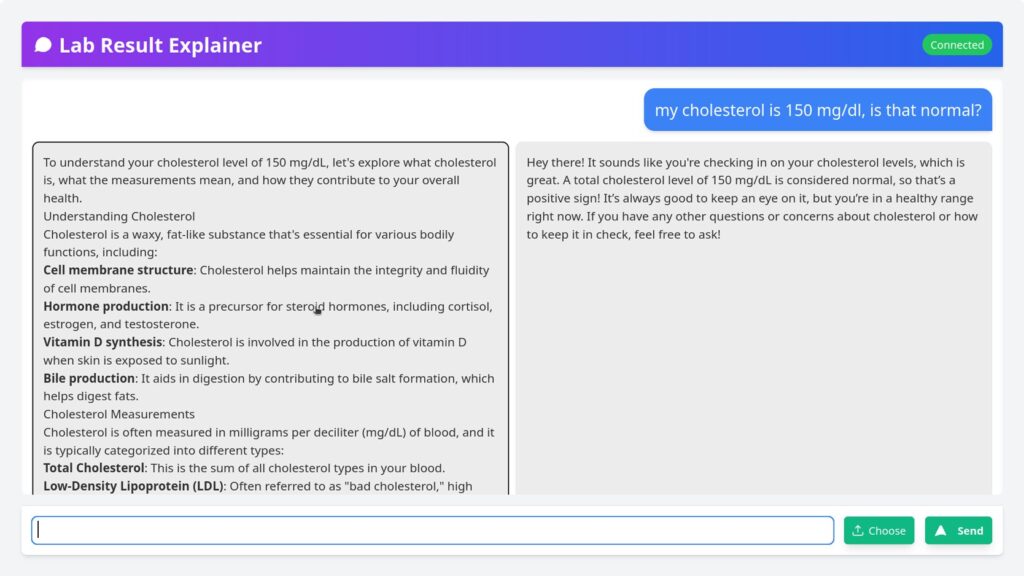
Throughout the project, Elinext gained significant expertise in the design and optimization of advanced retrieval-augmented generation (RAG) systems and medical AI chatbot development. The team strengthened its knowledge of techniques such as query rewriting, hybrid search, and semantic chunking, while also adopting automated evaluation workflows with the Ragas library. In parallel, hands-on experimentation with Direct Preference Optimization (DPO) and QLoRA provided practical experience in preference-based fine-tuning, resulting in a more natural, accurate, and user-friendly conversational flow.
Another key outcome of a medical AI chatbot development was the establishment of a modular chatbot architecture that clearly separates retrieval and conversational layers. This design choice improves maintainability, enables targeted optimization, and provides a blueprint for future projects where scalability and adaptability are critical.
At present, after the medical AI chatbot development, the software is not compliant with medical data protection regulations. To achieve full compliance, additional capabilities for secure handling of sensitive health information, including encrypted storage and controlled access to patient feedback, would need to be incorporated.