



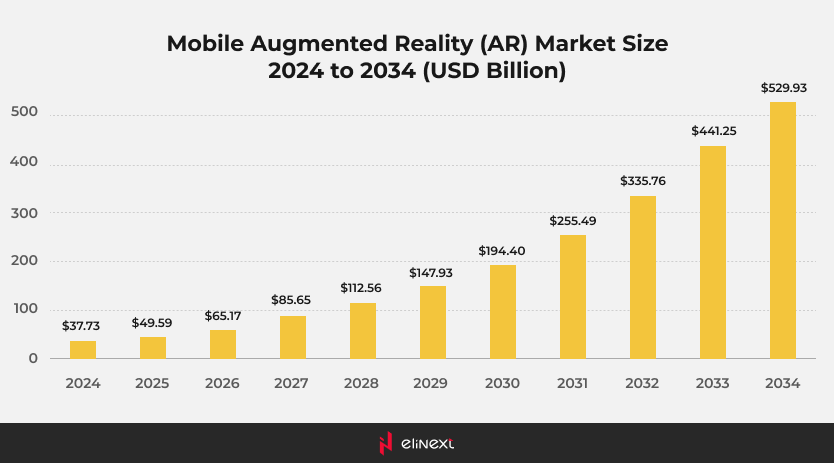
Mobile Augmented reality market is changing the way we interact and perceive the world since the new technology combines reality and digital information into one stream.
Mobile augmented reality is revolutionizing user interaction through AR mobile app development.
Key trends include gamification, increased user engagement, and location-based experiences that personalize content. Real-time collaboration tools are emerging, allowing users to seamlessly share augmented reality experiences. Additionally, advances in hardware are improving the quality of mobile augmented reality, making apps more immersive. As these trends evolve, they promise to redefine industries from gaming to retail, improving how users interact with their environment and each other.
10 Secrets of Mobile Augmented Reality
Integration with the Real World
Mobile augmented reality (AR) seamlessly blends digital content with the real world, allowing users to interact with virtual objects as if they exist in their environment.
User-centric experience
Successful mobile AR apps prioritize the user experience, offering intuitive interfaces and engaging interactions that entertain and inform users.
Location-based services
Many mobile AR apps use GPS and location data to deliver contextually relevant experiences, increasing user engagement by providing information based on their surroundings.
Gamification elements
Incorporating game-like features encourages user participation, making mobile AR apps more interesting. Users are often motivated by challenges, rewards, and interactive experiences.
Social sharing
Mobile AR allows users to capture and share their experiences on social media, driving organic growth and wider reach of AR apps through user-generated content.
Diverse applications
Mobile AR is transforming a variety of industries, including retail, healthcare, education, and entertainment, offering innovative solutions and improving customer experience.
Data privacy concerns
As AR mobile apps collect user data for enhanced personalization, developers must prioritize data privacy and security to earn user trust.
Continuous improvement
Mobile AR technology is rapidly evolving, and ongoing improvements in ARKit, ARCore, and other frameworks allow developers to create more immersive experiences.
Future potential
As mobile AR technology matures, its potential to transform everyday activities, from shopping to learning, continues to grow, paving the way for new applications and innovations in the future.
Accessibility and affordability
With the widespread adoption of smartphones, mobile AR is becoming accessible to a wider audience, allowing more users to experience and benefit from the technology.
Importance of Mobile AR in Various Industries
Wearable Augmented Reality Devices
The mobile augmented reality market is rapidly growing, driven by wearable devices. These gadgets offer immersive experiences in fields like healthcare, training, and entertainment, enhancing user engagement and efficiency.
Web-based Augmented Reality
The AR/VR software development company plays a major role in creating augmented reality web experiences. These solutions provide seamless interactions, increasing user engagement in industries such as retail and education.
Spatial Computing Advancements
Spatial computing advancements refer to the integration of physical and digital worlds through technologies like AR, VR, and IoT. AR mobile app development is key to spatial computing advancements. This enables immersive interactions, enhancing user experiences in various fields such as gaming, education, and healthcare.
5G and Cloud-Powered AR
Augmented reality mobile app development is greatly enhanced by 5G and cloud technology. This combination allows for faster data transmission, enabling real-time interactions and rich, immersive experiences, transforming industries and user engagement.
AI and Augmented Reality Fusion
In the mobile augmented reality market, the integration of AI with AR creates intelligent applications. This fusion enables adaptive content, improved object recognition, and enhanced user experience, driving innovation and engagement in real time.
Augmented Reality in eCommerce
Integrating augmented reality into eCommerce improves the user experience by allowing customers to visualize products in real-life settings. This leads to higher engagement, reduced returns, and ultimately higher sales conversion rates.
Augmented Reality in Healthcare
Augmented reality in healthcare improves surgical precision. For example, AR can project a patient’s 3D anatomy onto the surgical field, guiding surgeons during procedures, increasing accuracy and significantly reducing risks.
Augmented Reality in Education
AR mobile app development is transforming education by making learning interactive. For example, apps like Google Expeditions allow students to explore 3D models of historical sites or complex biological structures, increasing engagement and understanding.
AR for Social Media and Advertising
Augmented reality mobile app development is changing social media and advertising. For example, augmented reality effects on Instagram allow brands to create interactive ads, engaging users and increasing brand awareness through immersive experiences.
Privacy and Ethical Considerations
In AR mobile app development, privacy is of critical importance. For example, apps that track users’ locations for AR experiences must ensure data protection, giving users control over their information to maintain trust and comply with regulations.
Conclusion
If we look to the future, augmented reality mobile app development is set to redefine user experience across industries. With advances in cloud software development services, these apps will leverage powerful computing capabilities, enabling real-time data processing and seamless integration. Additionally, collaboration with ML software development company will enhance personalization and interactivity, creating immersive AR experiences that engage users like never before. The synergy of these technologies will drive the next wave of innovation in mobile AR.
FAQ
What platforms do you support for mobile AR app development?
We support multiple platforms for AR mobile app development, including iOS (ARKit), Android (ARCore), and cross-platform solutions like Unity and Vuforia, ensuring broad compatibility and immersive experiences.
How do you ensure performance on mobile devices?
To ensure optimal mobile app performance, we use efficient coding practices, optimize graphics and resources, use lightweight frameworks, conduct extensive testing, and use caching strategies for faster loading.
How long does it take to develop a mobile AR application?
The development time for a mobile AR app varies, typically between 3 and 6 months. As an AI software development company, we optimize processes to improve efficiency and ensure timely delivery while maintaining quality.
How much does mobile AR app development cost?
The cost of developing a mobile AR app varies depending on several factors, including the complexity of the app, the desired features, the choice of platform, and the experience and location of the development team.
