




The evolution of blockchain technology in 2025 is defined by incremental advancements in scalability, interoperability, and enterprise integration, with decentralized finance (DeFi) development services and revolutionary new business models driving this revolution. For example, DeFi’s total transaction volume (TVL) reached $123.6 billion, and the blockchain market soared to $57.7 billion. Enterprises are using blockchain for supply chain management, healthcare, and digital identity, while DeFi platforms like Aave and Uniswap are transforming global finance. This path combines steady progress with disruptive innovations that are transforming industries and economies worldwide.
What is a Blockchain?
Blockchain technology evolution has led to the creation of a decentralized, tamper-proof digital ledger that records transactions on a distributed network. Each block contains data, a timestamp, and a cryptographic hash of the previous block, ensuring transparency and security. Bitcoin uses blockchain to record peer-to-peer payments, and Ethereum enables the creation of programmable smart contracts. In 2025, blockchains will form the foundation of solutions in DeFi, supply chains, and healthcare, fostering trust and automation in digital ecosystems.
Stages of The Blockchain Evolution
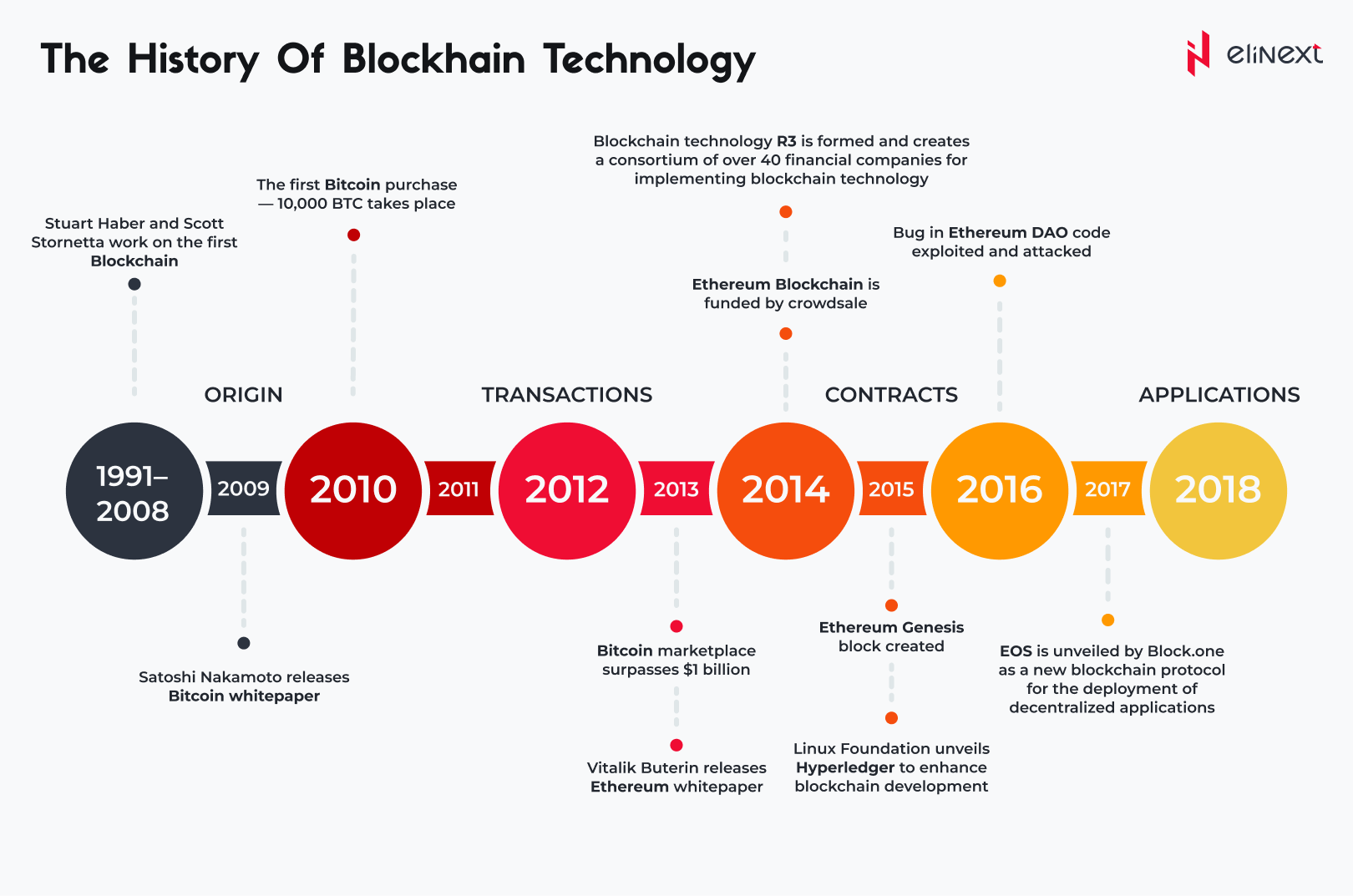
Knowing about the evolution stages blockchain has come through is initial for the understanding of its current trendy nature, as well as predicting ways it can further evolve. So to start with, let’s have a look at the process of blockchain versioning from 1.0 to 4.0.
Blockchain 1.0: Cryptocurrency
The history of blockchain has started in 2008 when the technology was conceptualized by Satoshi Nakamoto and then used as a core component of the cryptocurrency Bitcoin. A public ledger — a record-keeping system that maintains participants’ identities in a secure and anonymous format, has attracted a lot of attention from bankers, lawyers, accountants, and governments because of its potential to change both economic and operational models.
Blockchain 2.0: Smart Contracts
With the introduction of Ethereum, blockchain technology was complemented with smart contracts — autonomous computer programs that execute automatically in the blockchain. Defining and automatically enforcing obligations related to the agreement between different parties, smart contracts have become a perfect solution for simplifying and automating routine and repetitive processes, alongside ensuring their security and objectiveness.
Blockchain 3.0: DApps
Blockchain technology evolution underpins Blockchain 3.0—decentralized applications (DApps) such as Uniswap and OpenSea. These DApps enable peer-to-peer trading, lending, and NFT marketplaces, with over 14 million active wallets expected in 2025.
The concept of DApps (decentralized applications) was also originally linked to the Ethereum platform, and already mentioned smart contracts in particular. DApps are blockchain-based user-facing interfaces that connect end-users with the technology with the help of smart contracts.
Blockchain 4.0: Industrial Applications
The evolution of blockchain technology is opening up opportunities for industrial Blockchain 4.0 applications. IBM Food Trust uses blockchain to track supply chains, and Xage secures IoT networks in manufacturing and energy.
The 4.0 version is what happens right now, with more and more businesses adopting blockchain and making it the core element of their technological solutions. In other words, the current shift is for making blockchain fit real-life business scenarios.
Embrace the blockchain revolution!
Invest in revolutionary blockchain-based solutions to unlock new business models, increase transparency, and future-proof your enterprise.
Stay ahead by embracing the transformative path of blockchain development.
5 Industries Leveraging Blockchain
Even today, there are at least several use cases for blockchain in every industry. In this part, we will disclose some potential and existing uses cases for blockchain in such industries as finance, healthcare, insurance, retail & eCommerce, and media & entertainment.
Banking & Finance
Blockchain technology evolution is changing banking and finance. JPMorgan’s Onyx and Ripple are using blockchain for instant and low-cost cross-border payments, while DeFi platforms are automating lending and asset management. Crypto-payments are far from the only option for using blockchain technology in the financial sector. In banking, blockchain:
- Improves clearing and settlement procedures;
- Opens up new options for trading;
- Eliminates shortcomings in cross-border payments;
- Enhance anti-money laundering;
- Secure record sharing and storage;
- Increase transparency of processes, etc.
Healthcare
It is no secret that technological innovations work miracles for medicine, and blockchain is no exception. With a constantly growing need for more secure, stable, and reliable solutions for the healthcare industry, blockchain often becomes the answer. It allows:
- Securing processes of medical history management and sharing;
- Facilitating payment processing;
- Simplifying the process of credential verification for physicians;
- Improving consent management;
- Finding people for medical trails;
- Managing and accessing data for research purposes;
- Improving drug supply chain, etc.
Insurance
The evolution of blockchain technology is streamlining insurance. AXA’s Fizzy uses blockchain to automate flight delay claims, and Etherisc uses smart contracts for transparent and instant insurance payments. Blockchain has all the ingredients needed for the rapid optimization of processes related to insurance. It allows developing solutions for the insurance sector with advanced options for:
- Fraud prevention;
- Risk prevention;
- Policy creation and processing of claims;
- Reinsurance, etc.
Retail & Ecommerce
As the most challenging task of eCommerce and retail application development is to increase customer satisfaction through the enhancement of the industry-related processes, blockchain becomes a perfect solution for several good reasons. It allows:
- Increasing transparency in the supply chain;
- Securing businesses from cyber hacks;
- Cryptocurrency payments;
- Improving processes related to customer identity;
- Attaining tax refunds from purchases, etc.
Media & Entertainment
Protection and monetization of intellectual property are the key challenges media & entertainment players are facing. So how can blockchain help make M&E applications better? It opens up space for:
- Micropayments for content;
- Royalty distribution;
- C2C sales options;
- Crypto-payments, etc.
As you can see, there are numerous use cases for this technology, from blockchain as a service to secure data exchange networks, and they are not limited by these five industries. But are there any general benefits every business can enjoy? For sure!
“Blockchain technology evolution is a journey from incremental improvements to revolutionary change. In 2025, enterprises are using blockchain to ensure security and transparency in operations, while DeFi and industrial applications are reimagining finance and supply chains. The key to success is combining innovation with real-world integration to achieve sustainable impact.”
Elinext Expert Quote
Blockchain Evolution: What Is It Good For?
The blockchain revolution enables secure, transparent, and automated solutions. For example, DeFi platforms enable borderless lending, while supply chain blockchains guarantee product authenticity. This evolution reduces fraud, increases efficiency, and fosters the development of a new digital economy.
Here are the main reasons why blockchain is worthy of being considered as a business solution:
Efficiency
As there are no intermediaries, blockchain eliminates certain issues often created by middlemen’s involvement in processes.
Data Security
Smart contracts operating in the blockchain make unauthorized actions impossible, protecting business money and reputation.
Traceability
Advanced options for tracking (for example, tracking goods in a supply chain), make blockchain a perfect solution for addressing risky issues.
Transparency
Blockchain allows strengthening both B2B and B2C relations, creating more trust and building a healthier environment for partnership.
No Fees
Because there are no third parties involved in money transactions, there is no need to pay fees to intermediaries like brokers, lawyers, and bankers.
Credibility
Blockchain keeps records on every conducted transaction, ensuring its accessibility for audit trial.
Quality
With the blockchain revolution, it is always possible to trace the process from its beginning to the end, which is quite useful when something goes wrong and the situation requires investigation.
So Where is the Blockchain Revolution?
By the end of 2025, the blockchain technology evolution has driven the global market size to $57.72 billion, with a projected CAGR of 90.1% through 2030. DeFi active users have reached $123.6 billion, and over 14 million unique wallets interact with decentralized applications (DApps). Public cloud blockchains account for 61.5% of revenue, and stablecoin trading volume reaches $250 billion. North America leads the way with a 37.4% market share, while Asia-Pacific is the fastest-growing region. The adoption of blockchain solutions in the enterprise sector is growing rapidly: 94% of hospitals and 80% of Fortune 500 companies are piloting blockchain solutions.
Conclusion
The evolution of blockchain technology, supported by blockchain development services, is transforming industries, delivering both sustainable progress and disruptive breakthroughs. In 2025, DeFi development services will drive financial innovation, while industrial blockchains will power supply chains, healthcare, and the Internet of Things. IBM Food Trust and Aave are demonstrating real-world impact. As the market grows to $57.7 billion, companies need to combine innovation with integration, leveraging the transparency, automation, and security of blockchain to remain competitive in the rapidly changing digital landscape.
FAQ
- How does evolution differ from revolution in blockchain?
The evolution of blockchain technology involves incremental improvements in scalability, interoperability, and enterprise use. Revolution is disruptive: DeFi, NFTs, and new business models are transforming entire industries.
- What industries are most affected by the blockchain revolution?
Finance, supply chain, healthcare, insurance, and gaming have been hit hardest. DeFi is changing the banking system, and IBM Food Trust is transforming food traceability.
- How can businesses leverage blockchain evolution today?
Companies can use blockchain for secure transactions, supply chain transparency, and automated compliance. Ford tracks raw materials, and Circle enables instant payments.
- What challenges does blockchain face today?
Blockchain technology evolution faces challenges in scalability, interoperability, regulatory uncertainty, and integration. Cross-chain communication and legal transparency remain pressing issues.
- What is the difference between public and private blockchains?
Public blockchains (e.g., Ethereum) are open and decentralized, while private blockchains (e.g., Hyperledger) restrict access to authorized participants, providing greater privacy and efficiency.
- How do smart contracts fit into blockchain evolution and revolution?
The evolution of blockchain technology has enabled the emergence of smart contracts—self-executing code for automation. As part of this revolution, smart contracts are powering DeFi, DAOs, and industrial automation, transforming business logic.
- How can businesses prepare for the blockchain revolution?
Companies should invest in blockchain training, pilot projects, and partnerships with blockchain development companies. Start with supply chain or payments, and then scale as regulatory transparency and ROI improve.
