



Big Data in media and entertainment means analyzing massive amounts of user data to personalize content, predict trends, and optimize advertising. Digital marketing software development services help streaming platforms, studios, and agencies. This helps increase audience engagement, reduce churn, and boost revenue, as seen, for example, with Netflix’s data-driven recommendations.
It’s no secret that the current media & entertainment market is very competitive. While big players of the industry are conquering for dominance, smaller businesses are searching for ways of filling the big fish’s void. And both have all the chances to succeed without having left much to chance, but by simply understanding their customer preferences and building their strategies accordingly.
But is there any universal solution for getting into customers’ heads and learning everything about their wants? For sure: it’s data science! This blog post is here to show you how customer segmentation, sentiment analysis, real-time analytics, data visualization, social media content analysis, and predictive analytics can work miracles to media & entertainment businesses. So why beat around the bush? Let’s start discovering each of them right now!
In 2026, 5.7 billion users worldwide will generate massive amounts of data. Examples of big data use cases in the media and entertainment industry, such as TikTok’s 28% user engagement, enable real-time sentiment analysis, predictive recommendations, and targeted advertising, increasing user retention and ROI.
Customer Segmentation
Personalization of services is considered to be a magic pill that could take any business to dramatic heights. Because the M&E audience tends to be highly diverse, personalization has obtained particular importance for the industry’s players. And here is where customer segmentation — the division of the audience into natural groupings that share similar characteristics or behaviors — comes into play.
Allowing to determine new product or service offerings, and develop a personalized marketing campaign, customer segmentation is the key foundation for allocating resources and extracting maximum value from different groups of customers. Generally, the audience is segmented under the following criteria:
So how does customer segmentation help? It allows M&E players to:
- Identify meaningful to their business segments and micro-segments of customers;
- Tailor products, services, and marketing strategies to needs, behaviors, demographics, and other criteria of a particular segment;
- Determine the revenue potential for each segment;
- Measure the performance of each segment to facilitate further improvements to the strategy;
- Get a 360-degree customer view, eliminating blind spots.
Customer Sentiment Analysis
What does a customer feel when visits a website or uses the app while discovering some products or services: disappointment, curiosity, fulfillment, excitement, delight?
By distinguishing customer feelings with the help of sentiment analysis, media and entertainment companies can adjust their products, services, and apps to their audience tastes. Using natural language processing, sentiment analysis algorithms identify six emotional states that fall between positive and negative feelings. This allows businesses to learn what customers really think about their products or services, and then take actions to improve them.
Real-Time Analytics
As implied in its name, real-time analytics processes data received in a short period, offering a view on a current situation. Such analytics outputs are particularly important for the media and entertainment industry that constantly receive vast amounts of data, with every click of a user. With the help of real-time analytics, M&E businesses can make immediate improvements to their content and make crucial decisions within the shortest time.
Data Visualization
Because the media and entertainment industry receives a huge volume of data, it faces a necessity in a solution that can present processed information in an easy-to-understand way. For this purpose, data visualization is used. It allows making patterns, trends, and outliers in groups of data clear to the viewer by presenting them in the form of bubble clouds, bullet graphs, heat maps, radial trees, and other forms of intricate visualizations.
For example, SEO data visualization allows making it easier to come up with the optimization process strategy. And when it comes to competitive analysis, data visualization allows seeing how competitors are performing, identifying parts of the most workable content, and getting an insight into their keyword strategy.
Social Media Content Analysis
Since millions of people use social media platforms for business, social life, entertainment, and leisure, M&E players should not overlook such a huge piece of cake. Taking advantage of such left fingerprints as posts, reposts, comments, shares, and views, the algorithms track the patterns and coincidences in the text, process them, and deliver information on what content influences the audience most, and in which way. By getting a snapshot of how the audience reacts on a certain type of content, M&E businesses can modify their strategies to make them more effective.
Predictive Analytics
Data analytics is so attractive to M&E businesses because of its power to foresee audience behavior, predict the most appropriate content for various sets of audiences, and micro-target channel preferences-based content for consumers.
Predictive analytics takes into account:
- Consumption logs, devices, and clickstream;
- Feedback on and results of marketing campaigns;
- Content metadata, reviews, and ratings;
- The activity of customers in social media;
- Customers’ subscriptions and transactions;
- Customer segmentation and behavior analytic reports.
By analyzing this information, predictive analytics algorithms create some kind of a personal profile for each customer, where information on behavioral patterns is stored to be further used for personalized content delivery. Often considered as a key driver for an M&E company’s success, predictive analytics allows creating compelling content in advance, and with complete confidence in its relevance.
Unlock the potential of big data in media and entertainment industry, improve audience engagement, customer retention, and revenue with insights.
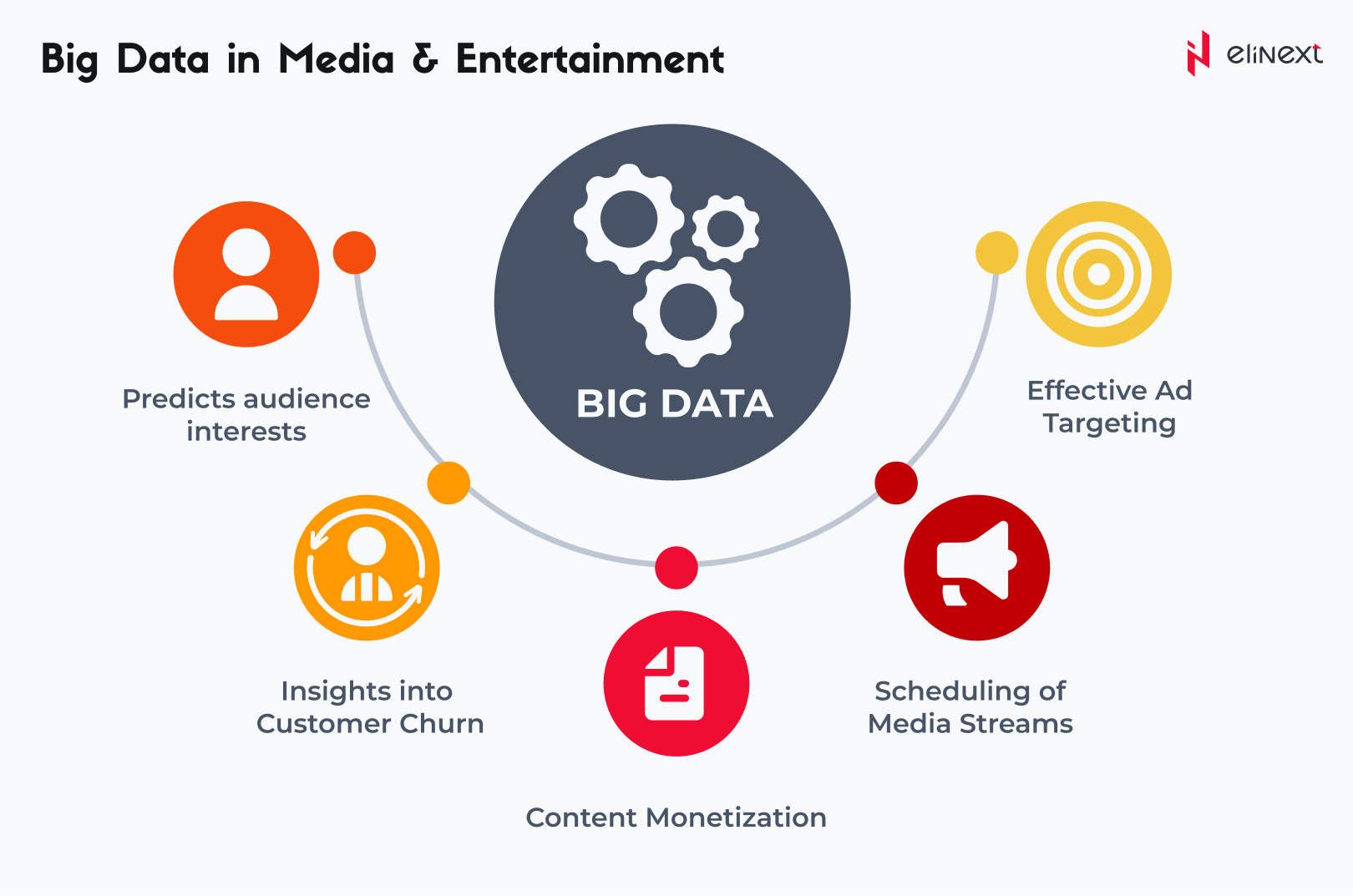
How Big Data Help the Media and Entertainment Industry to Connect with the Customers
Social media app development services use big data to engage with audiences. In 2025, the number of social media users worldwide reached 5.44 billion, and brand engagement on TikTok reached 27.6%. Netflix and Spotify use analytics to personalize user experiences, leading to increased user retention and viral campaigns like “Spotify Wrapped.”
-
Predicts Audience Interests
Big data use cases in media and entertainment predict audience interests by analyzing viewing habits and social trends. This allows platforms to recommend relevant content, increasing engagement and reducing investment risk. Netflix’s predictive analytics has led to hits like House of Cards.
-
Insights into Customer Churn
Churn analytics in media and entertainment uses behavioral data to identify users who are likely to churn. Companies implement targeted retention offers, reducing churn and increasing customer lifetime value. Netflix’s churn rate has dropped to 2% by 2025, saving over $1 billion annually through data-driven measures.
-
Content Monetization
Big data enables content monetization by optimizing pricing, advertising placement, and subscription models. Media companies maximize revenue by aligning offers with user behavior. In 2025, Netflix’s ad rate grew 30% quarter-on-quarter thanks to the use of analytics for targeted advertising and improved ROI.
-
Optimized Scheduling of Media Streams
Optimized scheduling uses real-time analytics to deliver content during peak hours, maximizing reach and engagement. Media companies like Viacom18 use big data to strategically place ads and shows, increasing viewership and audience retention while reducing operating costs.
-
Effective Ad Targeting
Big data in media and entertainment enables effective advertising targeting by segmenting audiences based on behavior and preferences. Platforms like YouTube and Netflix are displaying personalized ads, increasing click-through rates and ad revenue, with Netflix’s ad rate usage growing by 30% in 2025.
Big data in media and entertainment is challenging due to legacy systems and fragmented data. As a custom adTech development company, Elinext unifies data sources and enables real-time analytics. This empowers clients to deliver personalized content, optimize ad spend, and achieve measurable business growth.
Elinext Expert
The Bottom Line
Big data in media and entertainment industry enables companies to deliver hyper-personalized experiences and optimize revenue streams. In 2025, media & entertainment software development services drive trends such as AI-powered recommendations, real-time analytics, and mobile-first content. Leaders like Netflix and Spotify are setting the standard for data-driven engagement and monetization.
By leveraging the power of data inadvertently left by consumers, the media and entertainment industry players can enjoy a lot of success. Combining traditional techniques with marketing and content discovery data-driven methods, it is possible to increase the business efficiency, ensure the delivery of more valuable content, personalize products and services, attract a broader audience, minimize chances for its outflow, and gain a competitive advantage on the market.
Backed by tens of successful projects completed for the media and entertainment industry, and having more than 20 years of experience in delivering analytics software for companies worldwide, Elinext teams will answer all of your questions and develop a custom solution that will work for your business success. Contact us anytime, with any questions. We are here to make your tech dreams come true!
FAQ
What is Big Data in the media & entertainment industry?
Examples of big data use cases in media and entertainment include analyzing massive amounts of user data to personalize content, predict trends, and optimize advertising—for example, Netflix recommendations.
How is Big Data used for audience insights?
Big data in media and entertainment analyzes user behavior to identify audience interests, allowing platforms to tailor content and marketing, for example, Spotify’s personalized playlists.
How does Big Data improve content recommendations?
Examples of big data use cases in media and entertainment: algorithms suggest relevant content based on viewing history, increasing engagement—for example, 80% of Netflix views are based on recommendations.
How can Big Data help in content creation?
Big data in media and entertainment analyzes trends and sentiment to guide content creation, helping studios greenlight projects with higher success rates, such as Warner Bros.
How does Big Data support marketing and advertising?
Big data in media and entertainment industry enables precise advertising targeting and campaign optimization, increasing ROI. Data-driven YouTube ad placement increases revenue and relevance.
How does Big Data improve customer experience?
Examples of Big data use cases in media and entertainment personalize user journeys in real time, increasing satisfaction and loyalty. For example, personalized recommendations from Amazon Prime Video.
