What are the Key Trends That Have Defined the IoT Domain

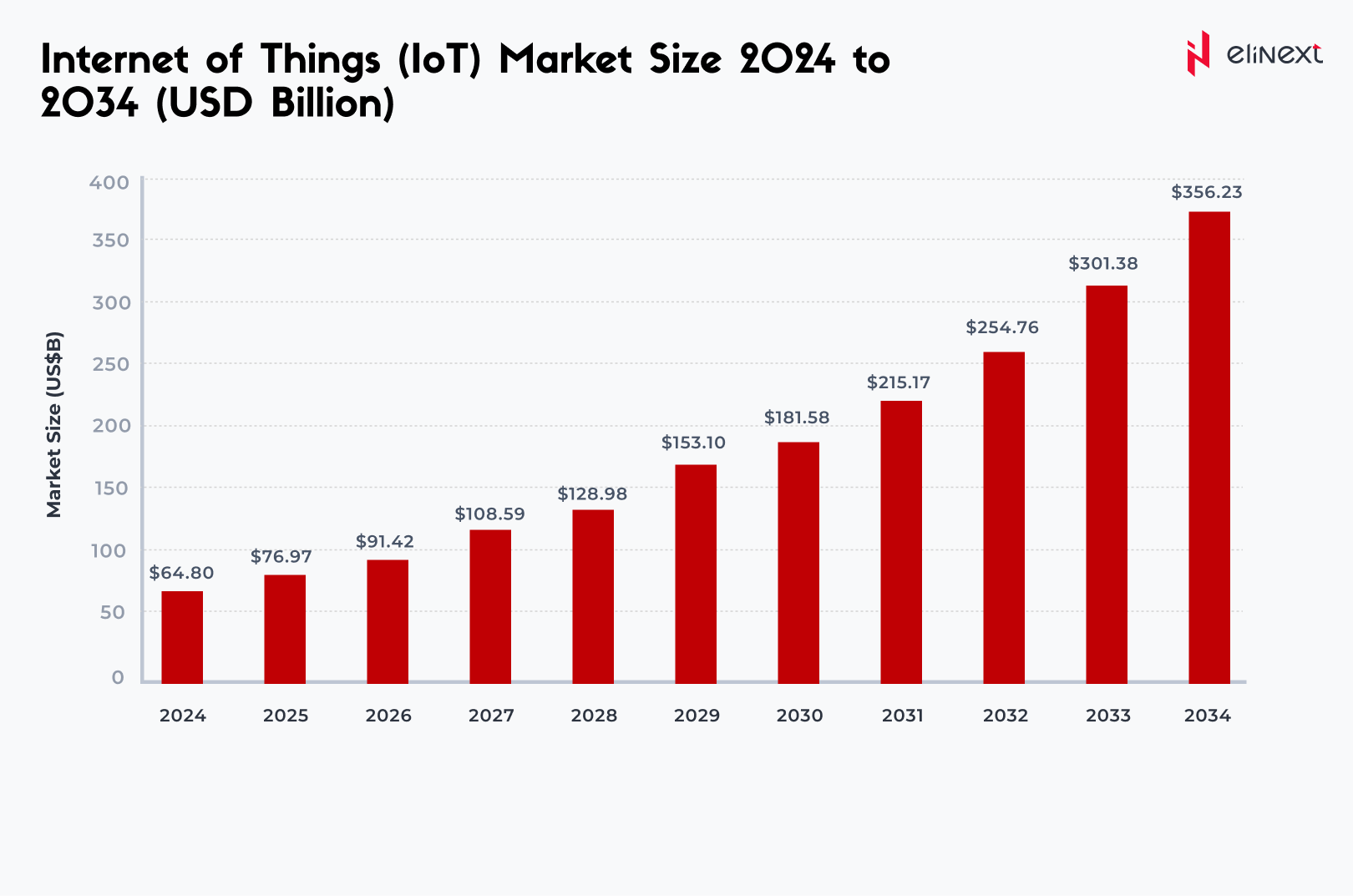
Internet of things domain trends in 2025 include AI-powered automation, edge computing, and enhanced security. With over 17 billion connected devices, mobile app development services are integrating the IoT into smart homes, wearables, and industry. Apps now allow users to control home appliances, track health, or monitor fleets in real time, illustrating the growing role of the IoT in everyday life and business.

What are the Key Trends That Have Defined the IoT Domain

Key Takeaways 

  • IoT trends: by 2025, there will be over 17 billion active devices worldwide, a 16% increase from the previous year.
  • Edge computing and AI integration improve the effectiveness of real-time analytics.
  • Security spending increased by 18% due to rising cyber risks and the growing number of devices.

The Key IoT Domain Trends 

Internet of things domain trends focus on intelligent automation, AI-powered analytics, and secure edge devices. IoT software development services enable predictive maintenance in factories and real-time monitoring in healthcare. Smart sensors alert managers to equipment issues before they break down.

  • Mass Expansion of IoT Platforms 

Professional IoT platforms from IBM, Cisco, General Electric or Amazon can be regarded as multi-tier solutions that facilitate the design and management of IoT infrastructure and enterprise data. 

These multifunctional products will help companies and governments create, protect, connect and manage IoT devices on a large scale.

And this is the perfect illustration of how the high level of competition between vendors may be profitable for all sides as it leads to the improvement of solutions they develop.

Internet of things domain trends show rapid growth of platforms. Cloud-based IoT platforms now manage millions of devices, enabling smart city infrastructure, remote monitoring, and seamless integration across industries.

  • Synergy: Artificial Intelligence, Augmented Reality and Machine Learning 

Internet of things trends and AI software development services combine AI, augmented reality, and machine learning to create a more intelligent IoT. AI-powered cameras detect anomalies, while augmented reality overlays help technicians perform repairs faster in real time.

A wide range of IoT applications includes multiple integrations with machine learning capabilities, pattern recognition, augmented reality (AR), the blockchain, and other technologies.

Those projects are omnipresent. For instance, IOTA blockchain cooperates with large IoT players to ensure the protection of micropayment transactions processed between smart devices autonomously. The Zappar AR platform, in partnership with Ervythng, develops solutions for improved interactivity of smart devices.

  • Dealing with Data 

IoT trends and Internet of things domain trends show exponential data growth—over 80 zettabytes of data will be generated by 2025. Solutions focus on edge data processing and AI analytics to transform raw data into valuable insights. Smart grids analyze consumption patterns to optimize energy distribution, and the IoT in healthcare enables secure patient data exchange for improved outcomes, highlighting the need for scalable data storage and real-time analytics.

  • New Approaches to Security 

Internet of things domain trends demand stronger security. End-to-end encryption and device authentication help prevent cyberattacks on connected medical devices, ensuring patient safety and data integrity.

The security issue is a matter of concern at different levels: from the transfer of enterprise data, the exchange of personal data and transaction security to ensuring the reliability of equipment and devices, and to the integrity of the IoT system.

Today, biometric identification of personal mobile devices has already become the standard for ensuring privacy. Soon, the connected devices will take advantage of the extended authentication. For instance, Amazon Alexa promises to teach voice recognition for up to ten people before performing any important user commands.


Unlock new value with IoT. Invest in IoT development to capture real-time data, automate operations, and create predictive services.


The Future of Internet of Things Trends

The future of Internet of Things (IoT) trends points to hyperconnected environments, edge AI, and enhanced security. By 2030, more than 25 billion devices will power smart cities, healthcare, and industry. IoT-based traffic systems reduce congestion, and smart hospitals use predictive analytics to monitor patient conditions. These advances, driven by innovations in mobile apps and IoT software, will transform business efficiency and everyday life.

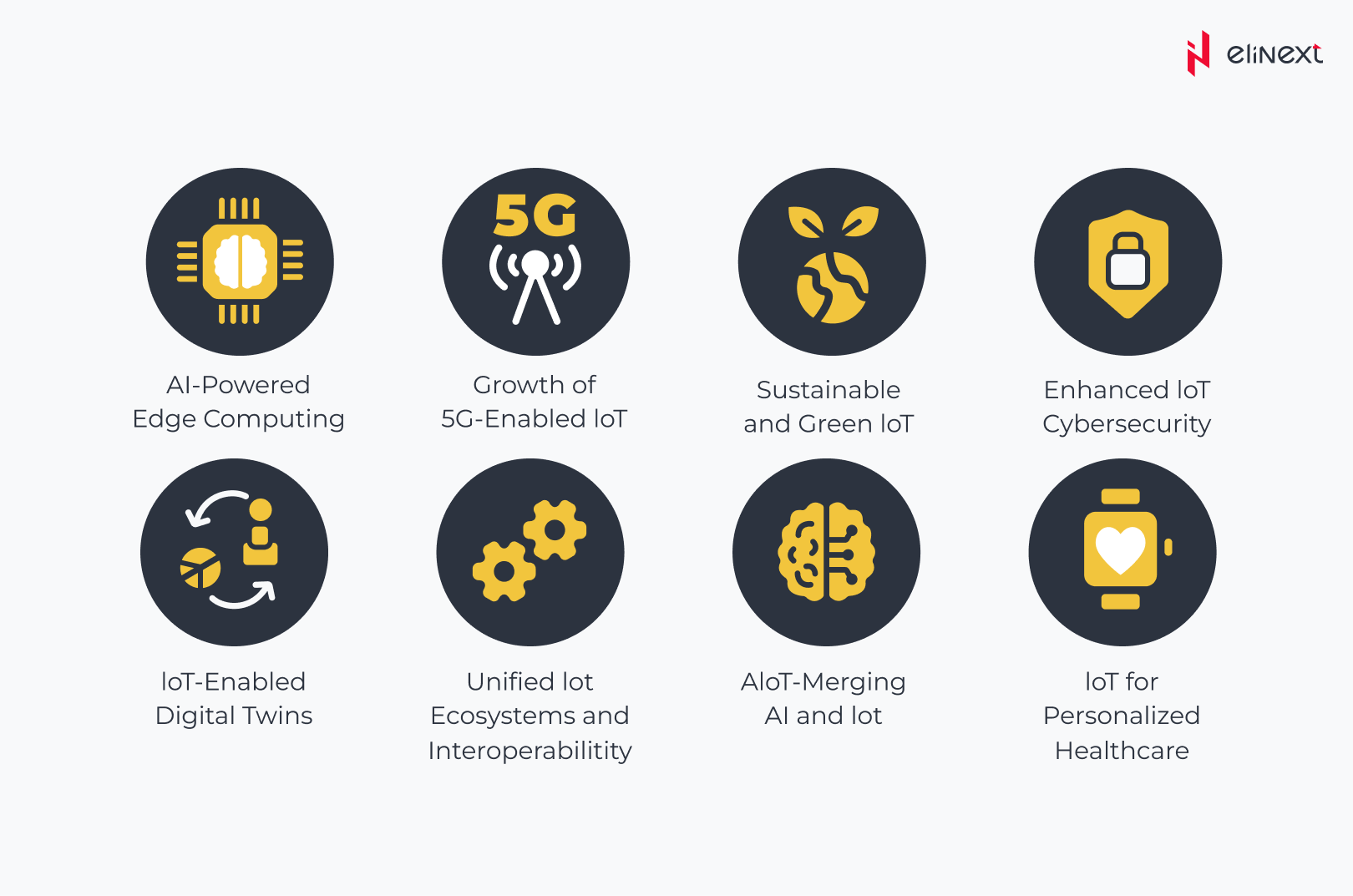
  • AI-powered IoT (“AIoT”)
  • Edge Computing / Processing
  • 5G, “5G+”, and Hybrid Connectivity
  • LPWANs (Low Power Wide Area Networks)
  • Digital Twins
  • Ambient / Context-Aware Intelligence
  • Hyper-Personalisation of IoT experiences
  • Industrial IoT
  • Blockchain & Decentralised Architectures
  • Sustainable / Green IoT
  • Voice / Natural User Interfaces
  • Scalability and Massive Device Deployment
  • IoT in Smart Homes & Smart Cities
The Future of Internet of Things Trends

“IoT trends demonstrate a huge leap forward in device connectivity and data-driven solutions. Companies are now using the IoT to optimize operations, improve security, and provide real-time analytics. The integration of AI and robust security is key to unlocking the transformative potential of the IoT.”
Elinext software development expert 

Conclusion 

The vision of the Internet of Things is clear: smarter edge devices, 5G scalability, AI-powered automation, and built-in security. Winners will combine sensors, analytics, and digital twins into results-driven platforms. For example, a fleet is using edge AI to reduce fuel consumption by 15% and failures by 30%. By 2027, most IoT analytics will be powered at the edge, and unified device management will become the standard for resilient, scalable deployments.

FAQ

What are the most important trends that shaped IoT so far?

Internet of things domain trends such as edge computing, AI integration, and improved security have shaped the Internet of Things. Connected sensors in manufacturing predict equipment failures, reducing downtime and saving businesses money.

How has AI influenced the IoT domain?

Internet of things trends show that AI enables smarter devices and automation. AI algorithms in smart thermostats learn user preferences, optimizing energy consumption and reducing bills while improving comfort and efficiency.

Why is edge computing so critical for IoT?

IoT trends emphasize edge computing for real-time data processing. Smart cameras analyze video locally, allowing for instant alerts to security breaches without sending large amounts of data to the cloud, reducing latency and bandwidth costs.

What are digital twins, and why are they important?

Factories use digital twins to simulate equipment operation, optimize maintenance schedules, and prevent costly breakdowns by predicting failures before they occur. Internet of things domain trends highlight the importance of digital twins—virtual copies of physical assets.

How is IoT transforming healthcare?

Internet of things trends are revolutionizing healthcare. Wearable IoT devices monitor patients’ vital signs in real time, instantly alerting doctors to abnormalities and enabling remote proactive treatment, improving outcomes and effectiveness.

How is blockchain being used in IoT?

Supply chains use blockchain to track goods, ensuring authenticity and transparency, reducing fraud, and increasing trust in connected IoT devices. IoT trends show that blockchain secures device data and automates transactions. 

What is the future outlook for IoT?

The Internet of Things promises promising results: by 2030, the number of devices will exceed 25 billion. Advances in artificial intelligence, 5G, and security will facilitate the development of smart cities, healthcare, and industry. Driverless cars and smart factories will become mainstream, transforming everyday life and business.


Contact Us
Contact Us


    Array
    (
        [_edit_last] => Array
            (
                [0] => 47
            )
    
        [_wpb_vc_js_status] => Array
            (
                [0] => true
            )
    
        [relevant_articles] => Array
            (
                [0] => 
            )
    
        [_relevant_articles] => Array
            (
                [0] => field_59395b1f2e793
            )
    
        [case_studies_in_blog_article] => Array
            (
                [0] => 
            )
    
        [_case_studies_in_blog_article] => Array
            (
                [0] => field_59396a18e89d4
            )
    
        [the_excerpt] => Array
            (
                [0] => 
            )
    
        [_the_excerpt] => Array
            (
                [0] => field_59400a59422e0
            )
    
        [author_photo] => Array
            (
                [0] => 
            )
    
        [_author_photo] => Array
            (
                [0] => field_594106ba4a3a2
            )
    
        [video_available] => Array
            (
                [0] => 0
            )
    
        [_video_available] => Array
            (
                [0] => field_59c18336c21cd
            )
    
        [_yoast_wpseo_primary_category] => Array
            (
                [0] => 92
            )
    
        [_thumbnail_id] => Array
            (
                [0] => 11854
            )
    
        [_edit_lock] => Array
            (
                [0] => 1762425099:47
            )
    
        [original_site_url] => Array
            (
                [0] => 
            )
    
        [images_slider] => Array
            (
                [0] => 
            )
    
        [_images_slider] => Array
            (
                [0] => field_5ee75564abe1e
            )
    
        [custom_permalink] => Array
            (
                [0] => industries/manufacturing/trends/what-defined-the-iot-domain/
            )
    
        [_custom_permalink] => Array
            (
                [0] => field_602ec1181fed7
            )
    
        [_yoast_wpseo_metadesc] => Array
            (
                [0] => Explore the top IoT trends of 2018, from AI integration to edge computing, shaping the future of connected devices. Read more on Elinext Blog.
            )
    
        [_yoast_wpseo_estimated-reading-time-minutes] => Array
            (
                [0] => 6
            )
    
        [lang_page_id] => Array
            (
                [0] => 8865
            )
    
        [primary_tag] => Array
            (
                [0] => 122
            )
    
        [_primary_tag] => Array
            (
                [0] => field_669f60677f9e1
            )
    
        [_lang_page_id] => Array
            (
                [0] => field_67167a251e356
            )
    
        [short_title] => Array
            (
                [0] => 
            )
    
        [_short_title] => Array
            (
                [0] => field_5ecf97d78daad
            )
    
        [css_class_name_general] => Array
            (
                [0] => 
            )
    
        [_css_class_name_general] => Array
            (
                [0] => field_5ed094cbee060
            )
    
        [enable_breadcrumb] => Array
            (
                [0] => 1
            )
    
        [_enable_breadcrumb] => Array
            (
                [0] => field_5eddfba50cb74
            )
    
        [enable_right_side_bar] => Array
            (
                [0] => 1
            )
    
        [_enable_right_side_bar] => Array
            (
                [0] => field_5ee09b21eb9b6
            )
    
        [enable_case_studies_block] => Array
            (
                [0] => 1
            )
    
        [_enable_case_studies_block] => Array
            (
                [0] => field_5ecf982ce922c
            )
    
        [enable_news_block] => Array
            (
                [0] => 1
            )
    
        [_enable_news_block] => Array
            (
                [0] => field_5ecf9950d8e87
            )
    
        [enable_contact_form_block] => Array
            (
                [0] => 1
            )
    
        [_enable_contact_form_block] => Array
            (
                [0] => field_5ecf99695a591
            )
    
        [case_study_block_css_class_name] => Array
            (
                [0] => 
            )
    
        [_case_study_block_css_class_name] => Array
            (
                [0] => field_5ed09500ae937
            )
    
        [case_study_block_header_title] => Array
            (
                [0] => Case studies
            )
    
        [_case_study_block_header_title] => Array
            (
                [0] => field_5ecf9b149f113
            )
    
        [case_study_block_caption] => Array
            (
                [0] => 
            )
    
        [_case_study_block_caption] => Array
            (
                [0] => field_5ed0812ca5fe4
            )
    
        [case_study_solution_categories] => Array
            (
                [0] => 
            )
    
        [_case_study_solution_categories] => Array
            (
                [0] => field_5ee74d2cc8b67
            )
    
        [case_study_industry_categories] => Array
            (
                [0] => 
            )
    
        [_case_study_industry_categories] => Array
            (
                [0] => field_5ee74ee7b2529
            )
    
        [case_study_technology_categories] => Array
            (
                [0] => 
            )
    
        [_case_study_technology_categories] => Array
            (
                [0] => field_5ee74f21b252a
            )
    
        [news_block_css_class_name] => Array
            (
                [0] => 
            )
    
        [_news_block_css_class_name] => Array
            (
                [0] => field_5ed095295310a
            )
    
        [news_block_header_title] => Array
            (
                [0] => News
            )
    
        [_news_block_header_title] => Array
            (
                [0] => field_5ecf9b8a4bc15
            )
    
        [news_block_caption] => Array
            (
                [0] => 
            )
    
        [_news_block_caption] => Array
            (
                [0] => field_62b4904f21245
            )
    
        [news_block_more_news_title] => Array
            (
                [0] => More news
            )
    
        [_news_block_more_news_title] => Array
            (
                [0] => field_5ecf9bbcbc459
            )
    
        [news_block_more_news_url] => Array
            (
                [0] => 
            )
    
        [_news_block_more_news_url] => Array
            (
                [0] => field_673df8af3eaa3
            )
    
        [news_block_categories] => Array
            (
                [0] => a:1:{i:0;s:3:"151";}
            )
    
        [_news_block_categories] => Array
            (
                [0] => field_5ee0b7b2b1008
            )
    
        [contact_form_block_css_class_name] => Array
            (
                [0] => news
            )
    
        [_contact_form_block_css_class_name] => Array
            (
                [0] => field_5ed0953ea14e1
            )
    
        [contact_form_block_image_banner] => Array
            (
                [0] => 
            )
    
        [_contact_form_block_image_banner] => Array
            (
                [0] => field_5ecf9cf052349
            )
    
        [_yoast_wpseo_title] => Array
            (
                [0] => Trends That Have Defined the IoT Domain in 2018 - Elinext
            )
    
    )