





A warehouse management system (WMS) is software that optimizes warehouse operations, including inventory control, picking, and shipping. For retailers, manufacturers, and logistics companies, a cloud based warehouse management system and supply chain software development services provide real-time tracking, faster order processing, and reduced error rates, improving efficiency and customer satisfaction.
WMS (warehouse management system) is the brain of a modern warehouse, if I may put it this way. The progenitors of modern solutions began to appear in the early 90s, along with the availability of new powerful computer systems. Two and a half decades later, warehouse management programs have been improved and differentiated. Traditionally, such systems consist of two types:
– a customized system developed for a specific client;
– standard equipment.
A properly-made WMS coordinates and synchronizes incoming and outgoing goods flows, internal regulatory operations, personnel work, loading and unloading equipment, robotic equipment and much more.
Warehouse management system cost vary, with cloud-based WMS offering lower initial investment and faster ROI. By 2026, the global WMS market is expected to reach $4.57 billion, with cloud-based solutions growing at a compound annual growth rate of 22.6%. Features such as real-time inventory and workforce management reduce costs and errors, while increasing efficiency and scalability.
However, the domain of modern logistics is on the rise, and new ventures inevitably appear which leads to the growth of their infrastructure. It’s fair to say that describing a warehouse manager’s job as just busy would be an understatement.
They have to manage, control, and track inventory as efficiently as possible on a daily basis. And it’s impossible to stress enough how painful the process of management is if a manager is in charge of multiple warehouses when the workload and stress increase tenfold. That’s why a decent warehouse management software is a must-have solution for logistics managers.
Automated accounting of goods in the warehouse depends on the following components:
- software is the central part of warehouse automation, which is responsible for the operation algorithms and logic of a WMS system;
- equipment — warehouse automation solutions involve the use of devices such as barcode scanners and printers, data collection terminals, label applicators, and so on;
- an individual project for the organization of warehouse accounting automation developed for each specific enterprise.
In a nutshell, the advantages of a warehouse management system are:
- the ability to quickly obtain the necessary information about the state of the goods, order or batch – regardless of where in the world you are located;
- ergonomic use of space in the warehouse;
- high speed of all operations (receiving, picking, shipping and writing off the goods);
- systematization of the nomenclature directory, accounting for not only goods but also components, sorting by groups and objects;
- simplicity in working with clients and new partners;
- productivity increase;
- an increase in the throughput of a warehouse;
- reduced administrative costs.
All in all, despite the irrational fear of IT solutions taking jobs off the human, the use of WMS is totally beneficial for staff. It provides a high level of familiarity with modern logistics concepts and increases the overall computer literacy.
What is a Warehouse Management System (WMS) ?
A cloud based warehouse management system automates inventory, picking, and shipping. A retailer using a cloud-based warehouse management system in 2025 increased order processing accuracy by 30% and reduced labor costs by 20%. The global warehouse management system market is projected to reach $3.38 billion by 2025, with cloud adoption accelerating due to its scalability and cost effectiveness.
What is the warehouse? According to some common yet biased opinions, a warehouse is a sort of the black sheep of an enterprise. It is regarded as a place that generates nothing but additional costs, freezes working capital and complicates the work of a business. This is the reason why many executives choose to pay little attention to warehouses and its staff (unless they are similar to Michael Scott from “The Office”, of course). As Mark Wheeler, the CEO of Warehouse Solutions, Motorola Solutions put it: “Warehousing and distribution have not traditionally been the most celebrated functions within leading businesses across manufacturing, retail and wholesale industries”.
Focus on key features of warehouse management system to make the right choice to future-proof your operations and maximize your return on investment.
How to Choose a Warehouse Management System?
Before starting to think about key features of a warehouse management system, a number of nuances should be taken into account. First, among all available WMS systems, there are no universal or best ones. Each of the warehouse management solutions is more or less suitable for the workflow of a particular enterprise.
If you have few orders to ship daily, there’s no need to invest in an expensive solution. On the contrary, if you have lots of goods to ship, you won’t be happy to rely on outdated technology. When increasing the load on the system, it is important to make sure it corresponds to the pace of business development of the company. So yes, the choice might be really difficult.
However, to facilitate the choice of a WMS system, it is necessary to outline beforehand the goals and problems that automation should solve. Executives must answer three simple yet vital questions:
– Are business processes within the company optimal?
– What kind of costs should be reduced and by how much?
– What increase in operating profit will make the implementation project a success?
There’s also one particular factor that affects the process of choosing a WMS warehouse automation system – the human factor. Starting from the skill level of warehouse staff and preferences of managers who make financial decisions, each time it is necessary to take into account the influence of subjective opinions, education and training, and, surely, personal qualities.
-
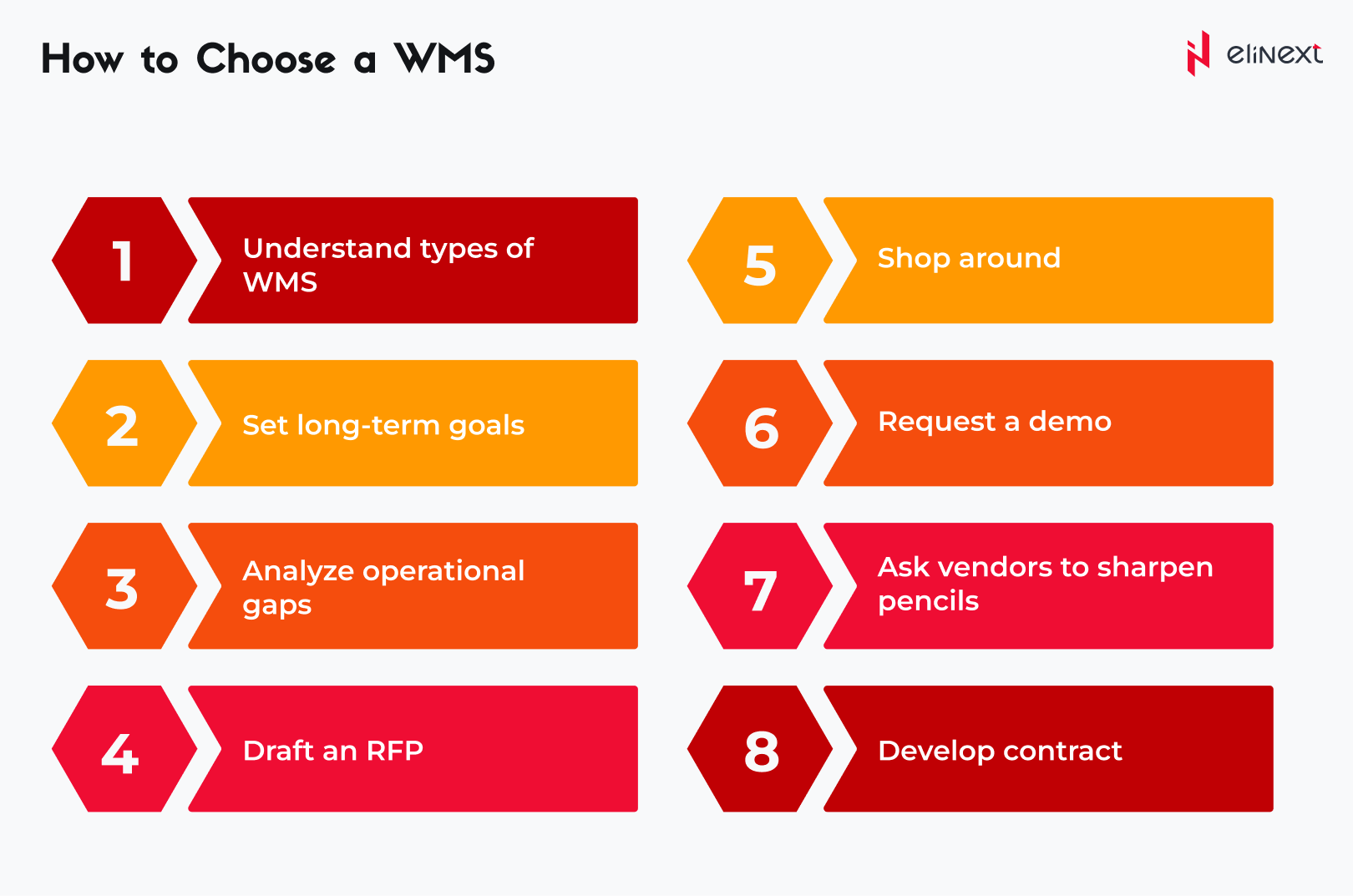
Familiarize Yourself with the Types of WMS
Explore cloud based warehouse management system options—standalone, ERP modules, and comprehensive supply chain management solutions. Cloud WMSs offer scalability and easy integration, making them ideal for growing businesses. Understanding these types will help you choose solutions that align with your operational needs and IT resources.
-
Understand Long-term Goals
Identify your long-term business goals expansion, automation, or digital transformation. Aligning your WMS selection with these goals and key features of warehouse management system will ensure scalability and future readiness. Cloud systems support growth across multiple sites and changing supply chain needs.
-
Analyze Current Operational Gaps
Identify inefficiencies in inventory tracking, order fulfillment, and workforce management. A WMS addresses these gaps by providing real-time data, reducing errors, and streamlining workflows. Identifying pain points ensures your new system delivers measurable improvements.
-
Draft a Request for Proposal for WMS
Create a detailed RFP outlining your functional, technical, and integration requirements. Include essential features such as real-time inventory, reporting, and compatibility with existing systems. A clear RFP simplifies vendor evaluation and ensures solution compliance.
-
Shop Around
Review proposals from multiple WMS vendors, compare solutions, and request references. Evaluate successful projects and industry reputations. Comparing proposals will help you find the optimal price-quality ratio, feature set, and support for your unique business needs.
-
Request a Demo
Request a live demo from pre-qualified vendors. Check usability, feature fit, and integration with your workflows. Demos show real-world performance and help your team evaluate the user experience before making a decision.
-
Ask Vendors to Sharpen Their Pencils
Discuss pricing and clarify the total cost of ownership. Ask vendors for a detailed breakdown and flexible terms. This step ensures you receive the best deal and understand all ongoing costs, including support and upgrades.
-
Develop and Sign a Contract
Finalize the service level agreements, implementation timelines, and support terms. A well-structured contract protects your interests and sets clear expectations for both parties, ensuring a smooth WMS implementation.
Data modernization is a complex task due to legacy systems and fragmented processes. At Elinext, we address this challenge by integrating scalable cloud-based warehouse management system cost tailored to each client. This approach streamlines operations, reduces errors, and delivers measurable business impact through increased efficiency and cost control and due to warehouse management system development services.
Elinext Expert
Final Words
Key features of warehouse management systems and logistics & transportation software development services are transforming supply chains. By 2025, AI-powered WMS solutions will provide real-time analytics, automation, and seamless integration. A logistics company using an advanced WMS reduced order processing time by 25%. Choosing the right WMS provides flexibility, scalability, and a competitive advantage.
The manufacturer must provide development companies with as much information as possible. After all, the possible degree of programs’ integration plays a significant role in determining the cost and the final positive effect from the introduction of a WMS system.
WSM systems have come a long way from elementary solutions for warehouse inventory to full-fledged, powerful systems capable of controlling huge robotic objects. But the need for automation is growing rapidly, and businesses must realize just how efficient their warehouses can be. After all, the customer journey is highly dependent on established warehousing processes.
FAQ
What is a Warehouse Management System (WMS)?
A warehouse management system (WMS) is software for managing inventory, picking, and shipping. A cloud-based WMS automates inventory tracking for retailers.
Why does my business need a WMS?
A WMS improves inventory accuracy, reduces costs, and increases efficiency. Manufacturers use WMS to reduce errors and speed up order fulfillment.
Should I choose cloud-based or on-premise WMS?
A cloud-based warehouse management system (WMS) offers scalability and lower upfront costs, making it ideal for growing companies. An on-premise system is suitable for businesses that require strict data control, such as pharmaceutical companies.
How do I determine my business requirements?
Analyze your workflows, pain points, and growth plans to determine your WMS needs. E-commerce companies require real-time inventory control and seamless integration with their ERP.
How important is integration capability?
Integration is crucial for real-time data flow between the WMS, ERP, and automation. Retailers require WMS-ERP synchronization for accurate order processing.
How long does WMS implementation take?
Implementing a WMS typically takes 3 to 12 months, depending on the complexity and integration. A cloud-based WMS can be deployed faster than on-premises systems.
