



Decoupled CMS development and custom CMS development services are revolutionizing digital content management. By 2025, 63% of businesses will have implemented headless or decentralized CMSs to ensure flexibility and multi-channel content delivery. A global retailer using decentralized CMSs accelerated website launches by 40%. Analytics show that these architectures facilitate faster innovation, seamless integration, and superior user experiences, making them central to future content strategy and digital transformation.
Income generation, sales leads, new customers, brand promotion require agility and flexibility of one’s CMS.
In this blog post, we’ll try to figure out the concepts of headless and decoupled CMS and discuss when it is a perfect fit for your content, and when it is better to go with the traditional CMS.
We should also state that the global content management software market is estimated to generate 123,500 million USD by 2026, and the growth is well documented.
So, which CMS can deliver the experience we desire? Let’s see.
What is a Headless CMS?
Headless CMS development separates content management from its presentation. Marketers use headless CMSs to deliver content to websites, apps, and IoT devices via APIs.
To understand it, let’s recollect one conventional thing. A traditional CMS consists of both the back end where content is created and stored and the front end that displays this content on HTML pages. If we chop off the content from the presentation, we’ll get a headless CMS.
From a technical point of view, it is a content-only back end data platform with editorial and management parameters having no concern about data presentation. Functioning as a content repository, the headless CMS delivers content for publication in a wide range of channels with the use of APIs. What is really appreciated is its ability to connect to any endpoint – from the web to mobile channels.
Explore headless CMS vs decoupled CMS to future-proof your content strategy.
Implement omnichannel content delivery, increase flexibility, and meet evolving user expectations today.
What is a Decoupled CMS?
Decoupled CMS development separates the backend (content management) and frontend (presentation), connected by an API. Unlike headless architecture, it offers a frontend by default but also supports custom outputs. A news portal uses a decentralized CMS to manage articles and deliver them to websites, mobile devices, and digital kiosks — a balance between flexibility and control.
Thus, in a headless CMS, your content is created and managed in the backend without a defined data presentation environment. A decoupled CMS consists of both the back end and the front end. However, these are managed separately and are not coupled like in a traditional CMS. In other words, a decoupled CMS is as front end independent as a headless one but it is still equipped with ready-made front-end templates to deliver content. Yet, the frontend and backend communicate with each other through API calls.
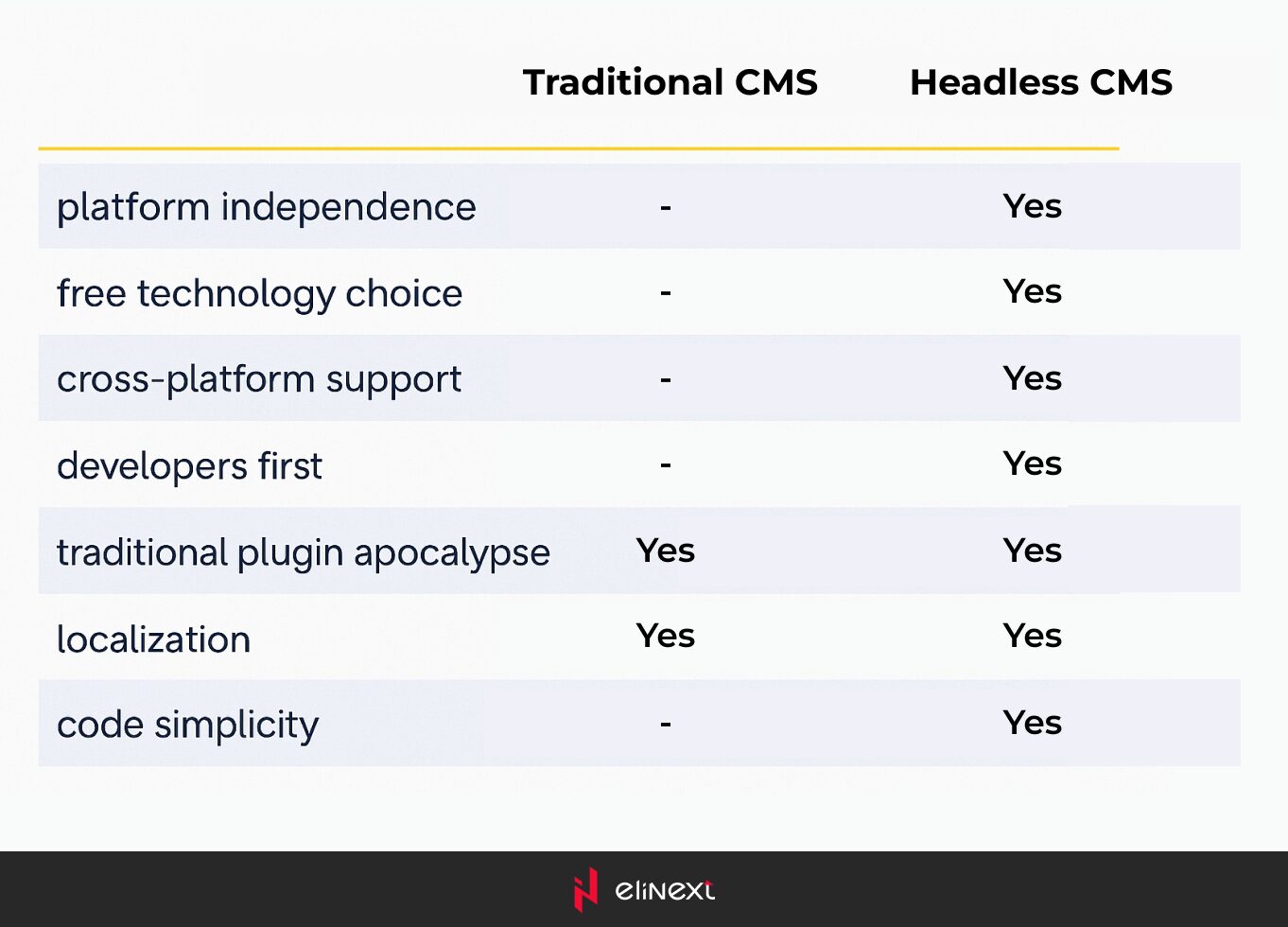
Although the term “decoupled” and “headless” CMS are sometimes used as synonyms, the core is not the same:
When to Go Headless?
Headless CMS development is ideal for omnichannel content delivery. Brands that simultaneously run web, mobile, and smart device apps benefit from a headless CMS.
Firstly, headless CMS are popular with developers who prefer to apply their favorite tools.
Secondly, bearing in mind unique content as a search engine ranking factor, data from headless CMS can be retrieved and presented in any way to stand out and compose unique content.
The absence of front end means time- and cost-effective redesigning of content as per business needs. You may enhance your website or app architecture agile and avoid excessive front-end expenses.
Furthermore, your product data from the online catalogue can adapt to the endpoint of the client’s publication. Here, flexibility stands not only for reach out to a spectrum of various content channels but also for jumping on promising software development trends in the future, even if they are not currently in your roadmap.
Headless CMS would be an impossibility to have an accurate preview of content until you publish it.
But here you can get on a decoupled bandwagon.
When to Use a Decoupled CMS?
Decoupled CMS development is suitable for teams that require both flexibility and a frontend by default. Publishers who want to quickly launch mobile-friendly websites via APIs choose a decentralized CMS.
Touching on the topic of headless cms vs decoupled cms. Both decoupled and headless CMS provide flexible content delivery, future-proof functionality, cost-effective development, and increased security.
Decoupled CMS does everything a headless CMS is capable of. With a decoupled CMS, a marketer can launch a landing page without any external technical assistance.
It’s a win-win decision in some cases because a headless CMS can alienate your marketer without technical experience who needs to interact with your customers in real-time and keep abreast of the latest trends.
Use headless CMS development to unlock true content flexibility, enable rapid launch of omnichannel projects, and create a future-ready digital presence for your brand or organization.
Which One to Choose Eventually?
Decoupled CMS development is best suited for brands that require fast web deployments and API flexibility. Rapidly growing e-commerce sites prefer decentralized CMSs due to their speed and scalability.
Headless CMS is a good idea in terms of growth. However, it could be complicated – you are giving up the simplicity in an exchange for a faster development cycle, or better experience on mobile out of the box.
Good technology decisions look ahead. In 5 or 10 years, content is going to come in a bigger variety of forms. So if you are planning for something that goes beyond current basic marketing websites, headless CMS might be the right concept for you.
The main advantage of it is that it gives your content strategy the flexibility it might need.
Anyhow, Elinext is providing outsource software development of all types, and if you feel like you need a new CMS- whether a traditional, or headless one – contact us to get a free quote.
Those are mostly some generic words. We’ve decided to look up for some information at various tech portals about the headless CMS, and it gathered some quotes about the matter.
Experts of Headless CMS
Steve Eros, digital transformation principal at Lenati, highlights the following:
“Headless CMS has technical advantages that steal the spotlight, but for many clients the greatest advantages are operational.”
Eros believes headless CMS platforms offer business value by allowing marketers to manage, maintain and evolve content without the need for development support.
He continued, “that is a substantial benefit as a company’s best developers are typically focused on its product and service offerings,” and pulling them away reduces resources for core product development.
At the same time, he admits that some businesses are “not there yet”.
Eros believes the deployment of a “headless CMS is about the size and scale of the business or marketing team.” The expert admits that some companies don’t have the budget or personnel to support an omnichannel strategy.
Focusing on fewer channels such as a website and app only favors the large communities and wide array of features that more traditional CMSs provide.
Even so, it’s possible to move towards a headless CMS on your main channels to allow your developers to better support particular web or mobile technologies, and later expand to additional channels as your company grows.
Justin Emond, CEO and co-founder of Third & Grove wrote that to future-proof decisions, many organizations simply want to bet on bleeding-edge tech and are willing to make the investment to enjoy longer-term efficiencies. Taking that risk in going headless might be the option.
Headless CMSs are ready to support technologies that will become popular in the future. Some companies are already pushing the limits of content delivery by incorporating more IoT devices, augmented reality, virtual reality and more. A headless CMS built upon powerful APIs will be more easily integrated with the newest technologies that come out, and companies will be poised for quickly taking advantage of new audience segments.
“In the digital age, a monolithic website won’t cut it as a modern digital experience for customers, and most traditional CMSs have been built for that exact purpose. Content presentation, therefore, isn’t just a static webpage anymore, and the flexibility of front-end frameworks allows developers to use the best tools to offer seamless digital experiences for websites, mobile apps, digital signs and more,” – adds Paul Erlicht, head of customer accounts at Raw Engineering.
Decoupled CMS development provides companies with flexibility, rapid deployment, and seamless integration. As content needs diversify, our clients benefit from scalable architectures that support multi-channel delivery, innovation, and personalized experiences. Headless and decentralized CMSs are clearly shaping the future of content management.
Elinext Expert
Instead of the Conclusion
There is no 100% right way and CMS for every use case. In the end, in a “ headless cms vs decoupled cms” debate, it is all about the concrete and exact functionality/feature needs, versatility requirements and the level of control your company needs to have against one’s own CMS.
Headless CMS development and decoupled CMS development represent a new standard for content delivery. An international media company implemented headless CMSs for publishing to websites, mobile devices, and smart TVs, cutting launch times in half. These solutions enable rapid adaptation to new channels, robust integration, and improved security. As digital ecosystems grow, headless and decentralized CMSs will drive innovation, efficiency, and competitive advantage.
FAQ
What is a Headless CMS?
Headless CMS development enables content management without a built-in interface. A headless CMS allows retailers to deliver product information to both apps and websites via APIs.
What is a Decoupled CMS?
Decoupled CMS development separates the backend and frontend, but includes the frontend by default. Publishers use it to manage content and deliver it to various channels.
Why are Headless and Decoupled CMS gaining popularity?
Headless CMS development provides flexibility and multi-channel reach. Businesses use headless CMSs to deliver personalized content to websites, mobile devices, and IoT devices.
Are they the future of content management?
Yes, decoupled CMS development enables faster content delivery across various platforms. Global brands use decentralized CMSs for real-time updates on digital channels.
What challenges exist with Headless or Decoupled CMS?
Headless CMS vs decoupled CMS can pose challenges, such as complex integrations, lack of real-time content preview, and a higher requirement for developer expertise. Editors may find it difficult to visualize content changes before publishing.
