





With almost 80% of companies actively using AI in their business operations, large language models continue to mature with the speed outpacing expectations. From data privacy & fine-tuning to alignment & ethics enhancements, these large language models’ future trends 2025 show the extent to which artificial intelligence has taken root in our daily lives and how LLMs will advance throughout the year.
LLM Market Growth at a Glance
The global large language model market size accounted for USD 4.5 billion in 2023 and is expected to reach USD 82.1 billion by 2033. The expansion of the market is attributed to the growth and spread of AI solutions across diverse sectors, and the rise in the need for automation and data-powered decision-making, among other factors.
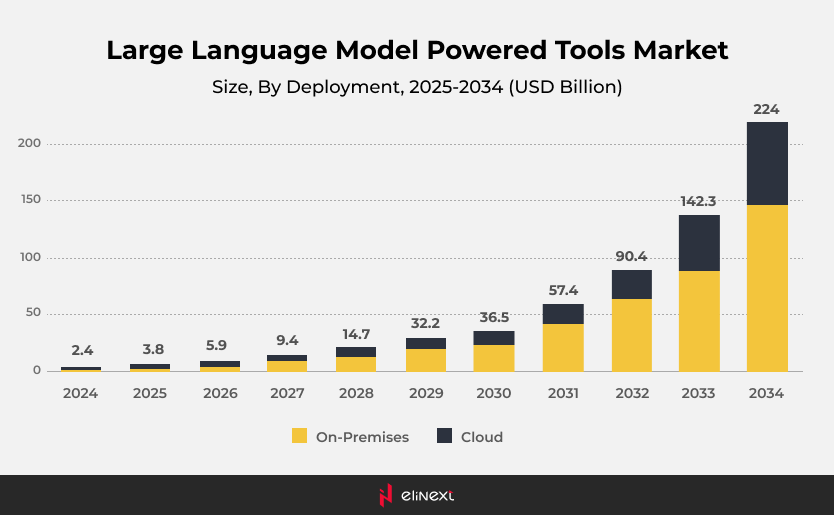
Key LLM Market Growth Drivers
With North America leading the way in LLMs adoption (52% of Americans actively use AI large language models like Copilot, Gemini and ChatGPT), AI is swiping the globe, fueled by these key drivers:
- Growing AI Investments are Driving Innovation
- Rising Demand for Automation Across Various Sectors
- Broader Adoption of AI in Industries
- Rapid Expansion of Digital Marketing
- Increasing Reliance on Chatbots and Virtual Assistants
Create powerful, human-like intelligent systems with AI software development services by Elinext.
LLM Development Services Elinext Offers
Custom LLM Development Services
An established LLM software development company, Elinext uses the expertise won from our 70+ successfully completed AI projects to engineer industry-compliant LLM solutions tailored to the unique workflows of companies from 16+ markets.
LLM Application Development Services
Hire reliable ChatGPT development services from a reputable, Clutch-recognized software engineering company to get your robust AI systems like LlaMa, ChatGPT, Claude and similar delivered within budget and agreed timelines.
LLM Software Development Services
Here at Elinext, our ML software development services encompass creating LLM-based software that assists businesses in clinical diagnosis, document review, fraud detection, content creation, sentiment analysis, customer service and support and more.
LLM Development Consulting Services
As a leading generative AI development services provider, Elinext offers holistic consulting services to businesses interested in LLM software development. We help plan an appropriate LLM development and implementation strategy and assist in each step of the way.
LLM Fine-tuning Services
Our AI experts with 8+ years of experience use supervised fine-tuning and reinforcement learning from human feedback (RLHF) approaches to turn general-purpose LLM models into industry-specific ones, ensuring model real-world effectiveness.
LLM-powered Solution Development
Having been delivering chatbots development services since 2015, the Elinext team relies on such proven tools as Azure OpenAI service, Amazon Lex, Databricks, TensorFlow, etc. to design robust LLM-powered solutions for a range of domains and use cases.
LLM Integration Services
With 15+ AI integration projects behind us, Elinext offers comprehensive AI integration services covering connecting CRMs, ERPs and other enterprise systems with both custom-built AI models and off-the-shelf LLM solutions.
LLM Support and Maintenance
AI models can quickly degrade or become outdated, requiring updates and retraining. Elinext is ready to maintain your LLM solution with performance and security monitoring, user feedback analysis, and fine-tuning for better accuracy.
Regional LLM Market Insights
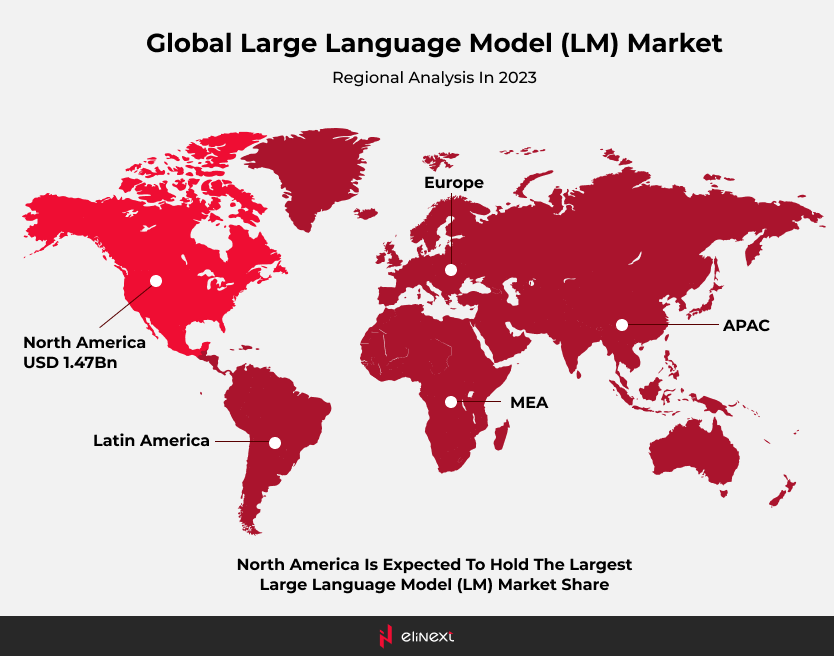
With powerful large language models developed by Google, Microsoft, and IBM, North America was the largest region in the LLM market, accounting for 32.7% of the total in 2023. Asia-Pacific and Western Europe followed as the next largest markets.
Looking ahead, Asia-Pacific and South America are projected to stand out as the fastest-growing regional markets in the LLM market between 2024–2030.
Prepare your business for the future large language models trends by partnering with an experienced LLM development company trusted by 300+ businesses around the world.
Top Large Language Models Trends in 2025
Multimodal Capabilities
One of the latest trends in large language models we see shaping the IT industry in 2025 is the rise of multimodal AI models. Unlike traditional ML models that typically handle a single form of data, these models can process different types of data inputs including text, audio, video, images, and other types of data.
Smaller, Specialized Models
Among the biggest LLM trends 2025 to keep an eye on is the shift from large language models that rely on petabytes of data to their smaller, domain-focused counterparts. Operating with fewer parameters, SLMs offer near-instant response times and greater accuracy for specific purposes.
Agentic Workflows
The rapid spread of autonomous AI agents capable of orchestrating complex tasks and making decisions with minimal human intervention has also hit the list of the latest trends in large language models. Combining environmental perception and continuous learning, agentic workflows are ideal for multi-stage problem-solving in complex scenarios.
Real-Time & Edge Deployment
Unlike cloud-based, edge deployment of LLMs (deployment on “edge devices” like IoT systems, smartphones, etc.) ensures low latency, real-time insights and enhanced privacy and security — critical requirements for such industries as healthcare, robotics, and autonomous vehicles.
Data Privacy & Fine-Tuning
Future large language models trends we can witness in 2025 and in the years to come will include fine-tuning machine learning models with privacy in mind using methods and techniques like differential privacy, LoRA (or Low-Rank Adaptation), federated learning and more.
Open-Source Momentum
“Open-source LLMs are gaining traction” among key LLM trends 2025 fueling industry innovation. With security, a high degree of customization and cost efficiency — advantages open-source LLMs bring — we are going to see wider adoption of these models in the longer term.
AI-Powered Development Tools
LLM-based tools like Github Copilot, Replit Agent, Tabnine, Warp, etc. that assist developers with setting up environments, writing code, developing algorithms, debugging, and other coding-related tasks are gaining great popularity and feature in the top LLM trends 2025.
Alignment & Ethics Enhancements
Creating fairer AI systems is also among the most prominent large language models future trends 2025. Rigorous curation of training data, regular bias audits and feedback loops are some techniques tech companies are applying to train LLMs free from prejudice, stereotyping and discrimination.
“Having 70+ successfully completed AI projects, Elinext keeps a keen eye on the rapidly evolving AI landscape and is well-versed in all the latest and future large language models trends.
With an expert team of AI consultants and developers boasting 8+ years of experience, we are ready to brace with every challenge related to LLM adoption, including choosing a domain-specific LLM model, pre-processing datasets, ensuring data privacy and security and more.” – Elinext expert
Real-World Examples of LLM for Industries
The transformational promise of AI large language models across business operations — from classification and analysis to prediction and more — is huge.
Below you can check out some successful real-world use cases for LLMs.
Clinical Documentation Automation
The new AI-powered clinical documentation app from Microsoft and Nuance — DAX Express — enables health professionals to draft and review post-visit notes. Enhanced by GPT-4 and Azure capabilities, it brings next-gen AI to more than 550,000 Dragon Medical (Nuance’s cloud-based speech recognition software for clinicians) users.
Personalized Tutoring
A GPT-4 driven AI personal tutor and assistant has a world-class content library (math, humanities, social studies, etc.) to make education less about busy work. Available 24/7, it encourages students to be independent learners by asking guiding questions and offering hints, while helping teachers with lesson plans, quiz questions, and more.
Contract analysis and summarization
Built on GPT-4, this advanced legal AI platform provides law professionals with assistance in legal research, contract analysis (missing clauses, unusual terms, risks or inconsistencies identification), litigation, drafting support, etc., and offers specialized models for domain-specific practice areas.
Future of Large Language Models Trends
With AI more and more ingrained in our daily routines, LLMs will continue to evolve. Experts assume artificial intelligence large language models are currently on the way to reaching human-level cognitive abilities by 2040-2050.
So, it might seem reasonable to think that in the next 20-30 years current and future large language models trends we’ve mentioned above will completely change due to advancements we can’t yet imagine today.
Conclusion
Large language models future trends 2025 including real-time & edge deployment, privacy-focused fine-tuning, development of smaller specialized AI models and the other mentioned in the article represent a sea shift toward more reliable, secure, adaptable, and ethically safe LLMs.
With nearly 80% of companies relying on commercial LLMs in their workflows, leaders should be aware of today’s and future large language models trends, ensuring their readiness for innovation and greater business competitiveness.
FAQ
What are the most important LLM trends in 2025?
The most prominent large language models future trends 2025 include the emergence of multimodal LLMs, the growing popularity of small language models, the expansion of agentic workflows, the surge in interest toward LLM-based development tools and more.
Are smaller LLMs replacing large ones?
Hardly. Both versatile LLMs and leaner, domain-focused SLMs come with distinct advantages and challenges, depending on the use case. So, instead of opponents, think of them as pals.
How are LLMs being used in business operations?
LLMs are great helpers in various business operations like document processing and analyzing, data handling, pattern and anomaly detection, regulatory research, sentiment analysis, customer self-service and more.
What industries are benefiting most from LLMs?
LLMs can find practical uses in a wide range of sectors. However, manufacturing, healthcare, retail, finance and banking, education, hospitality and travel industries are the biggest beneficiaries of LLMs implementation.
Are there risks with using LLMs?
The biggest concerns and risks of using LLMs include training data poisoning, unreliable or false outputs, copyright and legal exposure, sensitive information disclosure, and high levels of energy consumption.
