





In 2025, customer relationship management for small business will reach a turning point: 75% of small and medium-sized businesses are implementing digital tools. CRM for a small business optimize sales, automate tasks, and centralize customer data. Custom CRM software development services enable the creation of customized features, increasing productivity by 29% and increasing customer retention by 27%. Small businesses using custom CRM systems benefit from more effective lead tracking, more sophisticated marketing, and better customer support, all of which are critical for growth in a competitive market.
What is a CRM Software as a Marketing Software?
CRM marketing software integrates sales, marketing, and customer support, streamlining campaigns and customer data processing. CRM for a small business enables targeted email marketing, lead tracking, and campaign performance evaluation. Small retailers use CRM to segment customers and deliver personalized promotions, increasing conversions and building loyalty.
Invest in solutions like customized CRM systems for small businesses, which improve efficiency, inclusivity, and long-term growth.
Benefits of CRM System for Small Businesses
CRM software for small businesses centralize contacts, automate sales, and track interactions. CRM for a small business helps nurture leads, personalize interactions, and retain loyal customers.
-
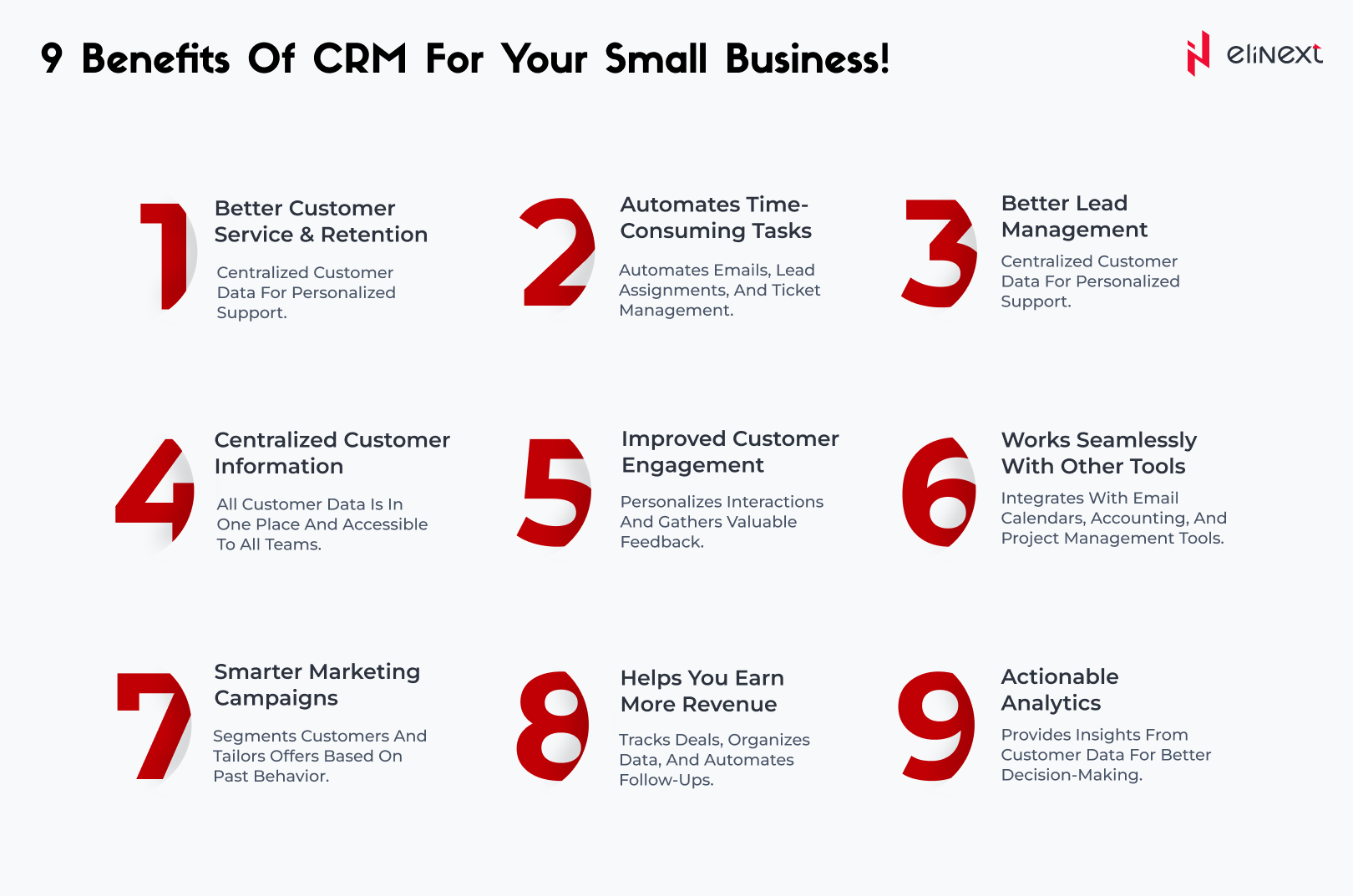
Better Customer Service & Retention
Customer relationship management for small business improves support by tracking every interaction and preference. Timely follow-up and personalized responses improve customer satisfaction, leading to a 27% increase in customer retention.
-
Automates Time-Consuming Tasks
CRM software for small businesses automates repetitive tasks such as sending emails, scheduling, and data entry. Automation frees staff to focus on sales and customer support, increasing productivity and reducing manual errors.
-
Better Lead Management
A customizable CRM system tracks leads at every stage of the sales funnel, sending reminders and nurturing potential customers. Companies receive more qualified leads, respond to them faster, and close deals effectively, turning potential customers into loyal customers.
-
Centralized Customer Information
A customer relationship management system for small business stores all customer data in one place. Sales and support teams have instant access to a complete relationship history, ensuring seamless service and personalized offers, increasing efficiency and customer satisfaction.
-
Improved Customer Engagement
A CRM system for a small business provides targeted communications based on customer behavior and preferences. Sending personalized offers at the right time leads to higher engagement, repeat business, and stronger relationships.
-
Works Seamlessly with Other Tools
Customizable CRM systems integrate with email, accounting systems, and e-commerce platforms. Placing an order online updates the CRM system and triggers automated follow-up emails, streamlining operations and improving the customer journey from start to finish.
-
Smarter Marketing Campaigns
CRM-based segmentation and analytics help companies launch more effective marketing campaigns. Personalized emails based on purchase history increase open rates and conversions, maximizing the return on every marketing effort.
-
Helps You Earn More Revenue
CRM software for small businesses increase revenue by identifying upselling and cross-selling opportunities. Analyzing past purchases allows for targeted product offers, leading to higher average order value and increased profits.
-
Actionable Analytics
CRM software for small businesses provides actionable analytics—tracking sales, customer behavior trends, and campaign results. Real-time dashboards help owners make data-driven decisions, optimize strategies, and identify new growth opportunities.
“A custom CRM marketing software allows small businesses to build long-term customer relationships, optimize sales, and personalize marketing. By centralizing data and automating tasks, SMBs gain a competitive advantage and develop smarter, more effective growth strategies.”
Elinext software development expert
CRM as a Marketing Software for Small Businesses: Future Outlook
By 2025, CRM software for small businesses will become indispensable, as 80% of companies use some version of CRM. Custom software development services are currently focused on AI-based analytics, omnichannel marketing, and mobile features. Predictive analytics in CRM predicts customer behavior, while seamless integration with social media and e-commerce platforms increases campaign ROI. The CRM of the future will offer even deeper personalization and automation, enabling small and medium-sized businesses to compete with larger competitors.
- Hyper-Personalization
- AI-Powered Marketing Automation
- Conversational CRM
- Omnichannel Marketing Integration
- No-Code & Low-Code Customization
- IoT-Enhanced Marketing
- Social CRM & Voice Search Readiness
- Data Privacy & Ethical CRM
- CRM as a Content Engine
- Sustainable & Purpose-Driven CRM
Conclusion
CRM marketing software, ERP software development services, and customer relationship management for small business are critical for small and medium-sized businesses today. Customized systems centralize data, automate workflows, and personalize marketing, increasing efficiency and sales. Integrating CRM with ERP optimizes inventory and order management. In an increasingly competitive environment, small businesses benefit from specialized CRM solutions, more intelligent analytics, and seamless integration across platforms, all of which contribute to sustainable growth.
FAQ
What are the main advantages of a custom CRM system for small businesses?
Customer relationship management for small business centralize data, automate workflows, and tailor features to business needs. Small and medium-sized businesses use CRM systems to improve productivity, enhance customer engagement, and increase sales.
How does a custom CRM improve customer relationships?
CRM systems track every customer interaction, personalize communications, and automate follow-up actions. A retailer sends relevant birthday offers, quickly resolving issues and building stronger, more loyal customer relationships.
Can a custom CRM reduce business costs?
A CRM for a small business reduces costs by automating manual tasks and increasing efficiency. Automated email scheduling and tracking saves employees time, reduces errors, and reduces the need for redundant software.
How does CRM support sales growth?
CRM systems track leads, automate follow-up, and identify cross-selling opportunities. Sales teams close more deals and increase revenue by using reminders, analytics, and targeted CRM offers to effectively engage with prospects.
Is a custom CRM scalable for growing businesses?
Yes, CRM systems scale with your business. As your sales, number of clients, or teams grow, features and integrations can expand. Add modules for marketing automation or inventory management as your small business grows.
What does it mean to use CRM as marketing software?
A CRM software for small businesses functions as marketing software by segmenting customers, automating campaigns, and tracking results. Sending personalized emails to specific segments can increase engagement and sales.
How does CRM help with marketing campaigns?
CRM boosts targeting, timing, and ROI by unifying contacts, segments, and behaviors. Automate emails, ads, and journeys with A/B tests and attribution. Customer relationship management for small business triggers win-back emails for lapsed buyers, lifting conversion 18%.
Can CRM replace other marketing tools?
CRM can replace some marketing tools by combining contact management, email automation, and analytics. Instead of separate tools, a CRM handles campaigns, tracks responses, and manages leads in one platform—making CRM for a small business a cost-effective, all-in-one solution.
How does CRM support small business marketing specifically?
CRM helps small businesses target the right customers, personalize messages, and track results. A local shop uses CRM to send deals to loyal buyers, analyze campaign effectiveness, and grow repeat business.
What’s the future of CRM as marketing software for small businesses?
The future is AI-powered CRM with smarter automation, real-time analytics, and seamless integration. Predictive tools will recommend campaigns, automate responses, and help small businesses compete with enterprise rivals.
