



In 2025, credit card payment app for Android are transforming the way businesses process transactions and invoices and how mobile pos works. Thanks to payment processing software development services, companies can now offer mobile POS systems that support time and materials tracking, ideal for service industries. For example, a repair company uses an Android app to track time and materials and instantly process card payments, reducing invoicing time.
Elinext: Leading Experts in Payment Software Development
Elinext specializes in Android card payment app solutions, providing secure and scalable payment software to clients worldwide. They developed a custom Android app for a logistics company, enabling drivers to accept card payments directly on-site. Their experience in payment software development ensures regulatory compliance, seamless integration, and a user-friendly interface, helping businesses modernize their payment processes and improve customer satisfaction.
What is Mobile PoS?
Mobile POS systems, powered by payment app development services, transform smartphones or tablets into portable payment terminals. These systems process card payments, manage sales, and generate receipts on the go. A food truck uses a mobile POS system to accept credit cards, track inventory, and print receipts and all from an Android device. Mobile POS solutions are popular in retail, hospitality, and off-premise catering, offering flexibility, real-time reporting, and lower initial costs compared to traditional POS terminals.
Expand your business by investing in a credit card payment app for Android to simplify invoicing and accept payments anywhere, anytime.
What is Time & Materials Billing?
Android card payment app and mobile app development services now support time & materials billing, where clients are charged based on actual hours worked and materials used. A freelance IT consultant logs hours and expenses in the app, then processes a card payment at the end of the job. This billing model is ideal for projects with variable scope, offering transparency and flexibility for both service providers and clients, and is increasingly popular in construction, repair, and consulting sectors.
Card Payment Process
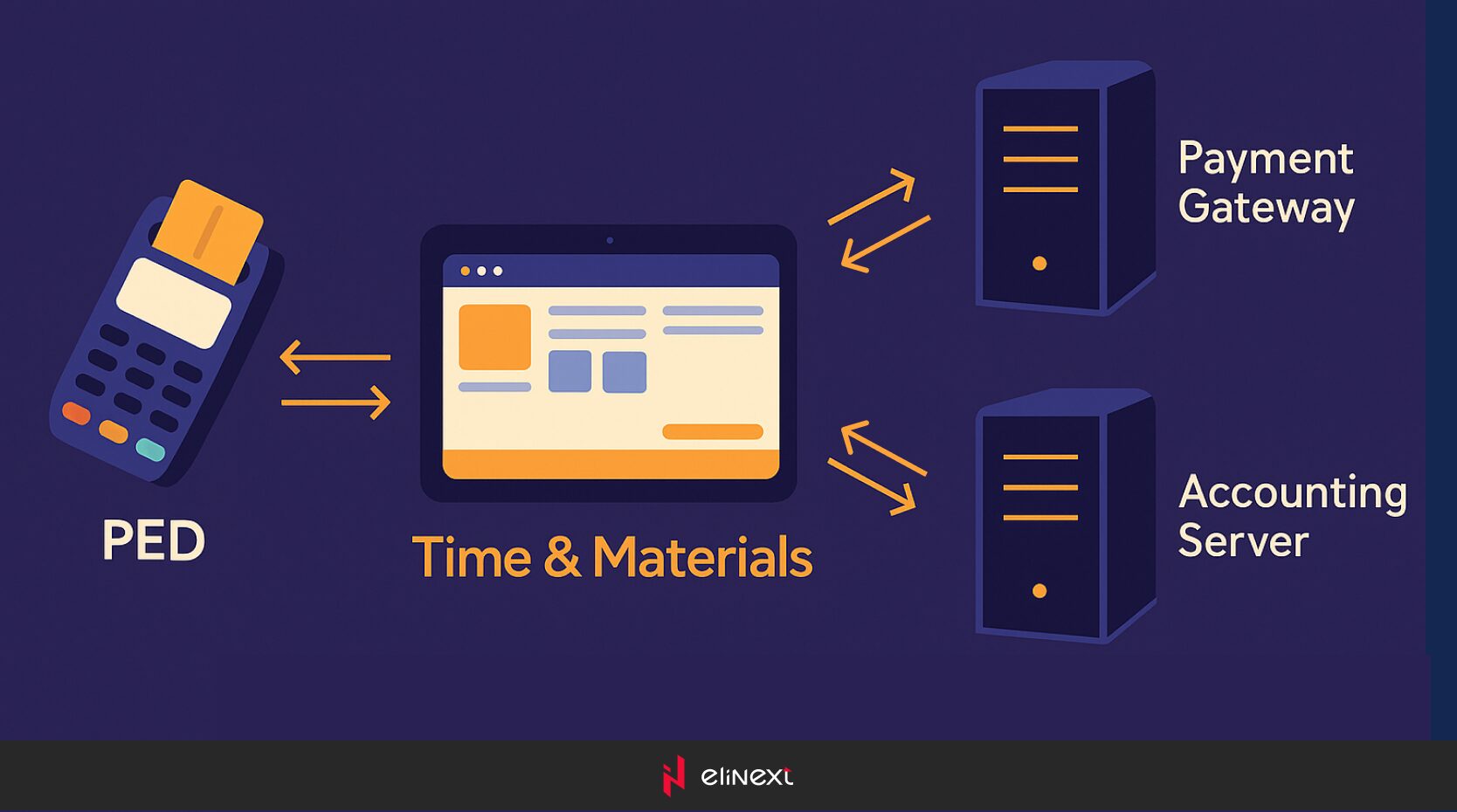
In this article, we will describe the implementation of the card payment process in the Time and Materials application. PED, ATM, and Payment Gateway take part in this card payment. A credit card payment app for Android allows users to enter an amount, swipe or tap their card, and securely process payments in seconds. For example, a plumber accepts payments on-site.
The payment process consists of the following steps:
- Time and Materials application sends the initial payment request to PED.
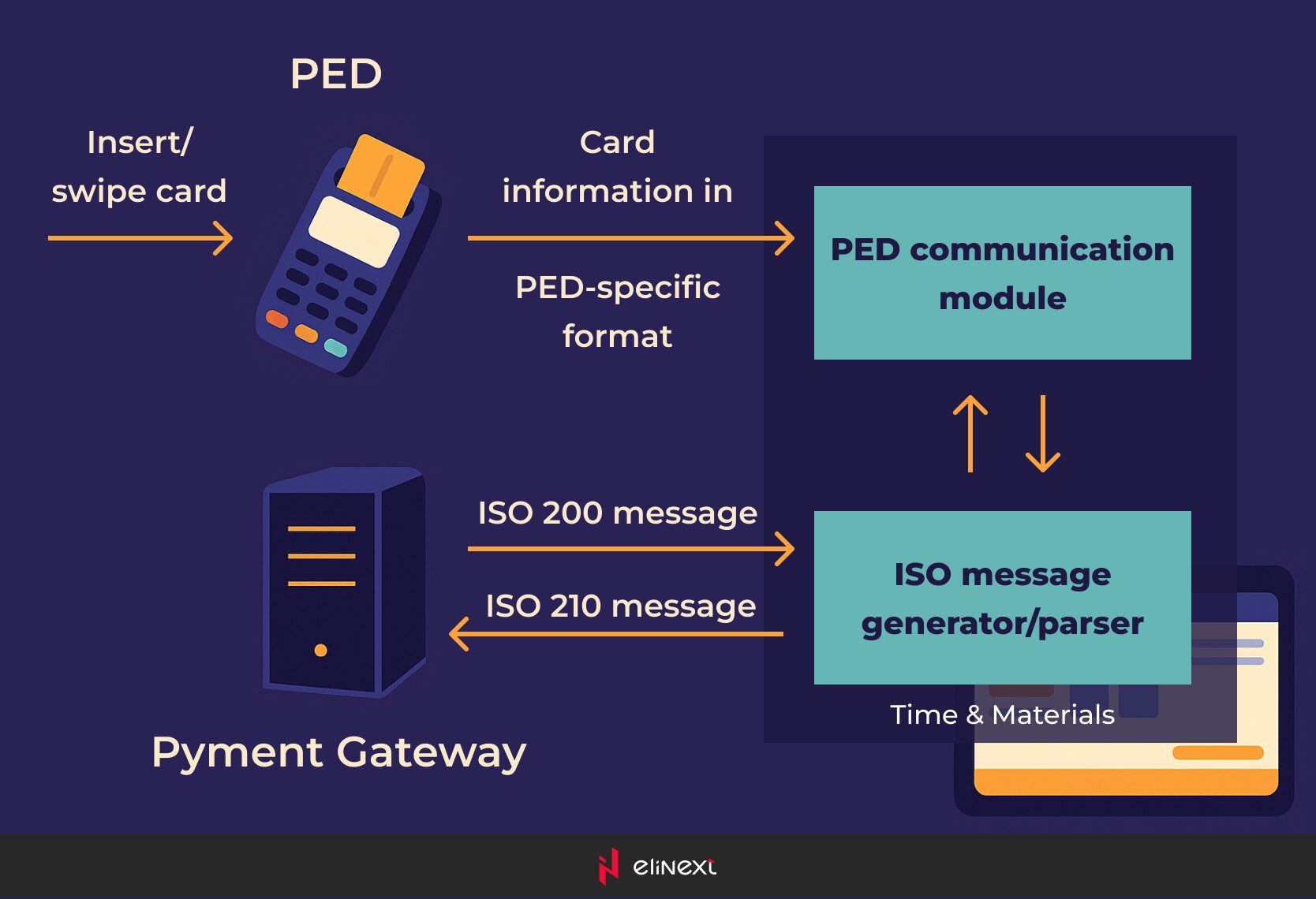
- PED reads the card and the user’s PIN input and sends this information to the ATM.
- The PED communication module extracts the required information pieces (EMV or magnetic card, card number, PIN block, EMV tags, etc.) from the PED-specific message and uses them to construct a payment request message in ISO 8583 format. j8583 library is used for ISO8583 message generation/parsing. The payment request message is then sent to the payment gateway.
- The payment gateway processes the message, communicates with the bank network, and sends a response message to the ATM containing the information on whether the transaction was approved and optional EMV tags.
- ATM parses the gateway response message and sends the approval status and optional EMV tags back to the PED.
The requirement was to have the ability to support different PEDs, so a generic PED interface was developed and used in the application’s PED communication logic. This approach makes specific PED support implementation easier, allows different PED connection options (currently Bluetooth and USB), and also makes PED change transparent to the application.
Currently Supported PEDs are:
Mobile POS systems support payment terminals such as Square, Clover, and Ingenico. A retailer uses a Square reader with their Android device to accept chip and contactless payments.
- PED Simulator “in early stages” of development we had no PED, so a PED Simulator application was developed to simulate basic operations with magnetic cards, such as swipe card, approve the amount and enter a PIN number. It runs on Android smartphones and uses Bluetooth for communication with T&M.
- SP30 supports magnetic stripe and EMV cards, uses an RS232 port for communication. A USB-to-serial adapter is used to connect this device to the Android tablet.
- MPED400: a more up to date device with magnetic stripe and EMV card support. It can connect via Bluetooth or serial port.
Upgrade to an android card payment app.
Accept payments, track work hours, and invoice clients and all from your mobile device!
Types of Mobile PoS Systems
Credit card payment app for Android include tablet-based, phone-based, and terminal-based systems. A cafe uses a tablet POS terminal to take orders, while a delivery person uses a mobile app to accept payments at the customer’s door. Terminal-based systems are popular in retail stores due to their durability and advanced features. Each type offers unique advantages, allowing businesses to choose the most suitable option for their workflow and customer needs.
-
Tablet-based Systems
Android app development services enable the creation of tablet-based POS systems that offer large touchscreens for easy order entry and customer interaction. A restaurant uses tablets at every table so guests can browse the menu, place orders, and pay by card. These systems integrate with accounting and analytics tools, providing real-time information and streamlining operations for businesses with high transaction volumes.
-
Phone-based Systems
Credit card payment app for Android transform smartphones into mobile POS devices. A home repair technician uses his Android phone and a Bluetooth card reader to accept payments on-site. These systems are portable, cost-effective, and ideal for businesses operating on-site or at events, offering flexibility and instant payment processing without the need for bulky hardware.
-
Terminal-based Systems
Android card payment app also enables terminal-based POS systems, which combine the reliability of traditional terminals with the flexibility of Android. A boutique uses an Android-based terminal for in-store payment acceptance, inventory management, and customer loyalty programs. These systems are reliable, secure, and suitable for high-traffic retail.
-
PoS Kiosks
How mobile POS works: POS kiosks are Android-based self-service stations that allow customers to browse products, place orders, and pay for them themselves. A fast-food chain installs Android kiosks for quick ordering and card payments, reducing wait times and freeing up staff. These kiosks integrate with inventory and analytics systems, streamlining operations and improving the customer experience.
Mobile app development services and Android card payment app are revolutionizing the payments industry. By integrating time and materials invoicing, we help businesses track work, bill accurately, and accept secure payments on the go. This approach improves efficiency, transparency, and customer trust in today’s rapidly evolving service industries.Elinext Expert
Conclusion
Payment gateway development services are driving the adoption of Android apps that enable credit card payments using time and materials tracking systems. A cleaning company uses an Android app to track time, consumables, and instantly process payments. This approach simplifies invoicing, reduces errors, and improves cash flow. As mobile POS technologies evolve, businesses gain flexibility, real-time analytics, and a competitive advantage by providing a convenient and seamless payment process for customers.
Application architecture
FAQ
What is a credit card payment app for Android with time & materials billing?
This app allows companies to track labor time, materials, and accept card payments on Android. A contractor invoices clients on-site after each job.
Who should use a time & materials credit card payment app?
Service providers, such as contractors, consultants, and repair technicians, benefit the most. An IT consultant logs work time and instantly invoices clients through the app.
Does the Android credit card payment app support multiple payment methods?
Yes, most apps accept credit/debit cards, contactless payments, and mobile wallets. A supplier accepts Visa, Mastercard, and Google Pay through their Android app.
Is the credit card payment app for Android secure?
Yes, leading apps use encryption and are PCI DSS compliant. Payment data is encrypted, and transactions are processed securely to prevent fraud.
Can the app generate invoices and receipts?
Yes, most apps instantly generate digital invoices and receipts. After payment, the customer receives an email receipt from the Android app.
Can the credit card payment app integrate with accounting software?
Yes, many apps sync with QuickBooks or Xero. Payments processed in the app are automatically recorded in the business’s accounting system.
