



Application lifecycle management solutions coordinate every stage of software development from planning to decommissioning ensuring quality and compliance. The ALM market will reach $5.64 billion in 2025, with 90% of organizations implementing DevOps, along with QA and software testing services, for faster, error-free releases. A global bank using ALM recorded a 47% reduction in critical defects, proving the value of integrated lifecycle and testing management.
Definition of Application Lifecycle Management
According to the Online Cambridge Dictionary, a lifecycle means the series of changes that a living thing goes through from the beginning of its life until death, while management implies the control and organization of something. Projecting these definitions on the information technologies sphere application lifecycle management services can also be generally explained by summing up the two terms, though with light changes due to a specific character of the subject (software applications).
Application lifecycle management services integrate planning, development, testing, deployment, and maintenance. A fintech company using ALM services accelerated releases and improved regulatory compliance by integrating requirements, code, and quality assurance into a single workflow, ensuring traceability and quality at every stage.
One can defy application lifecycle management, or to put it in short, ALM, as a process of governing and controlling a software application’s existence from its first appearance until it reaches its final point, in other words, until it is removed from the market.
Broader Perspective on Application Lifecycle Management
Taking into account the modern market challenges and requirements to any product, including a software application, we cannot limit ourselves with such a narrow view concerning ALM solutions. Let’s get deeper into the topic. From a more scientific perspective application lifecycle management solutions is the entire period of managing the life of an application from a concept to its removal. This period encompasses the whole development process which is not so far away from us as it seems to be at first sight.
Applications are used for private and business purposes. Surely, there is no doubt ALM solutions are first of all made for business customers. However, as far as any application lifecycle encompasses certain stages, it will be better to examine them referring to a beloved Skype application and make the ALM definition clear for everyone. It is always right to go from an easier to a more complex thing.
Choose a mobile app development company that prioritizes application lifecycle management, ensuring the quality, security, and long-term success of your app from day one!
Let’s see which components ALM consist of. Here one can reason on an everyday level.
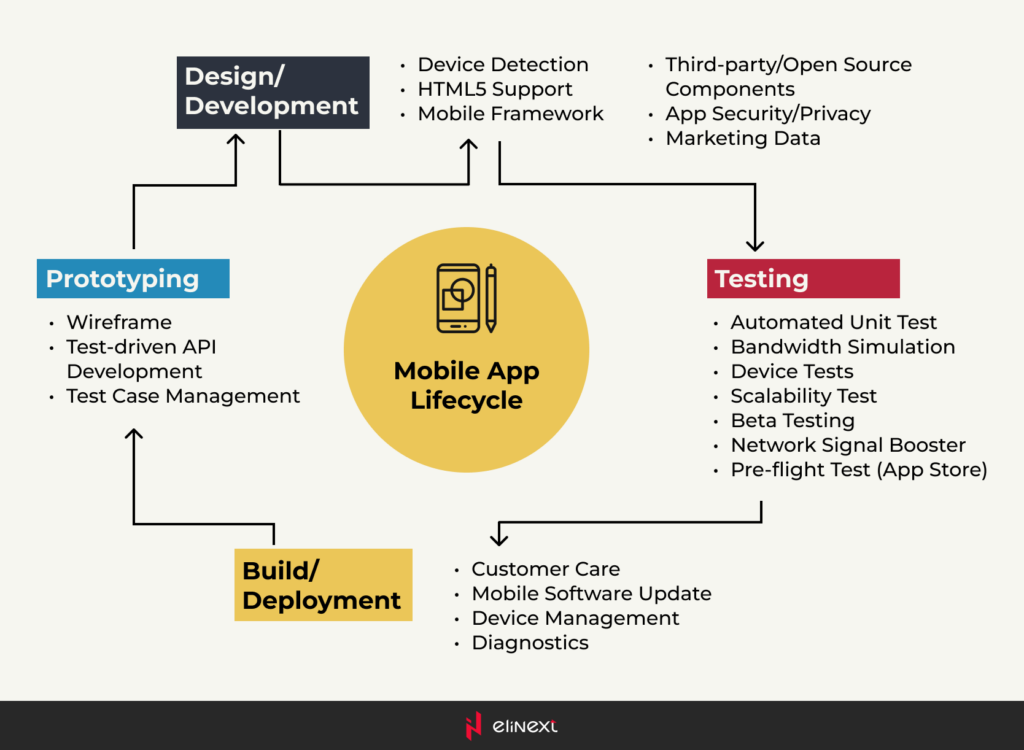
Application Lifecycle Management in Everyday Use
Each of us faces application lifecycle management examples every day. Suppose the top 10 examples of applications include Microsoft Word, Google Chrome, Windows Media Player, World of Warcraft, Adobe Photoshop, iTunes, Skype, Steam, Adobe Dreamweaver, and Corel WordPerfect. On a philistine level we are offered to “refresh” this or that application on our PC. This is a part of ALM solutions in a broad sense which satisfies a necessity to make an application more adaptive to the needs of users and, in such a way, more profitable at the market. (Generally one can defy the goal of the ALM in such a way in general).
In other words, an update of an application is one of the application lifecycle stages. However, the application lifecycle management solutions begin much earlier.
Skype as an Example of ALM
Let’s take Skype as a philistine and understandable case among other application lifecycle management examples.
Skype was founded in 2003. At first, the application had a simple interface, voice adapted unlike ICQ and MSN Messenger.
During installation Skype chose the language localization of Windows and had a quick and easy registration login in comparison with competing programs. This is how one of the application lifecycle management examples began, with an idea that users demand a highly innovative product, easier to be treated, in this particular case in comparison to the existing communication programs, and this can also be called requirement management.
The Skype 1.2 Version included Voicemail for the first time, as well as introduced a Skypeln function that allows linking a Skype account with a phone number. In other words, requirement management as a part of the ALM extends over the entire application lifecycle management and is its crucial point, is a method and a means to provide what business needs.
Then, one should mention a more narrow and specific component of the application lifecycle management services – software architecture. It includes software components and relations between them as well as features of both the components and relations. Software architecture encompasses instruments to design an application.
Application architecture is closely interconnected with computer programming which makes an executable program out of a problem. It creates an algorithm in confirmation with which an application works.
The Skype architecture consists of a central registration server to which all clients register, its main operation principle is a peer model.
As software development experts, we view application lifecycle management services as the foundation of successful projects. By integrating manual software testing services, we ensure every requirement is verified, risks are minimized, and clients receive reliable and robust solutions that evolve with their business needs.
Software Development Expert Elinext
App Testing and Enhancement in ALM Circle
Application testing is a vital stage of the application lifecycle management services. It validates an application and answers the question whether requirements for its development are met. From the technical point of view, application testing presupposes that no mistakes should occur after its release.
ALM solutions are demarcated with an application testing as far as the matter of quality predetermines the success or failure of the deal. Applications should be maintained, which means modifications with a view to correct faults and improve the operation and the optimization on the whole. A few days ago the Microsoft Corporation stunned the world by announcing that it is developing a program which will make a near real time speech-to-speech translation in Skype. In this particular case application maintenance means enhancement of the application’s capabilities.
However, sometimes maintenance is perceived as correction or defect tracking which is also an aspect of application maintenance. According to Meir Lehmann’s law of the continuing change systems must change so as not to become less useful. For most applications changes reappear again and again several more times during the life cycle, changes introduce new versions and upgrades of an application which we face every day.
ALM as an Industry Solution
ALM is a huge complex activity of the IT companies to supply a highly innovative product to the market.
But that’s, however, a broad perspective regarding the phenomenon of ALM. As it have been already mentioned, there is a need to introduce narrower, more specific customized products that is why application lifecycle management is aimed at solving problems of individuals.
Referring to the VTB24 Bank example, the ALM was introduced to optimize the work of the applications whose number increased rapidly as the bank’s activity expanded. In such a way ALM turns into an industry of the IT-market. Microsoft, IBM, Oracle, Boland and other big players introduce a set of means to support an application lifecycle (e.g. Visual Studio, IBM Rational Solution, FusionForce etc.).
Nowadays ALM solutions are made for discrete manufacturers and include all the above mentioned components: requirement management, test and maintenance management, change management that are presented as a single integrated solution that supports variant complexity of an application.
Partner with web development services that specializes in application lifecycle management to ensure smooth delivery, ongoing support, and superior web app performance!
Business Value and Future of ALM
Since ALM is concentrated on transfer of the newest information throughout the whole application life and its maintenance, that’s a way to make business effective as well as to make it grow. Automatization, collaboration, synchronization, integration, innovation are ALM’s best features that will surely make it grow and spread.
Conclusion
Automated software testing services and mobile app testing services play a vital role in ALM, ensuring fast and reliable releases. Integrating automated tests into ALM reduced the release cycle at a fintech company from weeks to days. ALM ensures the management, testing, and improvement of every stage of app development, delivering business value and user satisfaction in today’s digital world.
FAQ
What is application lifecycle management (ALM)?
ALM is the end-to-end management of software from concept to retirement. ALM tools help banks track requirements, code, and tests for secure and compliant applications.
What are the main stages of ALM?
The main phases of ALM are requirements, design, development, testing, deployment, and maintenance. A healthcare application uses ALM to manage updates, testing, and compliance.
How is ALM different from software development life cycle (SDLC)?
ALM covers the entire application lifecycle: planning, development, and maintenance, while SDLC focuses on the development phases. ALM manages multiple SDLCs, much like a CRM that evolves over many years.
What role does testing play in ALM solutions?
Testing in ALM solutions ensures quality at every stage. Automated tests in ALM identify defects early, reducing rework and increasing the speed of banking application releases.
What is application maintenance in ALM solutions?
Application maintenance in ALM solutions means ongoing updates, bug fixes, and support. A retail application uses ALM to manage patches and new features after launch.
How do ALM solutions support business goals?
ALM solutions align IT with business goals, improving quality, speed, and compliance. ALM helped a fintech company reduce delivery time by 30% and improve customer satisfaction.
