





In 2025, AWS leads the cloud computing market, accounting for more than a third of the global market, offering unrivaled scalability, security, and a broad portfolio of services. The benefits of AWS cloud computing include flexible pricing, global infrastructure, and advanced AI integration. However, AWS advantages and disadvantages include complex cost management and periodic service outages, making it critical for users to balance innovation with careful planning.
Benefits of AWS cloud computing: what exactly does cloud mean?
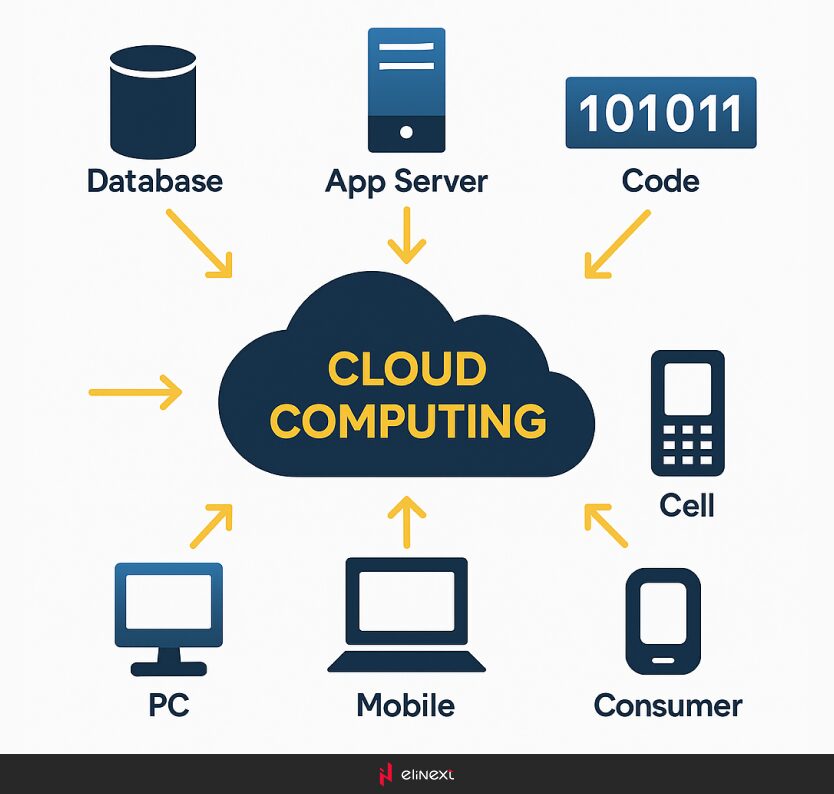
Cloud computing is the delivery of computing as a service rather than as a product, so that shared resources, software, and information are provided to computers and other devices as a metered service over a network, rather than coming from local, limited, isolated hardware resources.
When considering the advantages and disadvantages of AWS, its scalability, security, and vast global infrastructure provide significant benefits for companies adopting cloud computing. However, there are also challenges such as complex pricing models and regional service restrictions. Balancing these AWS advantages and disadvantages is critical to effective cloud adoption. That’s why we decided to choose Amazon Elastic Cloud for its extensive capabilities and flexibility.
Why Amazon EC2?
1. True virtual computing environment
Amazon EC2 allows you to use web service interfaces to launch virtual machine instances with a variety of operating systems, load them with your custom application environment, manage your networks access permissions, and run your image using as many or as few resources as you decide.
2. Flexible rates
You are in control. You pay only for the time of every working instance. You can shut down all instances that you aren’t using, or you can add new instances if you have an extreme load, and it can all be done automatically. This can help save you money – you don’t need to build your own data center or rent a fixed number of expensive servers for your startup.
3. Elastic
Amazon EC2 enables you to increase or decrease capacity within minutes. You can commission one, hundreds, or even thousands of server instances simultaneously. This is all controlled with web service APIs, your application can automatically scale itself up and down depending on its needs.
4. Completely Controlled
You have root access to each one, and you can interact with them as you would any other machine. You can stop your instance while retaining the data on your boot partition and then subsequently restart the same instance using web service APIs. Instances can be rebooted remotely using web service APIs.
5. Reliable
Amazon EC2 offers a highly reliable environment where replacement instances can be rapidly and predictably commissioned. The service runs within Amazon’s proven network infrastructure and datacenters. The Amazon EC2 Service Level Agreement commitment is 99.95% availability for each Amazon EC2 Region.
6. Secure
Amazon EC2 provides numerous mechanisms for securing your computer resources. Amazon EC2 includes web service interfaces to configure firewall settings that control network access to and between groups of instances.
Load balance
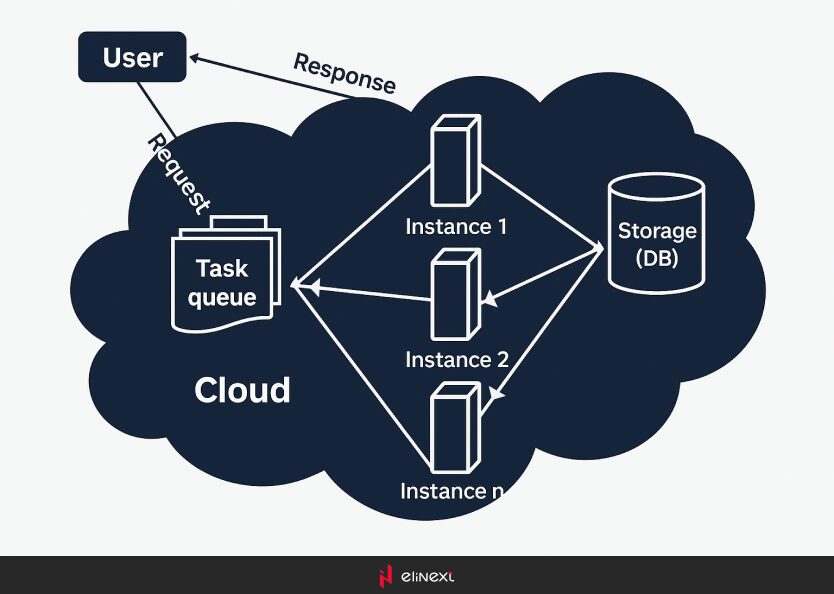
To ensure load balance & scalability, the cloud works with a task queue; in classic network architecture a user sends a request to a server, that server then calculates the data and sends back a response.
In order to provide load balancing and scalability, the cloud uses a feature called the “Task queue” (or message queue.) The user sends a request, such as a download an archive, unpack it, parse it and return the data to the user, and that request is put into a queue. The queue is continuously monitored, and when there is some free time it will process the tasks and build a response. However, if all instances are busy, the user’s task will wait until an instance is freed up. In any case, while the task will not be forgotten it may have to wait until all instances of high-loaded – tasks have been processed, and perhaps after some considerable delay. See scheme.
How to ensure automatic scalability?
Your developers don’t need to write thousands of rows of code. For example, a procedure written in Python, look like this:
import boto
ec2 = boto.connect_ec2()
key_pair = ec2.create_key_pair(‘ec2-sample-key’)
key_pair.save(‘/Users/patrick/.ssh’)
reservation = ec2.run_instances(image_id=’ami-bb709dd2′, key_name=’ec2-sample-key’)
And that’s all!
Your developers can use simple coding, when your project needs more resources, to process data, and run new instances to increase performance.
Result
Amazon EC2 helped us to implement a powerful and flexible system – it can increase and decrease its computing capacity according to the current project load (elastic scalability). As we paid only for the time of our working instances, we saved a lot of money on servers that were turned off when we did not need them, on turned on only when we did need them.
When our project grew up, we didn’t do any architectural changes or optimization – we just ran new instances, as needed, to ensure computing capacity.
(For developers) Sample application: architecture & processes
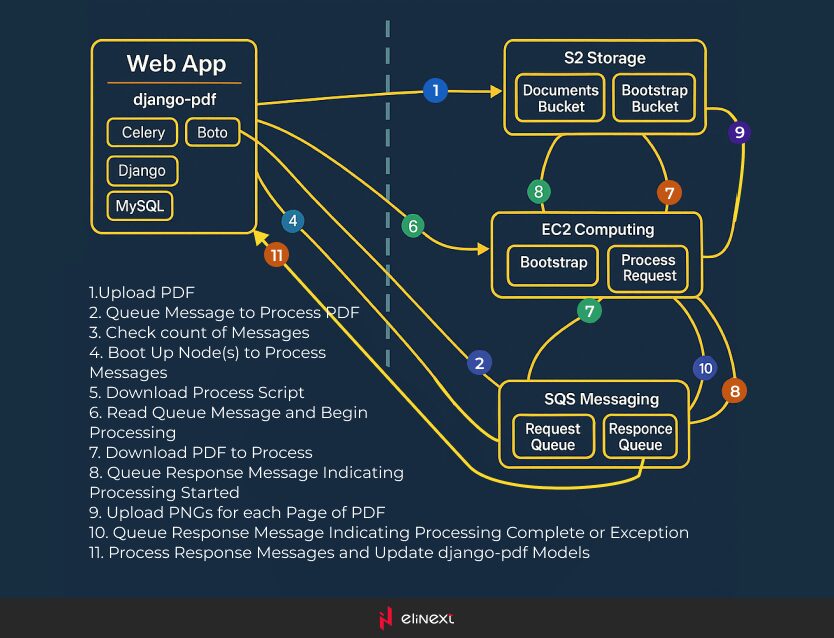
The application process for creating preview images of PDF documents for display on a Web site.
The PDF is moved to Amazon S3 from the local Web server. Messages are queued up to process the uploaded PDFs; nodes are booted up in response to the queue count, and the nodes bootstrap themselves with the software necessary to process the PDFs. The nodes then write a result message to a queue that is checked by a background task on the Web server that updates the database with the appropriate record.
Disadvantages of (AWS) Amazon Cloud Platform
AWS offers unmatched scalability and a broad portfolio of services, but disadvantages of AWS include a complex pricing structure that can lead to unexpected expenses. For example, it can be difficult for a startup to accurately forecast monthly expenses. Understanding the advantages and disadvantages of AWS helps companies weigh benefits like reliability against challenges like cost management and regional service restrictions.
Billing Can be Confusing
One of the key factors that influences AWS advantages and disadvantages is the complexity of billing. Complex pricing models and the abundance of services make it difficult to predict costs, requiring careful monitoring to prevent unexpected expenses and optimize cloud spending.
Amazon’s EC2 Limits
Among the advantages and disadvantages of AWS, it is worth noting that Amazon EC2 limits can limit resource usage, which affects scalability during periods of high load. While AWS provides flexibility, these limits require careful planning to ensure smooth operation and prevent service interruptions.
Common Cloud Computing Problems
AWS cloud software development faces common challenges such as managing complex configurations, controlling costs, and ensuring security. Developers need to address these challenges to build efficient and secure applications while optimizing AWS resources and avoiding unexpected costs.
Conclusion
In 2025, the benefits of AWS will continue to exist, including scalability, a wide range of services, and global reach. However, companies should also consider the drawbacks, such as complex pricing and service limitations. AWS advantages and disadvantages show powerful features but complex pricing; plan well for success. Many companies compare AWS with alternatives, such as partnering with an Azure development company or a Google cloud development company, to find the best fit. Ultimately, understanding the strengths and weaknesses of AWS helps organizations choose the right cloud strategy for their needs.
FAQ
Is AWS suitable for small businesses?
AWS offers excellent scalability and functionality, but the advantages and disadvantages of AWS mean that small businesses will have to consider complex pricing and management issues before choosing it as their cloud solution.
How does AWS compare to other cloud platforms like Azure or GCP?
AWS advantages and disadvantages show its superiority in the variety of services and global reach, while Azure integrates well with Microsoft tools and GCP leads in AI and pricing. The benefits of AWS cloud computing include flexibility, but cost and complexity can be disadvantages compared to Azure or GCP.
Can I migrate to AWS from another cloud provider or on-premises?
Yes, migrating to AWS from another cloud or on-premises is possible and common. The advantages and disadvantages of AWS include powerful migration tools, such as AWS Application Migration Service, which makes it easy to migrate servers with minimal downtime. For example, a company can quickly migrate on-premises virtual machines to Amazon EC2, taking advantage of the scalability and flexibility of AWS, but it must consider the cost and complexity of the migration process.
